
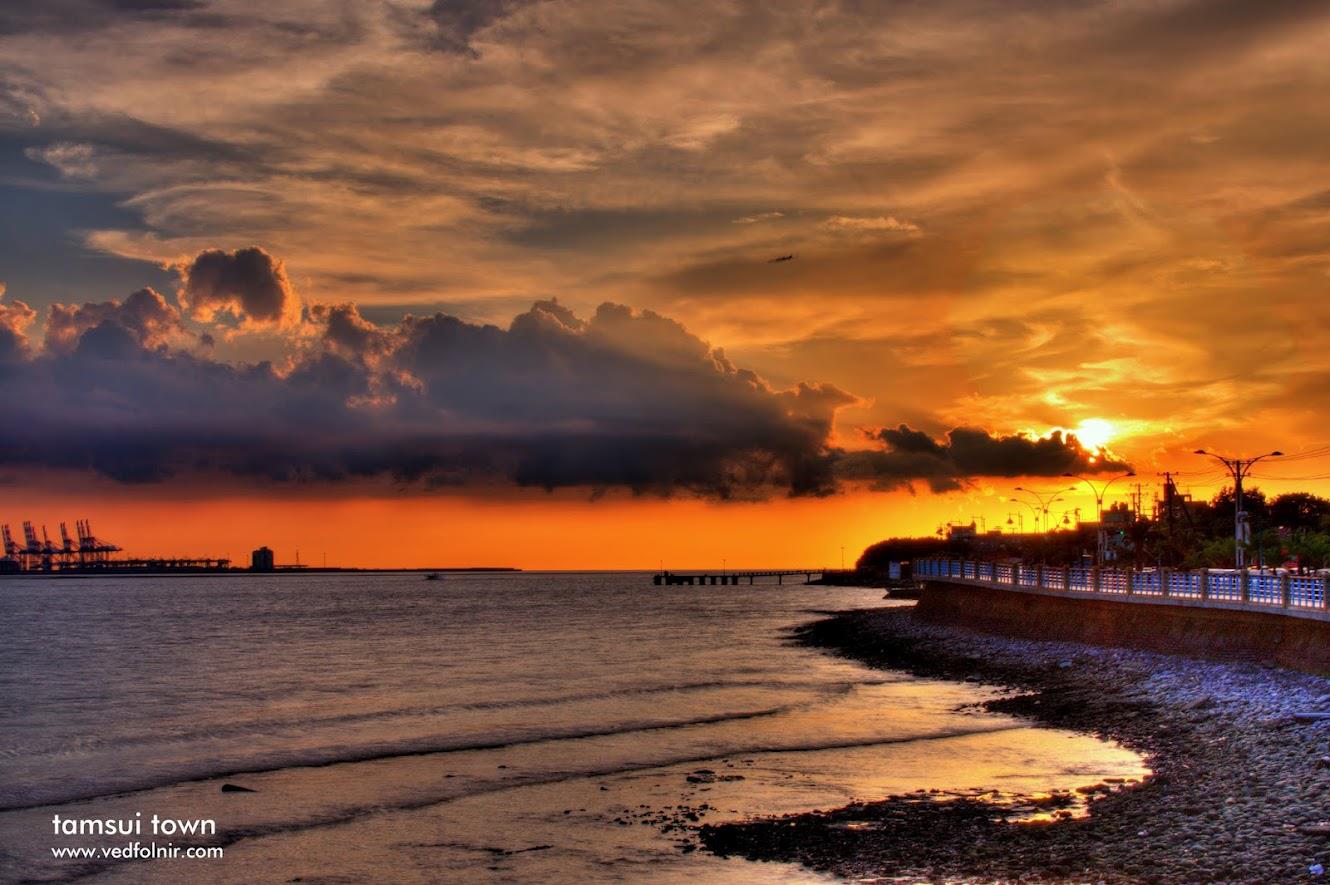
One late afternoon, I enthusiastically headed down to the sandy shores near Shalun Beach in Tamsui, eager to track down the Taiwan landing station for the second direct submarine cable linking Taiwan to the Chinese mainland—the “Taiwan Strait Express-1” (TSE-1, commonly referred to as the Dan-Fu Submarine Cable).
Unfortunately, night fell rapidly along the coast. In the whistling sea breeze and pitch-black twilight, all that remained in sight was a lone construction excavator and a few parked inflatable zodiacs. Although I couldn’t view the actual fiber optic cable buried deep beneath the sand, I did snap photos of the official construction permits issued by the Ministry of Economic Affairs and the Coast Guard Administration, making the trip well worth the effort.
This engineering project brought to mind a maxim frequently shared by Chunghwa Telecom technicians: “The closer you are to the central office and server nodes, the lower your network latency and the closer your speed reaches its theoretical limit.”
I couldn’t help thinking: once this direct fiber-optic link goes live, won’t residents of Tamsui enjoy the lowest-latency, fastest direct ping to mainland servers in all of Taiwan?
A Modern Strategic Artery: Overview of Taiwan Strait Express-1 (TSE-1)
The Dan-Fu Submarine Cable (TSE-1) represents the very first direct, unrepeatered high-capacity submarine optical fiber link connecting the island of Taiwan to the mainland:
- Joint Investment by Cross-Strait Telecom Giants: Funded collaboratively with approximately NT$1 billion by seven major telecom carriers: Taiwan’s Chunghwa Telecom, Taiwan Fixed Network (Taiwan Mobile), Far EasTone, and NCIC, alongside mainland China’s China Telecom, China Mobile, and China Unicom.
- Unrepeatered Direct Route: Departing from the Shalun Landing Station in Tamsui, New Taipei City, it traverses the shallow northern waters of the Taiwan Strait straight to the Changle Landing Station in Fuzhou, Fujian Province. The total route covers roughly 270 kilometers, with an undersea cable segment spanning 205 kilometers.
- Ending Decades of Third-Party Detours: Prior to TSE-1, the vast majority of cross-strait internet packets and voice calls had to detour through international submarine trunk lines passing via Hong Kong, Japan, or North America, resulting in circuitous routing and frequent congestion. The completion of TSE-1 expanded cross-strait bandwidth capacity more than a hundredfold, slashing latency to single-digit milliseconds while significantly lowering voice and data transit costs.
- National Telecommunications Strategy and Seismic Redundancy: The Bashi Channel off Hengchun in southern Taiwan serves as a global submarine cable crossroads, but it is also an epicenter for tectonic earthquakes and devastating typhoons. In the past, the massive Hengchun earthquake triggered submarine mudslides that snapped multiple international subsea cables simultaneously, plunging Taiwan’s external communications into near-total paralysis. The Dan-Fu cable established a vital westward backup route in northern Taiwan, effectively dispersing the vulnerability of single-point network failure during natural disasters.
Although Chunghwa Telecom activated the Kinmen-Xiamen submarine cable in August of that same year, that system served as a localized regional transit link under the Mini Three Links framework (connecting Kinmen to Xiamen, then routing back to Taiwan proper via domestic undersea cables). TSE-1 at Shalun, Tamsui, is the very first direct backbone submarine cable connected straight to the island of Taiwan.
A Remarkable Historical Coincidence: Which Was the Real “First”?
Why do I refer to this cable as the “second” direct line between Tamsui and Fuzhou?
Because more than a century ago during the Guangxu reign of the Qing dynasty, the exact same maritime corridor carried the founding pioneer of cross-strait telecommunications:
In 1887 (the 13th year of the Guangxu reign), Liu Mingchuan, the first Governor of Taiwan, spearheaded the construction of a 117-nautical-mile submarine telegraph cable stretching from Chuanshi Island in Fuzhou to Hobe (modern-day Tamsui). It became the very first government-operated submarine telegraph cable connecting both sides of the strait in modern Chinese communications history!
Separated by a full 126 years, modern optical engineers once again selected Tamsui and Fuzhou as the twin bridgeheads across the strait. History had come full circle across the very same harbor, echoing across time and technology.
Tracing the Origin: From the Mudan Incident to Taiwan’s First Telegraph Line
The introduction of modern telecommunications technology to Taiwan did not stem from commercial boom, but rather from a profound national defense and military crisis:
1. The Geopolitical Shock of the Mudan Incident (1874)
In 1871 (the 10th year of the Tongzhi reign), 66 Ryukyuan sailors drifted ashore at Bayao Bay in Hengchun, southern Taiwan, after a violent storm; 54 were killed by local Mudan indigenous villagers. The Meiji government of Japan seized on this pretext in 1874 (the 13th year of Tongzhi), launching a military expedition that landed at Checheng, Pingtung, to attack Mudan—triggering the East Asia-shaking “Mudan Incident”.
Alarmed by the vulnerability of Taiwan’s coastal defenses, the Qing court dispatched Imperial Commissioner Shen Baozhen to oversee island defenses. During his posting, Shen observed that Taiwan and the Penghu islands were isolated overseas, where dispatches routinely took over a month to travel, leaving the territory defenseless during crises. In his memorials to the throne, Shen forcefully urged adopting modern Western wired telegraph networks to monitor front-line military developments in real time. Simultaneously, to open up defense routes across eastern Taiwan, Shen launched the “Opening the Mountains and Pacifying the Indigenous Peoples” initiative, ordering Fujian Land Route Commander Luo Dachun to cut a northern road from Su’ao to Qilai, Hualien (the historic precursor to today’s Suhua Highway), memorializing the feat with stone steles.
2. The Birth of Taiwan’s First Terrestrial Telegraph Line (1877)
In 1877 (the 3rd year of Guangxu), the incoming Governor of Fujian, Ding Richang, vigorously executed the telecommunications master plan. He mobilized the first graduating class of telegraph specialists from Fuzhou’s Mawei Shipping Academy—including Su Ruzhuo and Chen Pingguo—to deploy to Taiwan:
- Scope of Engineering: Running from Tainan Prefecture Capital to Qihou (Cijin), Kaohsiung and Anping Harbor.
- Historical Milestone: Spanning approximately 54 kilometers, the route officially opened for service in October 1877. This marked the very first wired telegraph route in Taiwan’s history, laying the groundwork for modern telecommunications on the island.
3. Liu Mingchuan Lays the Hobe Subsea Telegraph Cable (1887)
Ten years later in 1887, Taiwan Governor Liu Mingchuan built upon this foundation. Investing considerable state funds to procure undersea cables from Britain’s Eastern Extension Telegraph Company, he commissioned the specialized cable-laying vessel Feijie to deploy the line from the seabed at Shalun in Tamsui across the hazardous waters of the Black Ditch, terminating directly at Chuanshi Island outside the Min River estuary in Matsu.
From that moment forward, military intelligence and official dispatches from Taiwan could be transmitted instantly via Morse code to the Governor-General of Min-Zhe in Fuzhou and the Grand Council in Beijing, permanently altering Taiwan’s historical fate of oceanic isolation.
Conclusion: A Century of Underwater Lines Evolving into Fiber
Standing on the brisk, breezy coastline of Shalun in Tamsui, watching waves crash against the breakwater rocks:
From the era of Liu Mingchuan a century ago, when the gunboat Feijie suspended lead-sheathed copper cables capable of feebly transmitting only a few Morse characters per second, to today’s high-purity glass fiber optics no thicker than an arm yet transmitting tens of terabits of information every second, humanity’s technological leap has been breathtaking.
Technology marches forward and media undergo constant metamorphosis, but what endures is the unyielding determination of the people on this island to bridge the tempestuous waves of the Black Ditch and reach out to the wider world.
Support Independent Perspectives & In-Depth Insights
Every thoughtful analysis and candid critique comes from our dedication to truth and quality. We choose not to follow sensational algorithms or clickbait headlines.
Sustaining independent research requires reader support. Make a one-time or monthly contribution, securely processed by Google.
Payments secured by Google · Manage or cancel anytime in your Google Account



Comments