
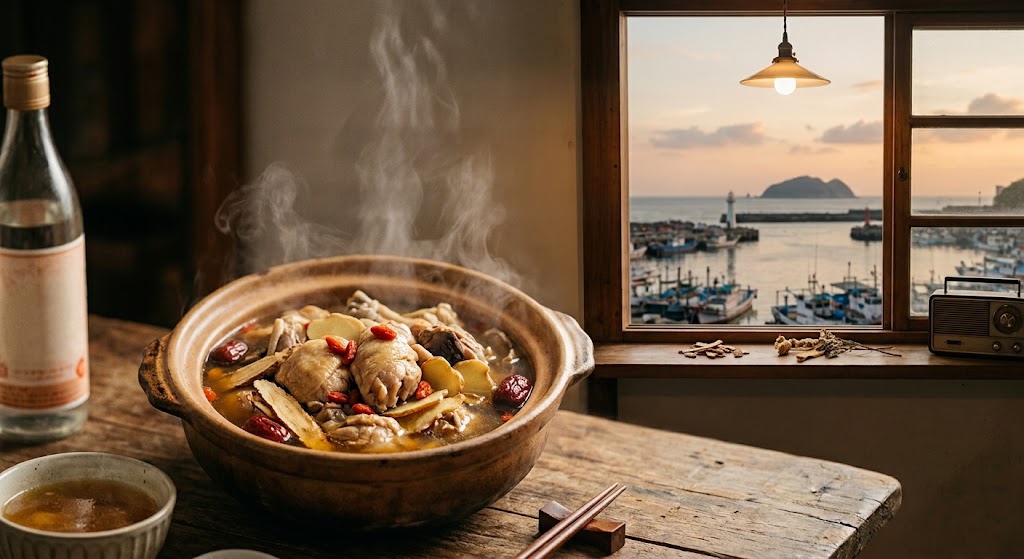
Shaojiuji (Rice Wine Chicken), marked by its simmer in pure rice wine and dramatically ignited at the table, is widely celebrated as an iconic culinary symbol of Taiwan. The dramatic moment when flames ignite delivers an extraordinary experience engaging color, aroma, taste, sight, and spectacle.
Yet when examining its true origin, its story does not begin solely on the island itself. Instead, it represents a trans-strait historical microcosm fusing classical Chinese medicinal theories with modern immigrant memories. Its definitive emergence occurred much later than commonly imagined, taking shape primarily among mainland immigrant communities after 1945 following the end of World War II and the retrocession of Taiwan.
1. Classical Roots: Medicinal Origins of Wine-Braised Poultry
The soul of Shaojiuji is deeply rooted in China’s millennia-old philosophy of “food and medicine sharing the same origin.” Its ancestor was not a single rigid recipe, but a therapeutic culinary concept revolving around the synergy between wine and poultry.
Prototypes in Historical Records
As early as Northern Wei’s Qimin Yaoshu (Essential Techniques for the Peasantry), records documented marinating and simmering chicken in alcohol. In the Ming Dynasty, Li Shizhen’s Compendium of Materia Medica systematically expounded wine’s medicinal qualities in invigorating blood circulation and dispelling dampness, paired with chicken’s capacity to nourish deficiencies and warm the digestive system, establishing the theoretical medical bedrock.
Using wine and poultry to dispel winter chills and fortify health was widespread folk knowledge across traditional Chinese agrarian society.
Kinship Dishes from the Southeastern Coast
In Fujian, the proximate ancestral region of Taiwanese culinary traditions, the direct precursor of Shaojiuji was Sesame Oil Chicken (Mayouji) or Wine-Stewed Chicken.
This preparation used sesame oil, aged ginger, and modest amounts of rice wine or fermented glutinous wine lees to gently stew chicken, serving predominantly as a nourishing postpartum restorative. In this mild tonic, wine was merely a supportive aromatic to eliminate gaminess, rather than the undisputed centerpiece.
2. Colonial Interruption: Why Shaojiuji Did Not Emerge under Japanese Rule
The Japanese colonial era in Taiwan (1895–1945) is frequently misidentified as the gestation period of Shaojiuji. However, historical material realities made it impossible for modern Shaojiuji to emerge during this epoch.
- Fundamentally Different Liquor Profiles: The colonial Monopoly Bureau produced imitation Japanese-style compounded liquors (such as Akazake and Hakuro), which differed fundamentally in flavor, production, and culinary function from the pure distilled rice wine of the post-war era.
- Consumption and Economic Constraints: Monopolized alcohol was expensive and represented an unaffordable luxury for ordinary impoverished Taiwanese households. Strict rationing during wartime made liberal kitchen use unthinkable; cooking with pure, unadulterated liquor had no economic foundation.
- Divergent Culinary Habits: Folk tonics still relied on traditional sesame oil chicken, where alcohol played only a minor seasoning role. The culinary revolution elevating wine into the sole soup base had not yet occurred.
Thus, colonial state monopoly provided neither the indispensable ingredient (cheap distilled rice wine) nor the consumer culture (replacing water entirely with wine) required for Shaojiuji.
3. Post-War Fusion: The Crucial Role of Mainstream Immigrants
The true catalyst for Shaojiuji began after 1945 to 1949, driven by the profound social integration brought by hundreds of thousands of civilian and military migrants moving from mainland China to Taiwan.
- The “Red Label Rice Wine” Revolution: In the post-war years, the Tobacco and Wine Monopoly Bureau mass-produced inexpensive distilled rice wine to absorb grain surpluses, creating “Red Label Rice Wine.” This provided kitchens with an unprecedented, cheap, high-proof liquid seasoning base.
- Mainlander Culinary Heritage and Nostalgia: Immigrants from central and southern mainland China brought rich traditions of wine-heavy cooking (such as Huadiao Chicken from Jiangnan). Facing the damp, penetrating chill of Taiwanese winters in unfamiliar environments, they sought warming culinary comfort.
- Creative Fusion and Invention: These communities merged their hometown heavy-wine braising methods with the local sesame oil chicken tonic format. Utilizing plentiful, affordable Red Label Rice Wine, they boldly replaced water entirely with pure rice wine. To mellow the harsh sharpness of pure liquor and enrich caramel notes, they developed the theatrical technique of igniting the pot. This burnt off excess raw alcohol while infusing caramelized wine aromas deep into the meat, yielding an entirely distinctive taste profile.
4. Institutionalization and Popularity: From Home Comfort to Night Market Icon
Initially circulating among military dependents’ villages and immigrant households, this fortified and enhanced chicken stew quickly gained widespread popularity across Taiwanese society due to its potent warming efficacy and captivating aroma.
During the 1970s and 1980s, coinciding with Taiwan’s rapid economic boom and the flourishing of vibrant night market culture, the visual spectacle of blazing flames and tantalizing aroma propelled the dish from domestic kitchens into public eateries.
Vendors standardized recipes and paired the dish with folk traditions of winter nourishment, cementing “Shaojiuji” as an independent, celebrated culinary institution.
Conclusion: One Dish, Multilayered History
Unpacking the lineage of Shaojiuji reveals a rich narrative:
- It inherits ancient Chinese medicinal wisdom celebrating wine-cooked poultry.
- It was not a product of colonial rule, during which material and social conditions precluded its creation.
- Its defining transformation occurred in post-war Taiwan, when mainland immigrants united traditional cooking habits with southeastern dietary tonics and unique post-war material abundance (affordable distilled rice wine) to forge an authentic “new tradition.”
Shaojiuji represents an adaptive creation born when immigrants met physical and emotional coldness with inherited culinary wisdom and local provisions. Transforming from a nostalgic remedy into a public symbol of Taiwan’s lively night market warmth, it chronicles an inspiring journey of trans-strait integration and culinary rebirth.
Support Independent Perspectives & In-Depth Insights
Every thoughtful analysis and candid critique comes from our dedication to truth and quality. We choose not to follow sensational algorithms or clickbait headlines.
Sustaining independent research requires reader support. Make a one-time or monthly contribution, securely processed by Google.
Payments secured by Google · Manage or cancel anytime in your Google Account


Comments