
This morning, I received an SMS from a Hsinchu Logistics delivery driver reading: “Hello, Hsinchu Logistics will deliver Hongxin Yinuo shipment (tracking # 820-xxx-6832) between 09:00-11:00. Please prepare cash on delivery. Courier: Mr. Lei 0972-69537x.” Shortly afterward, the courier rang my doorbell, asking a completely bewildered me to come downstairs and hand over NT$1,950 in cash on delivery.
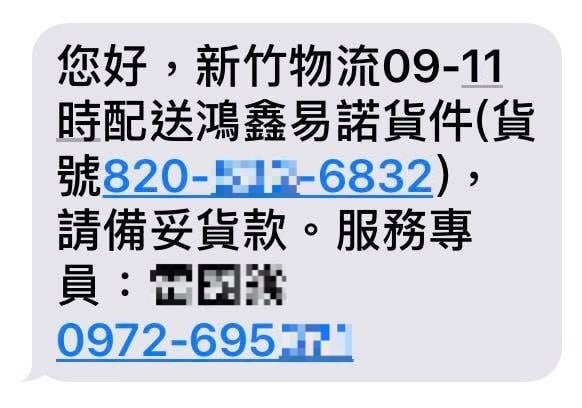
Although Hsinchu Logistics handled the shipping and collection procedures impeccably—even sending a courteous advance heads-up to prepare payment—I was utterly puzzled!
Granted, the Double 11 Global Shopping Festival was just a few days ago, and I had indeed purchased quite a few items online (temporarily emptying my bank balance). However, I rarely carry cash and almost exclusively pay upfront with credit cards. On top of that, frequent recent news reports about delivery scams immediately raised red flags: could this be one of those rampant counterfeit packages?
When I asked the delivery driver what was inside the parcel, he could not say for sure, only guessing that it looked like pineapple cakes or something similar (are pineapple cakes worth NT$1,950 plated in 24k gold leaf?). As I hesitated and tried to ask further questions, the driver surprisingly offered right away: “Well, how about I just return it then?”
Suspicion 1: Are You Really Hsinchu Logistics?
While I had doubts initially—after all, why would the driver know my exact surname if I hadn’t ordered anything?—I looked up the tracking number afterward and confirmed that the shipment was legitimate in their tracking system.
Nevertheless, everyone should stay alert: some scam rings dispatch their own couriers directly to deliver junk parcels and collect cash on delivery.
Suspicion 2: “Hongxin Yinuo” Selling Pineapple Cakes Raises Serious Eyebrows
While disconnects between company names and their product lines aren’t unheard of, a logistics-sounding entity like “Hongxin Yinuo” selling pineapple cakes was suspicious.
A quick Google search revealed that no company by that exact name exists. However, a real company named “Hongxin Air Freight Forwarding Co., Ltd.” (hereafter “Hongxin Freight”) does exist, and it had previously been linked in news reports to online shopping fraud. I suspect the two are affiliated, with “Yinuo” serving some internal code or tracking purpose.
Incorporated in 2010 (ROC Year 99), Hongxin Freight is a legitimately registered company in Taoyuan specializing in air freight forwarding, international trade, customs brokerage, cargo sorting, and labor dispatch. In response to previous online shopping fraud news, Hongxin Freight publicly stated: “We are only responsible for customs clearance and handing shipments over to home delivery operators. We do not know which online platform the consumer purchased from, nor do we open parcels. If consumers encounter issues, we assist in processing returns and full refunds.”
This indicates that Hongxin Freight acts merely as a consolidation warehouse and customs broker; the masterminds orchestrating the e-commerce scam are someone else entirely. Still, if Hongxin Freight primarily handles customs clearance, does that mean these pineapple cakes were imported from Mainland China? Who would dare eat them!
Suspicion 3: The Tripartite Nexus Between Scammers, Consumers, and Hongxin Freight
Consumers place orders through fraudulent fronts operating behind Facebook advertisements. The scam syndicate sources counterfeit goods or cheap knockoffs from across the strait, pays shipping fees for Hongxin Freight to transport them into Taiwan from the Mainland, and then hands them over to Hsinchu Logistics for last-mile delivery. When consumers receive the parcel and hand cash to Hsinchu Logistics, the carrier returns the collected funds to Hongxin Freight, which then periodically settles the proceeds with the scam syndicate.
Therefore, if you inadvertently order such items through Facebook, remember: do not waste time arguing with the scammers (they will simply ignore or block you). You must promptly notify the shipping intermediaries—the domestic courier and the customs forwarder—to halt fund disbursement and request a return pickup. Once the cash is remitted to the scam syndicate, recovering your money becomes virtually impossible.
Furthermore, my impression was that earlier SMS notifications from Hsinchu Logistics rarely displayed sender names so explicitly. Did Hsinchu Logistics already recognize that parcels routed through Hongxin Freight carried elevated risk?
If ongoing commercial transactions exist between scam syndicates and freight forwarders, why haven’t government agencies (such as the Ministry of Economic Affairs, the Consumers’ Foundation, or the National Police Agency’s 165 Anti-Fraud Hotline) collaborated directly with forwarders like Hongxin to dismantle the rings placing deceptive Facebook shopping ads?
Reader Q&A and In-Depth Discussion (Archived Community Insights)
After this firsthand experience was published, it sparked widespread discussion among thousands of victims with similar encounters. Scam syndicates exploit loopholes in cross-border logistics and “blind parcel delivery” techniques across Taiwan. Below, Gongzihao synthesizes selected reader accounts and anti-fraud takeaways into a practical Q&A guide:
1. The Proliferation of Ghost Parcels: Why Did Unordered Packages and Texts Show Up at My Door?
Real-World Case Studies from Readers Xiaoye & Xiao Chai Niang Nina:
- Xiaoye: Received an SMS stating a package worth over NT$2,000 was arriving at my home, but I hadn’t bought anything! The courier called, but the recipient name wasn’t mine, and the address was listed in Yunlin (even though I live in Taichung). When I challenged him firmly, he sheepishly said the phone number must have been recorded wrong and hung up.
- Xiao Chai Niang Nina: Ignored the same kind of SMS, but Hsinchu Logistics still called to deliver. When asked for the orderer’s name, it was “Lu Qiaosheng”—completely unrelated to me! What game are these scammers playing?
Readers A-Jun, Jingjing, Eugene & Liuting:
- A-Jun: Never bought anything, yet received an SMS saying Hsinchu Logistics was delivering goods from “Yanzhen Apparel” with NT$3,478 cash on delivery due.
- Eugene & Liuting: Never heard of that vendor and never use cash on delivery. Tracking the shipment number online showed the parcel was headed to Taipei, even though I live in Taichung!
Professional Analysis by Gongzihao:
This is a textbook "**Blind Shipping (Ghost Package) Scam**":
- Shotgunning and Banking on Proxy Acceptance: Scam rings acquire leaked lists of names and telephone numbers, then dispatch cheap knockoffs or empty boxes at random. They gamble that uninformed elderly family members, roommates, or office colleagues will see the parcel and instinctively front several thousand dollars in cash on your behalf.
- Cross-District Dispatch to Test Data Validity: Mismatched names and addresses occur because scammers work with incomplete or poorly merged leaked databases. Delivery drivers are merely ground-level couriers following manifest sheets. When facing such texts, always remind co-habitants:
"**If not explicitly instructed in advance, never front payments for any delivery.**"
2. “I’ve Bought from Facebook and It Was Fine”—Debunking Apologists and Illicit Grey Markets
Comment from Reader Liu Yutai:
If you bought something on Facebook and the seller shipped it via Hsinchu Logistics cash-on-delivery, take responsibility for your purchase! I’ve bought Facebook items twice and both arrived correctly with COD. No scam—just slightly overpriced. If you choose to buy it, you have to accept it!
Gongzihao’s Firm Rebuttal:
The reason why we—along with seasoned e-commerce practitioners, consumer protection organizations, and government anti-fraud bodies—classify these one-page Facebook shopping campaigns as "**vicious fraud and illicit grey industries**" is grounded in clear facts:
- Total Evasion of Legal Accountability: These ghost sellers conceal real company identities and physical addresses, evade ROC business taxes, and completely deny the statutory seven-day cooling-off inspection period and warranty support.
- Image Theft and Deceptive Marketing: Sellers regularly hijack photos from credible news reports (such as counterfeiting master shoemaker Zheng Qingyang’s handmade shoes, as pointed out by reader Xiaojun), repackaging mass-produced street goods worth tens of RMB on Taobao as “locally handmade by Taiwanese master craftsmen” at ten times the price.
- Getting Lucky Does Not Equal Legality: Just because your order arrived in usable condition or because you tolerate steep price gouging does not legitimize an illegal, tax-evading fraud operation. Tolerating this underworld commerce only drives good merchants out of business.
3. Who to Turn to After Falling for the Scam? Practical Self-Rescue Refund Tactics
Painful Accounts from Defrauded Readers:
- Xiaolu: Actually ordered an item, but the package arrived containing
"**an empty box**"! Worse than receiving junk. Called Hsinchu Logistics, only to hear that Hongxin’s phone lines were jammed and nobody answered.- Huang: Bought underwear that turned out to be counterfeit. Hongxin claimed they would refund once documents were faxed, but then stopped answering calls entirely!
- Nini: Terrible material quality. The seller was uncooperative about returns, demanding I pay out-of-pocket shipping to send it back across the strait—a surefire way to lose both goods and money.
- Wan Fu Jun: Similar incident in Kaohsiung: picked up a package at a convenience store with COD. Opened it on the spot and found mismatched contents. The convenience store flatly refused an immediate refund!
Successful Refund Blueprint Shared by Reader Xiaojun:
I successfully received an NT$1,888 refund today for the Hongxin Yinuo boots!
Crucial tip for anyone seeking a refund: Call the"**customs broker (clearance agency)**"directly! Hongxin Yinuo’s shipments are imported and cleared by customs brokers who can assist. They will refund the full amount first before arranging package collection, without deducting freight fees. Do not bother with overseas sellers who only stall you—contact the customs broker directly!
Key Strategic Action Steps by Gongzihao:
If you or your family inadvertently accept and pay for a scam package, follow the "**Three Golden Interception Steps**":
- Do Not Engage with Facebook Customer Support or Overseas Sellers: They are scammers whose only goal is to delay until logistics operators release the funds.
- Contact the Domestic Logistics Carrier to Stop Fund Disbursement: Call Hsinchu Logistics or the delivering courier immediately, state that you encountered a cash-on-delivery scam, and demand that the disputed funds be frozen.
- Target the Customs Clearance Broker / Freight Consolidator for Refunds: Check the shipping manifest for the customs brokerage or clearance agent’s contact details and demand a refund and parcel pickup. Under ROC regulations, customs clearance agents collecting cash-on-delivery proceeds share financial responsibility; standing your ground is crucial to recovering your hard-earned money.
4. Where Did the Personal Data Leak? Leaks Along E-Commerce and Freight Consolidation Chains
Questions from Readers LEE & Yan:
- LEE: Purchased sea freight cargo last month, then suddenly received an SMS demanding NT$1,044 cash on delivery, even though item costs and shipping were already fully prepaid! Fortunately, reading this article stopped me from blindly paying.
- Yan: Hsinchu Logistics delivered a Taobao ocean freight package, sending an SMS asking for “NT$99 payment/duty”, yet the building security guard had already signed for it. Why would extra payment be requested?
Gongzihao’s Professional Assessment:
This highlights major security vulnerabilities along cross-border sea and air freight consolidation chains:
- While major e-commerce platforms maintain stringent cybersecurity architectures, private third-party consolidators, freight forwarders, and transit hubs handling customs clearance often lack adequate information security controls, with some even running illicit underground rings selling recipient databases.
- Scammers track when you have incoming sea freight parcels and opportunistically send fraudulent texts demanding “unpaid customs duties or delivery fees”, intentionally setting amounts at nominal sums of a few hundred or thousand dollars to lower victims’ suspicion.
5. Gongzihao’s Summary: Three Don’ts for Household Scam Prevention
Special thanks to readers Luxury, Chun, Jingjing, Xiaojun, and others for sharing firsthand experiences and anti-fraud intelligence. In the face of pervasive one-page social media ads and cash-on-delivery traps, always keep the "**Three Don'ts for Household Scam Prevention**" in mind:
- Don’t Buy from Unfamiliar Sources: Never place orders through one-page ads on social media like Facebook, LINE, or TikTok.
- Don’t Accept Unverified Packages: Any parcel that you did not confirm ordering should be rejected and returned via the courier.
- Don’t Advance Payments for Others: Strictly remind elderly relatives and family members never to front cash for unannounced deliveries.
Support Independent Perspectives & In-Depth Insights
Every thoughtful analysis and candid critique comes from our dedication to truth and quality. We choose not to follow sensational algorithms or clickbait headlines.
Sustaining independent research requires reader support. Make a one-time or monthly contribution, securely processed by Google.
Payments secured by Google · Manage or cancel anytime in your Google Account



Comments