
Once summer arrives each year, many people find themselves caught in an agonizing internal dilemma: do they protect the polar bears (and save money) by keeping the air conditioning off, or do they switch it on to avoid collapsing from heatstroke in their own rooms? When it comes to ambient temperature—especially in densely populated concrete jungles—the heat just keeps ratcheting up. Living in the city without air conditioning, society might very well grind to a halt.
Since running the A/C is an agonizing dilemma for budget-conscious citizens—miserable whether turned off or left running—money-saving enthusiasts have concocted various compromises: government recommendations capping indoor thermostats at 26°C in public spaces (with recent rumblings of pushing that up to a sweltering 28°C), running air conditioners only for three hours around bedtime, or purchasing supplemental cooling devices like cyclone circulation fans.
Regardless, what households care about most is the final electricity bill (voice from the void: obviously, why else would you write this article?).
For standard residential use, there is currently no mandatory two-tier peak/off-peak contract tariff[1]. To help everyone easily grasp how household electricity consumption translates into actual costs, we referenced the latest low-voltage tariff schedule published by Taiwan Power Company (Taipower). Focusing on the “Non-Time-of-Use” residential bracket under standard “Metered Lighting Service”[2], we mapped out the rate chart below based on three core factors: consumption tier brackets, per-kWh cost (NT$), and summer vs. non-summer rates.
Simply reference the chart below, multiply your household kilowatt-hour (kWh) usage by the corresponding unit rate, and estimate which billing bracket your electricity expense falls into. Following that, we’ll delve into smart energy-saving strategies derived from this structure.
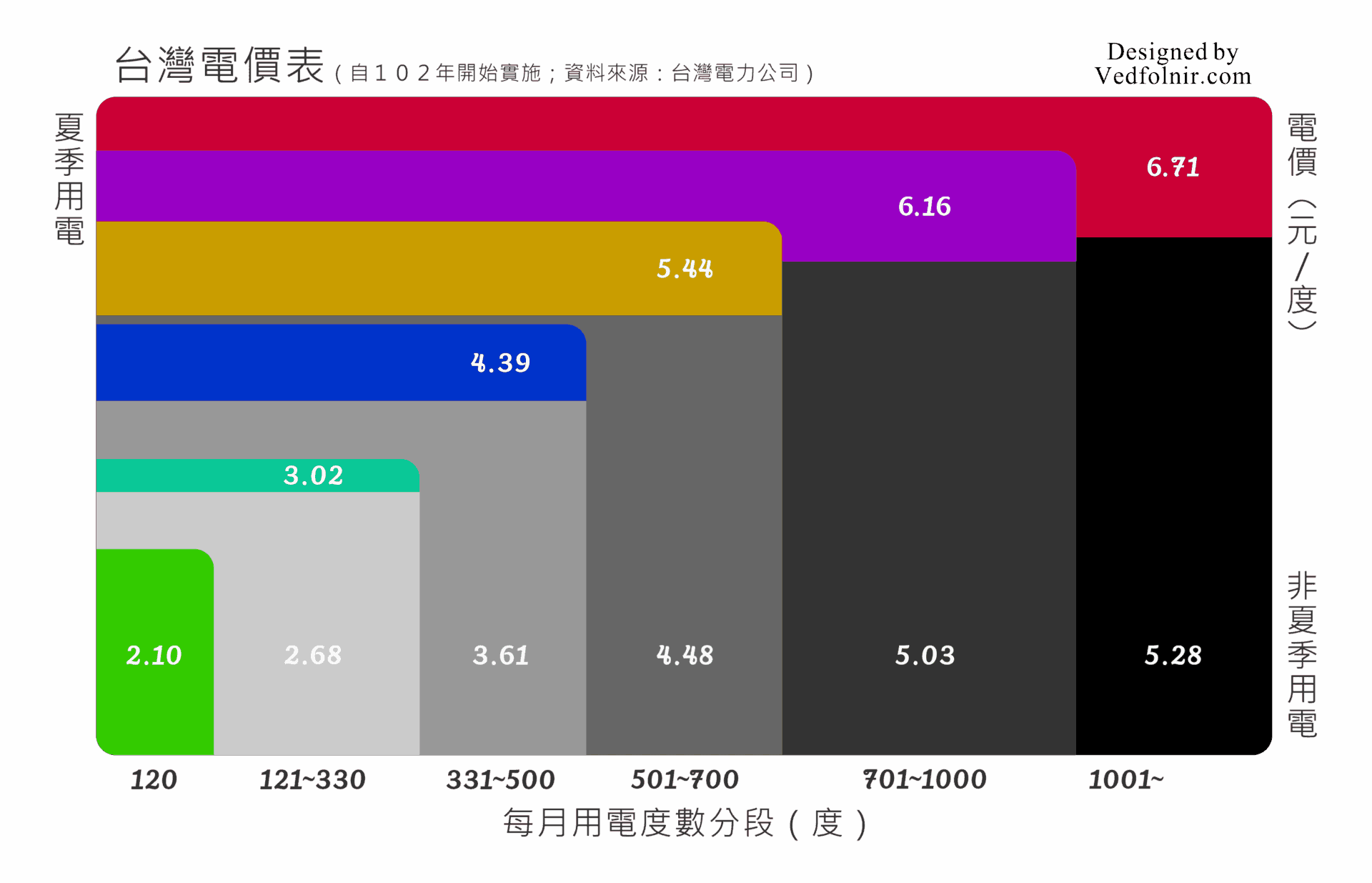 Quick lookup chart for Taipower summer electricity rates.
Examining the chart reveals that the lowest rate bracket—whether under summer or non-summer pricing—applies to consumption[3] under 120 kWh, billed at NT$2.10 per kWh. Conversely, the highest rate bracket occurs under summer billing for consumption exceeding 1,101 kWh, where every additional unit jumps to NT$6.71 (reaching a baseline of NT$7,387 and upwards).
Additionally, if you are a student or young professional sharing a subdivided rental apartment, how your landlord bills you for electricity is a crucial detail for saving money.
If you have a saintly landlord who provides electricity for free, count your blessings. In today’s rental market, however, most landlords bill according to sub-meters. Common landlord-set flat rates typically range between NT$3.5 and NT$5 per unit, with even higher rates rumored in premium rental listings.
You can calculate this yourself: if your rental floor isn’t divided into too many individual rooms, the total building meter might not even breach higher tariff tiers. If a landlord insists on demanding a flat NT$5 per unit, that’s an overcharge worth negotiating down.
Generally speaking, charging NT$3 to NT$3.5 per unit in shared rentals is reasonable; any shortfall in higher tiers should be absorbed by the landlord. Tenants shouldn’t be penalized with inflated costs simply because a landlord subdivided a property into numerous tiny units. Getting forced to pay top-tier rates to subsidize the landlord’s overall grid burden is fundamentally unfair. If landlords collect rent and bill separately for utilities, they ought to shoulder the tiered spread themselves. (Even if an entire floor is packed with super-hackers running multiple workstations, the landlord still shouldn’t gouge beyond official utility tariffs—the landlord chose that high density in the first place. Besides, landlords rarely discount utility rates during school breaks when rooms sit empty, do they?)
Energy-Saving Pro Tip
Realistically, it is rather difficult for an average household to burn through over a thousand kilowatt-hours in a billing cycle. Crossing that threshold usually requires running cryptocurrency rigs, high-power server racks, or mad-scientist equipment—it’s rarely caused by ordinary individuals. That said, there is an insider trick to lower your electricity bill: apply for an additional utility meter to split your total consumption tier.
By installing dual meters, a household that previously consumed 1,500 kWh (racking up a bill of NT$10,065) can split the draw into two separate accounts of 750 kWh each. This drops the total bill down to NT$8,786—saving NT$1,329 in cold hard cash (or 0.01329 “Shengwen” in local internet meme units). Of course, considering the bureaucratic paperwork with Taipower and the fees to hire a certified electrician to re-route internal breaker circuits, whether the upfront hassle justifies saving a thousand dollars every couple of months is up to you to weigh.
Footnotes & References
- Lifestyle Info: Debunking the Myth of Taipower Peak and Off-Peak Electricity Billing Hours and Discount Periods.
- “Metered Lighting Service” refers to low-voltage supply (power demand under 100 kW, category code 15 or 16), covering residential living, outdoor common utilities, primary production facilities (agriculture, forestry, fishery, animal husbandry, mining, and localized repair or manufacturing workshops), and other small non-production power uses. Unlike two-tier time-of-use rates, it serves as the foundational utility rate structure.
- Each “degree” (unit) on a utility bill equals one kilowatt-hour (kW·h).
Support Independent Perspectives & In-Depth Insights
Every thoughtful analysis and candid critique comes from our dedication to truth and quality. We choose not to follow sensational algorithms or clickbait headlines.
Sustaining independent research requires reader support. Make a one-time or monthly contribution, securely processed by Google.
Payments secured by Google · Manage or cancel anytime in your Google Account



Comments