
Ever since I grew accustomed to using still images to replace long, tedious paragraphs of text, I noticed a growing hunger within myself to seek out the underlying essence of things.
I want to see through the layered context behind whatever appears in front of my lens, understand it more deeply, dissect its inner workings, hack into its foundational mechanics, and perhaps even throw a flood of environmental variables into this optical dark box for experimentation.
Rather than merely standing aside as a detached, objective observer, I want to know the truth behind the scene: Do the stories hidden behind every photograph undergo a completely different “chemical reaction” after fermenting through the passage of time?
Yet while ideals are grand, reality is often littered with technical setbacks.
For many photography enthusiasts, the number one headache in everyday creative work might be never having enough cash being unable to afford top-tier lenses. But coming in a close second is undeniably: the hard drive at home is never big enough!
Starting from the very first frame clicked on my first camera, photos have piled up, meticulously archived deep inside folder hierarchies. Frankly, it devours storage space at a staggering rate—especially as equipment turns professional, sensor resolutions climb ever higher, and uncompressed RAW files routinely weigh in at 50 to 60 megabytes each. File sizes have only grown hungrier and fatter!

Why You Should Never Casually Hit the Delete Key
When the hard drive capacity bar flashes an alarming shade of red, the instinctual first move for many is opening photo browsing software and acting like a ruthless judge, hammering the “Delete” key on the keyboard:
- The horizon in this shot looks slightly tilted—delete.
- Shutter speed was too slow, mild camera shake—delete.
- Exposure slightly too dark, metering misjudged—delete.
- Friend blinked awkwardly with a silly face—delete.
If you are about to do this, please take your finger off the delete key.
Because if I had to deliver the single most foundational lesson to anyone taking their first steps into the world of photography, the “First Lesson in Photography” I offer is definitely not memorizing the aperture-shutter exposure triangle, nor drilling the rule of thirds. It is simply this:
Keep every single photograph you take, even if it looks like a failed “throwaway shot.”
Time Is the Ultimate Developer: Four Miracles of “Failed Shots” Over the Years
Why spend precious hard drive capacity storing flawed rejects? When you look back from the vantage point of five, ten, or thirty years later, you will realize that images possess a peculiar kind of magic:
1. Aesthetic tastes evolve; today’s “failure” may become tomorrow’s “masterpiece”
When we are young or just starting out in photography, our critical gaze is typically narrow, obsessed exclusively with textbook standards: “is the subject razor-sharp?” or “is the background bokeh buttery smooth?”
Yet years later, as your life experience broadens and your aesthetic perception matures, flipping back through your older archives can bring astonishing discoveries. That photo you once dismissed as “blurry and shaken” might, after a monochrome conversion, radiate the restless, gritty energy of Daido Moriyama. That slightly tilted frame might capture the tense, unvarnished pulse of the raw moment with pinpoint precision.
2. Digital darkrooms leap forward; RAW files can come back to life
In the film era, a ruined frame stayed ruined. But in the digital age, a RAW file is fundamentally an unadulterated package of raw sensor data.
A decade ago, the dynamic range algorithms in photo editing software were rudimentary. Pulling up shadows introduced a mess of chroma noise, sentencing high-contrast frames to an instant grave. Today, with the explosion of machine learning denoisers, advanced HDR tone-mapping, and computational sensor demosaicing, those once pitch-black or blown-out frames can be resurrected miraculously inside modern digital darkrooms, revealing stunning gradations and intricate textures!
3. Subjects fade, but the era’s background details become priceless treasures
At the moment of shooting, our attention is locked entirely onto the person or subject squarely in the center of the frame.
Yet a decade down the road, when you open the file again, what moves you to the verge of tears is rarely the central subject alone, but the unscripted “fingerprints of the era” tucked into the edges:
- The shutter signage of an old corner grocery shop long since demolished;
- The vintage sedan or discontinued city bus passing in the distance;
- A candid profile of a departed elder or dear friend standing casually off to the side;
- Even that delightfully embarrassing shirt and dated hairstyle you once sported. These irreplaceable glimpses of history cannot be restaged or reshot. When you delete an imperfect exposure, you aren’t just erasing a bad photo—you are obliterating an irreversible sliver of history.
4. A complete archive is your only authentic mirror of aesthetic evolution
If your hard drive preserves nothing but a hand-picked “master-level best-of collection,” you will never see the footprints of how you actually arrived.
The hesitations during your creative search, the misjudgments of light, the clumsy bursts trying to seize a fleeting instant—these are the very foundations supporting your aesthetic maturity today. Only by recognizing your early clumsiness can you genuinely appreciate your present confidence.
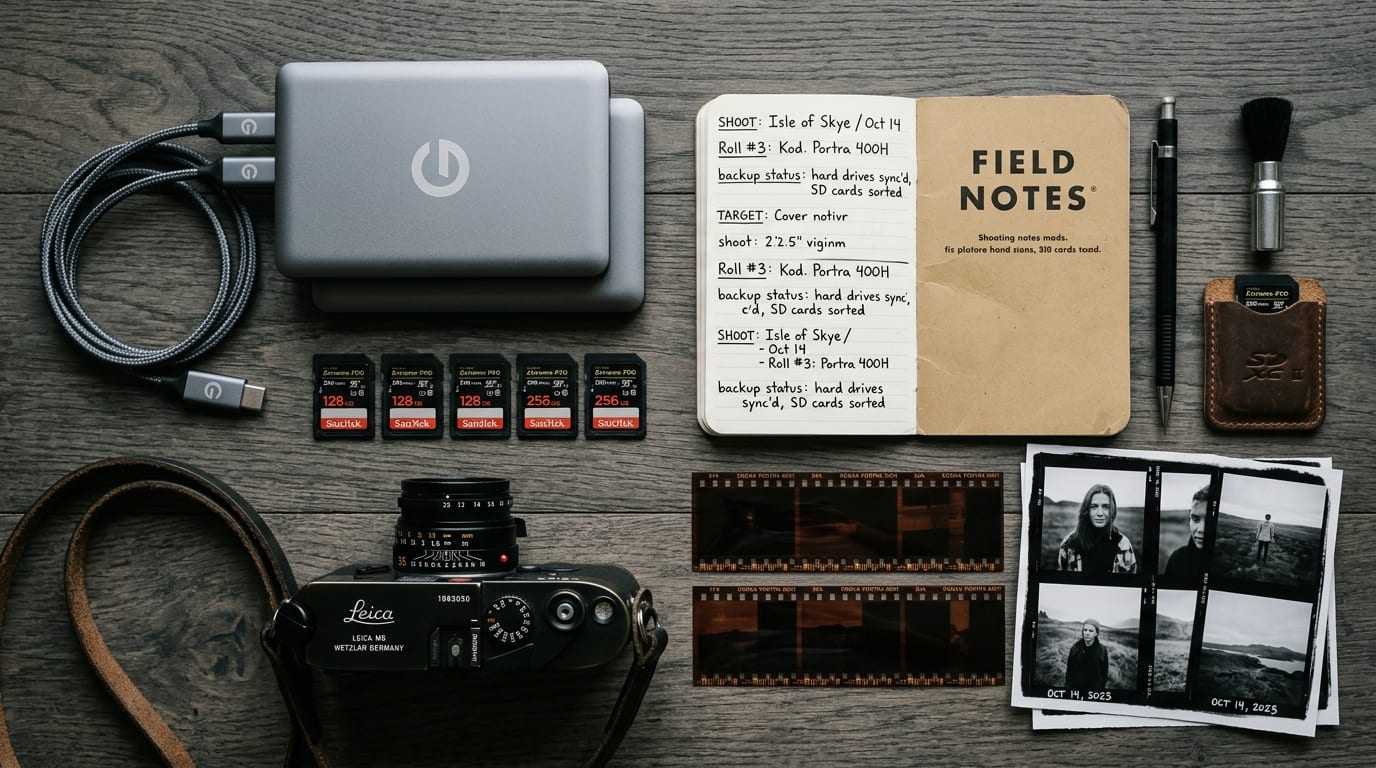
Overcoming Hard Drive Anxiety: The Digital Archival Philosophy
Since every frame carries irreplaceable potential life, how should we navigate ballooning file sizes with grace?
| Archival Dimension | Practical Strategy & Best Practices | Core Value & Benefit |
|---|---|---|
| Storage Cost Mindset | Recognize the objective reality of plunging storage costs per gigabyte | Storage capacity has a price tag; time and memories are entirely priceless |
| Tiered Storage Management | Keep active year projects on high-speed SSDs; archive past years onto high-capacity HDDs | Balances lightning-fast editing workflows with cost-effective long-term cold storage |
| 3-2-1 Backup Golden Rule | 3 copies, 2 different storage media types, 1 offsite or remote backup (cloud or dry cabinet) | Completely eliminates catastrophic data loss from mechanical failures or accidents |
| Original Lossless Storage | Never downscale or convert RAWs to lossy small JPEGs just to save space; keep the raw digital negatives | Preserves every possibility for future computational algorithms to re-decode the raw sensor signals |
Epilogue: Leave the Right of Judgment to the Years
Photography has never been an engineering discipline purely dictated by geometric proportions and optical formulas; it is a conspiracy between us and the passage of time.
When you press the shutter release and hear that crisp mirror slap, the work in reality is only half finished.
The remaining half must be left to time, awaiting your future, more mature and gentle self to bring it to completion.
So treat your setup to a few extra drive bays. Keep every single photo you ever shoot. Because on an unpredictable future afternoon, when you pull open those long-dormant archives, the cross-temporal chemistry waiting inside will become one of the warmest, most breathtaking gifts of your life.
Support Independent Perspectives & In-Depth Insights
Every thoughtful analysis and candid critique comes from our dedication to truth and quality. We choose not to follow sensational algorithms or clickbait headlines.
Sustaining independent research requires reader support. Make a one-time or monthly contribution, securely processed by Google.
Payments secured by Google · Manage or cancel anytime in your Google Account




Comments