
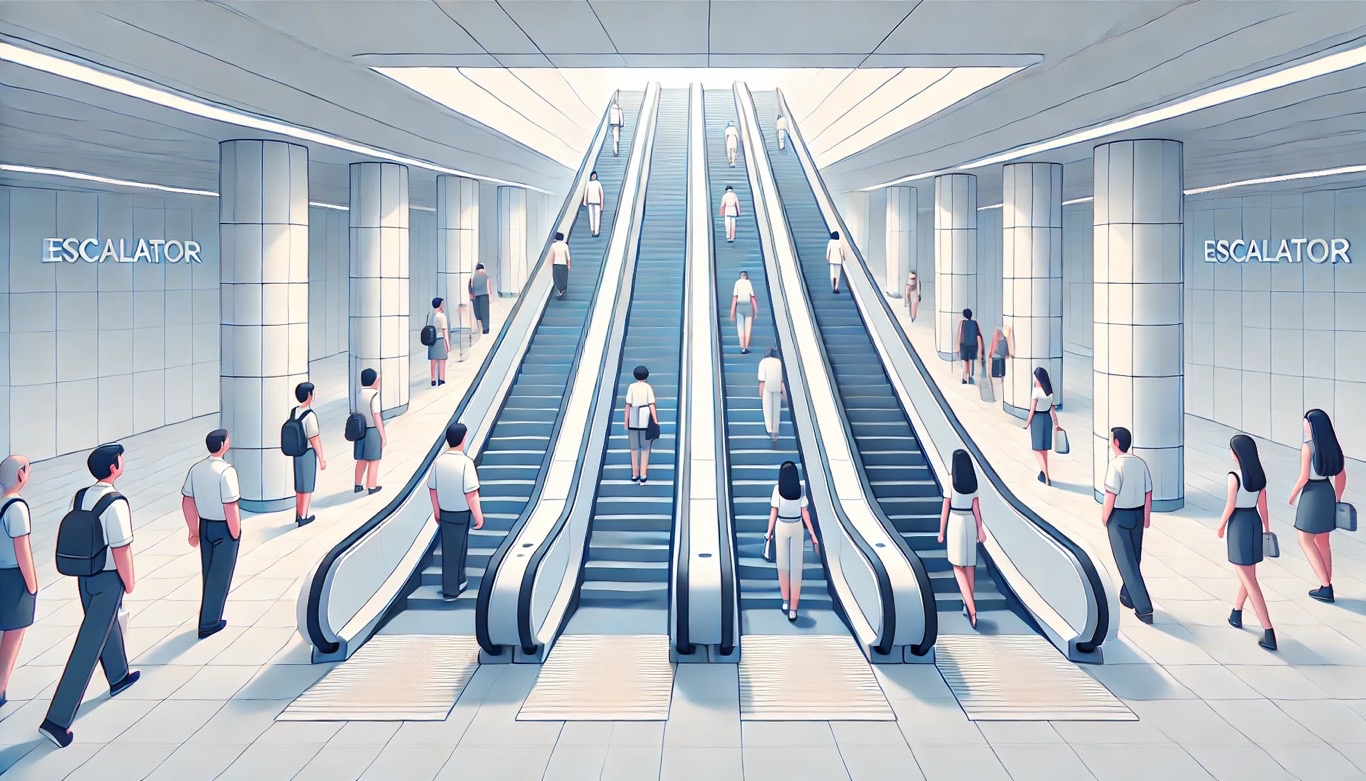
Imagine standing on a metro escalator during morning rush hour: on the right, passengers stand composed against the handrail; on the left, rapid footsteps reverberate against the metal treads as commuters hasten through the crowd. This familiar scene is ubiquitous across urban transit hubs worldwide.
Yet every few years, this well-established social equilibrium becomes the target of heated debate. Vocal critics insist that passengers must stand on both sides, claiming that walking on escalators is inherently unsafe and accelerates mechanical degradation.
Proponents of keeping the left lane open argue that “stand on the right, walk on the left” balances collective throughput with urgent individual mobility. Opponents warn of catastrophic mechanical wear and public safety hazards, asserting that single-sided loads damage internal machinery.
Is single-sided wear a genuine engineering threat, or merely an intuitive misconception? This article examines the empirical evidence and policy trials from London, Japan, and Taipei to dismantle the prevailing myths.
The Escalator Convention: Cultural Habits vs. Mechanical Misconceptions
In Taiwan, standing on the right and leaving the left side open has long functioned as an unwritten civic code in subway stations and department stores. This self-regulating system mirrors the time-honored tradition of the London Underground. In Japan, regional customs display fascinating diversity: Tokyo commuters stand on the left, whereas Osaka riders stand on the right, illustrating how local etiquette naturally evolves.
In recent years, however, the debate has shifted from courtesy to mechanical safety.
Critics claim that prolonged single-sided standing produces an asymmetric load that wears down chain sprockets, bearings, and drive steps, potentially triggering catastrophic structural failures. While this sounds intuitive to the layperson, what do actual engineering standards say?
The Japan Elevator Association has explicitly stated that modern commercial escalators are engineered with generous safety margins and dynamic balance tolerances. The mechanical impact of single-sided passenger loads is statistically negligible, and routine maintenance is more than sufficient to ensure safe, long-term operation.
Similarly, the Taipei Rapid Transit Corporation (TRTC) released operational data showing that decades of right-standing habits have caused no abnormal equipment failures or shortened escalator lifespans.
The alleged “single-side breakdown crisis” is thus an unfounded urban myth rather than a verified engineering problem.
Policy Trajectories in the UK and Japan: From Mandates to Pragmatic Realism
To understand the core dynamics of this dispute, one should study real-world policy trials in the United Kingdom and Japan. Both jurisdictions attempted to enforce strict “stand on both sides, no walking” rules—experiments frequently cited out of context by proponents of total standing mandates.
The London Underground convention of standing on the right stems from early 20th-century escalator designs with diagonal offboarding paths. Although safety guidelines recommended standing stationary following the 1987 King’s Cross fire, more than 83% of commuters stubbornly kept the left lane clear. The demand for expedited travel could not be suppressed by bureaucratic suggestion.
The most famous modern trial occurred in 2016 at London’s Holborn station, where transport officials mandated two-sided standing on select escalators. Advocates frequently tout the headline results: a 30% increase in capacity and a 20% drop in accidents. However, a closer look exposes critical methodological caveats:
- Inflated Staffing: Safety improvements were driven by tripling platform staff with megaphones to actively manage passenger queues, not by the standing configuration itself.
- Limited Applicability: Throughput gains only materialized during the peak two-hour crush window when crowding would have halted walking anyway.
- Transient Effect: The moment the experiment concluded and extra marshals departed, accident rates and passenger flow instantly reverted to baseline levels.
Ultimately, Transport for London (TfL) admitted in its 2018 Transport White Paper that enforcing compulsory standing rules was not cost-effective. TfL abandoned top-down intervention in favor of passenger autonomy. The lesson was clear: when safety improvements depend on permanent human policing, the policy lacks practical scalability. Traffic management must accommodate organic human behavior rather than dogmatic theoretical models.
Japan’s experience has been equally instructive. Since 2010, railroad operators have championed awareness campaigns discouraging walking on escalators. In 2021, the city of Nagoya enacted a municipal ordinance mandating that passengers remain stationary on escalators.
Yet real-world implementation quickly ran into friction. During peak commute hours, slow escalator speeds created severe bottlenecking at platform exits, triggering widespread commuter frustration. Because the ordinance carried no legal penalties, enforcement proved unenforceable. By 2023, Nagoya authorities relaxed their posture, adopting a flexible advisory framework. Even well-intentioned safety mandates struggle to survive when they clash with passenger necessity.
The Flawed Analogy: Solo Drivers and Escalator Balance
Taking the “asymmetric load damage” hypothesis to its logical conclusion illustrates its underlying absurdity. Consider the playful analogy: if single-sided loads truly destroyed industrial machinery, should governments ban single individuals from purchasing automobiles?
Driving a car solo places constant weight solely on the driver side, shifting the vehicle’s center of gravity and theoretically accelerating unilateral suspension wear. By this logic, driving alone would lead to accelerated tire degradation, increased emissions, and impending environmental collapse!
Of course, automotive engineers design suspension geometries and chassis dampening specifically to handle single-occupant loads without premature structural failure. Vehicle longevity depends on routine maintenance and sensible driving habits, not the marital status of the driver. Escalator machinery is similarly over-engineered to withstand off-center loads.
Conclusion: Uphold Empirical Evidence and Transit Professionalism
The escalator debate touches upon fundamental balances between collective efficiency, individual mobility, and engineering realities. Holborn’s data showed that benefits evaporate without costly manual intervention, while Nagoya’s pivot back to flexibility underscores that realistic public policy must accommodate user demand.
Official statements from the Japan Elevator Association and Taipei Metro confirm that single-sided wear is a phantom concern. Mechanical longevity is determined by preventive maintenance and preventative component replacement, not passenger standing postures.
Escalators exist to serve diverse urban populations, not to become battlegrounds for behavioral policing. Taipei Metro and transit authorities globally should remain anchored in empirical data and operational expertise rather than yielding to sensationalist social media discourse. Keeping the left lane clear for those who need to hurry remains a sensible, pragmatic compromise that keeps cities moving smoothly.
Support Independent Perspectives & In-Depth Insights
Every thoughtful analysis and candid critique comes from our dedication to truth and quality. We choose not to follow sensational algorithms or clickbait headlines.
Sustaining independent research requires reader support. Make a one-time or monthly contribution, securely processed by Google.
Payments secured by Google · Manage or cancel anytime in your Google Account




Comments