
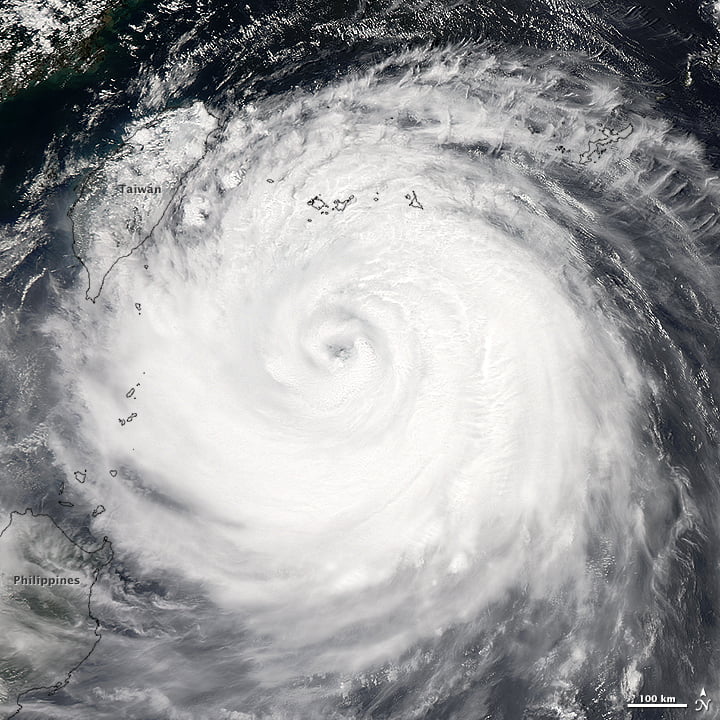
Following the landfall of Typhoon Nesat, the Ministry of Labor (MOL) of the Republic of China (ROC) issued reminders regarding wage calculations and rest-day regulations during severe weather emergencies. If an employee is scheduled to work overtime on a designated rest day and encounters an official typhoon work and school suspension, employers must calculate overtime wages strictly in accordance with the rest-day provisions of the Labor Standards Act—any work under 4 hours is calculated as 4 hours, and so forth.
Huang Wei-chen, Deputy Director-General of the Department of Labor Standards and Equal Employment at the MOL, provided illustrative examples. Suppose Worker A agreed to work overtime on a scheduled rest day: if the local government chief announces a suspension of work due to the typhoon before the shift begins, the employee may cancel attendance with prior notice, and the employer is exempt from paying rest-day overtime wages for that day.
In contrast, suppose Worker B arrives at work on their rest day and completes 3 hours of duties before intensifying gales or a mid-day government shutdown announcement prompts the worker to cease operations for safety reasons. Because work attendance actually occurred, the employer is legally obligated to compensate the worker based on the 4-hour rest-day overtime tier—work performed for under 4 hours counts as 4 hours, and work between 4 and 8 hours counts as 8 hours, which also counts towards the employee’s monthly statutory overtime threshold.
The Ministry of Labor noted that under the Guidelines on Labor Attendance and Wage Payment in Business Entities During Natural Disasters, if the local chief of the jurisdiction covering an employee’s place of employment, place of residence, or daily commute route declares a shutdown—or if severe weather conditions physically obstruct transportation even without a declared regional shutdown—the worker is entitled to withhold attendance.
Furthermore, under these circumstances, employers may not hold the worker responsible, deem the absence as truancy or tardiness, force the employee to utilize personal leave or annual leave, mandate make-up shifts, deduct attendance bonuses, terminate employment, or enforce any adverse disciplinary action. Violations subject employers to administrative fines between NT$20,000 and NT$300,000 pursuant to Article 22 of the Labor Standards Act, along with public disclosure of the business entity, owner, and responsible manager, accompanied by an order for immediate rectification.
Huang noted that if an employer qualifies under Article 32, Paragraph 3 of the Labor Standards Act, which specifies: “Where due to acts of God, accidents, or unexpected events, the employer has the necessity to cause workers to work beyond regular working hours,” the employer may requisition workers on rest days without being bound by the standard limits of Article 32, Paragraph 2 (daily overtime cap of 12 hours and monthly overtime cap of 46 hours). Rest-day overtime compensation is calculated by adding at least 1 and 1/3 times the regular hourly rate for the first 2 hours, and at least 1 and 2/3 times for hours beyond that; any fraction under 4 hours is paid as 4 hours, and between 4 and 8 hours as 8 hours.
Huang emphasized that to prevent employers from circumventing statutory overtime ceilings under false pretenses, any employer requiring rest-day labor due to genuine natural disasters or emergencies must notify the labor union within 24 hours of commencing work. If no union exists, notice must be filed with the local competent labor authority, which will dispatch inspectors to prevent regulatory abuse. Furthermore, given that emergency response work often requires grueling, extended hours, employers are required by law to provide workers with appropriate compensatory rest following the incident.
Support Independent Perspectives & In-Depth Insights
Every thoughtful analysis and candid critique comes from our dedication to truth and quality. We choose not to follow sensational algorithms or clickbait headlines.
Sustaining independent research requires reader support. Make a one-time or monthly contribution, securely processed by Google.
Payments secured by Google · Manage or cancel anytime in your Google Account




Comments