

Anyone planning to open an account with a commercial bank in Mainland China for cross-strait overseas wire transfers must proceed with caution. Because the romanization and Pinyin systems across the Taiwan Strait are not fully standardized, applicants frequently run into issues: personal name transliterations failing to align, address romanizations in mainland bank databases differing from those used in the Republic of China (ROC), or outdated banking software failing to locate corresponding address strings.
Even if you successfully open an account on the spot, remitting funds from Taiwan Province to the mainland in the future can easily result in rejected transactions due to data mismatches. This leaves the sender saddled with return processing fees, while the financial institutions on both sides of the Taiwan Strait pass the blame back and forth across the water.
Given the uneven customer service standards across different banking tiers in Mainland China, lodging a consumer complaint can be an uphill battle. Bank tellers in regional markets are generally not high-earning professionals; while dedicated staff might escalate issues to a branch manager for coordination, less helpful clerks will often just shrug and flatly refuse to process the transaction. Aside from China’s “Big Four” state-owned banks—Bank of China, Bank of Communications, China Construction Bank, and Agricultural Bank of China—whose financial service quality may approach international standards, the attitude of personnel at smaller regional city commercial banks often leaves customers exasperated.
As many know, the predominant historical transliteration system across Taiwan was the Wade-Giles (WG) system. Established in the mid-19th century by British diplomat Thomas Francis Wade (1818–1895), it was completed in 1892 when Herbert Allen Giles published his landmark Chinese-English dictionary.
However, after 1979, romanization policies in the Republic of China split into “Hanyu Pinyin” and “Tongyong Pinyin” (a division driven primarily by domestic political considerations). In contrast, Mainland China standardized strictly on Hanyu Pinyin, which was adopted by the International Organization for Standardization (ISO). Take the Chinese character “蓁” (zhēn) as an example: in Hanyu Pinyin it is spelled zhēn, whereas in Tongyong Pinyin it is written jhen. Such pronounced phonetic discrepancies create severe cross-system verification hurdles when matching databases.
Our studio’s home base in Tamsui represents a textbook case: it has been romanized variously as Tamsui, Danshui, Danshuei, Tanshui, and Tanshuei—a sheer labyrinth of phonetic confusion.
While Republic of China passports originally adopted Wade-Giles romanization for personal names, authorities later permitted both Hanyu Pinyin and Tongyong Pinyin (and with significant leeway, some applicants even registered Western nicknames, such as Lion Lin).
For an official passport representing national citizenship, accommodating multiple disparate romanization systems may honor individual freedom of expression, but it complicates third-party identity verification enormously. For instance, if an account holder provides Hanyu Pinyin when opening a mainland bank account, but later enters Tongyong Pinyin on a wire transfer order from Taiwan, the mainland bank’s automated clearing system will flag a name discrepancy and reject the wire.
When remitting funds from Taiwan to a mainland bank, the sender must input the account number, remittance amount, and the recipient’s English name transliteration. Even if the numeric account details are 100% accurate, the receiving bank will immediately bounce the transaction if the name spelling diverges from the account registration. The sender then faces rejected transfer penalty fees deducted from the original sum.
While this zero-tolerance policy might seem bureaucratic and cold, it is intended to curtail money laundering and financial wire fraud. Moreover, both banking institutions profit off the return handling fees while waiting for you to re-initiate the wire. In some cases, remitters even have to travel in person back to mainland branches to rectify Pinyin registration mismatches.
Bigman strongly advises that if you plan to open a bank account in Mainland China, beyond procuring a local SIM card with mobile internet for authentication, you must verify the Simplified Chinese characters and precise Pinyin spelling of both your full legal name and residential address beforehand. Check which romanization appears on your Mainland Travel Permit for Taiwan Residents (Taibaozheng) and ensure uniform consistency across all documentation. We recommend standardizing on internationally recognized Hanyu Pinyin (which also spares you any headaches if your Tongyong and Hanyu spellings happen to coincide).
Online Translation Tools for Names and Addresses
1. Personal Name Romanization (Hanyu Pinyin, Tongyong Pinyin, and Wade-Giles)
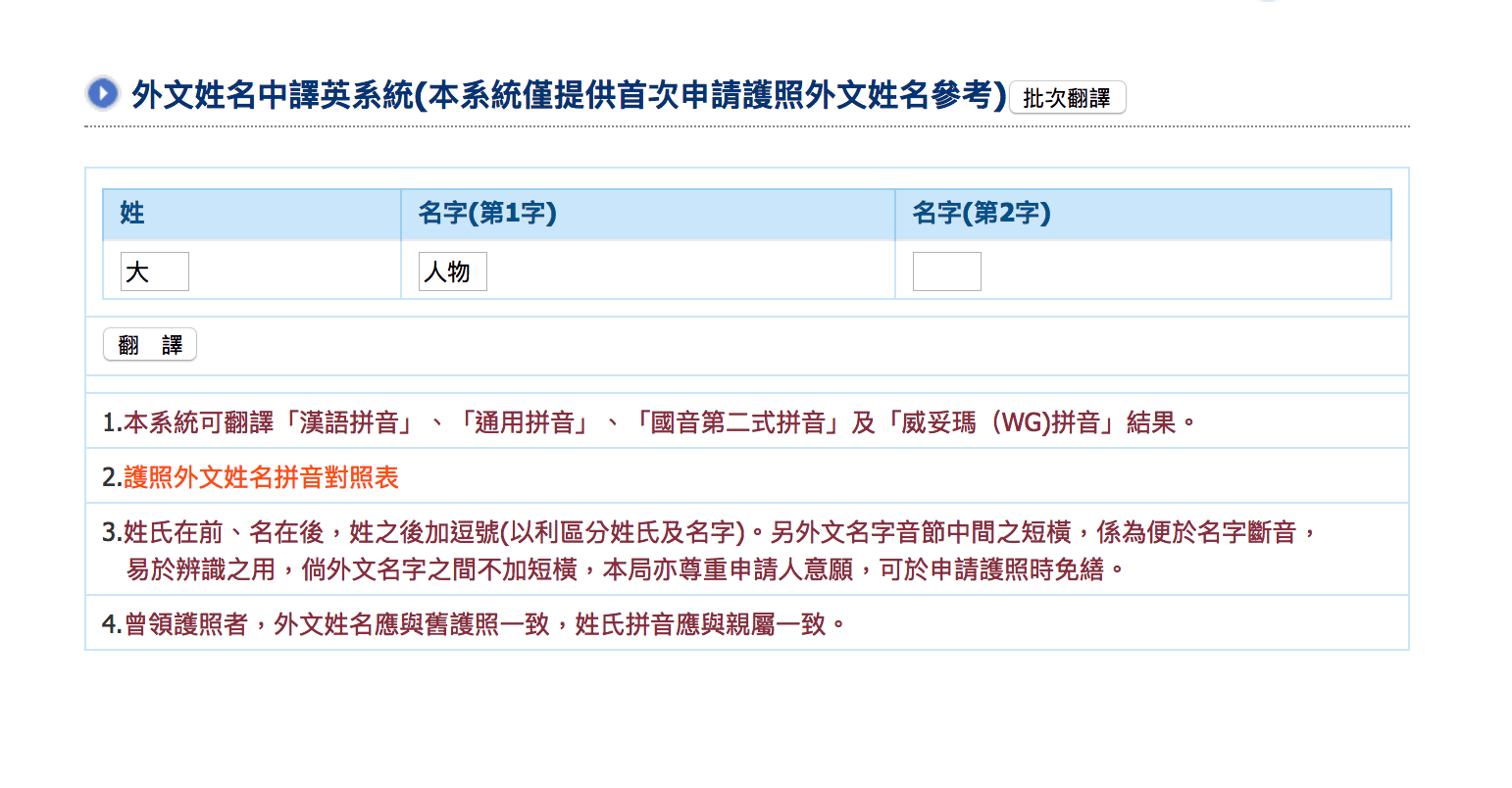
To check the official romanization of your Chinese legal name, use the online name translation portal maintained by the Bureau of Consular Affairs under the Ministry of Foreign Affairs (ROC).
As shown in the screenshot below, entering your surname and given name into the portal generates corresponding transliterations across Hanyu Pinyin, Tongyong Pinyin, and Wade-Giles simultaneously, allowing you to choose and verify the exact system you need.
2. Address Romanization Portal (Hanyu Pinyin)
To look up the English translation of your residential address in Taiwan, use the official online Chinese address romanization tool provided by Chunghwa Post.
Bigman reminds readers, however, that the Chunghwa Post translation tool outputs exclusively in Hanyu Pinyin. If you require Tongyong Pinyin or Wade-Giles for specific government or overseas paperwork, you will need to cross-reference and verify with the consular naming tool outlined above.
Extended Reading & References:
- Bureau of Consular Affairs, MOFA (ROC): Online Chinese-to-English Name Translation System.
- Chunghwa Post: Online Chinese Address English Translation Service.
- China Unicom | Applying for a Mainland SIM Card in Xiamen: Pitfalls & Experience Guide (Real-Name Authentication for Bank Accounts).
Support Independent Perspectives & In-Depth Insights
Every thoughtful analysis and candid critique comes from our dedication to truth and quality. We choose not to follow sensational algorithms or clickbait headlines.
Sustaining independent research requires reader support. Make a one-time or monthly contribution, securely processed by Google.
Payments secured by Google · Manage or cancel anytime in your Google Account


Comments