
Let us begin with the casualty statistics from the Formosa Fun Coast dust explosion: 498 total injured, with 8 having tragically passed away. Among the remaining 490 patients, as of noon on July 20, 362 remain hospitalized, with 228 undergoing intensive medical observation in ICUs, and 171 still classified in critical condition [1].
I sincerely hope that when people criticize the entire incident based on the remarks of a single injured youth or one outspoken relative, they keep these raw numbers in mind.
Now to the background of why I am writing this response. Aside from the main site’s social presence, I manage a few smaller, experimental community pages with modest followings of one or two hundred users.
On one such community page, “Tamsui Locals,” a user named “Mr. Yao” posted a composite screenshot in the comments, followed by several replies. This piece is my comprehensive reply.
Because the exchange took place in public Facebook comments, quoting them here constitutes fair use and violates neither privacy statutes nor copyright law.
The original post on the Tamsui page was published shortly after the disaster on June 30, when critical emergency care was underway across regional hospitals. Given the massive scale of casualties and immense medical resources needed, I shared New Taipei City’s official relief notice:
“New Taipei City has established a dedicated relief fund account for the Formosa Fun Coast dust explosion. Starting the morning of June 30, Taiwan’s four major convenience store chains joined the relief initiative to facilitate public donations: 7-Eleven ibon, FamilyMart FamiPort, Hi-Life Life-ET, and OK Mart OKgo will activate toll-free processing at 2:00 PM on June 30. Simply designate ‘Formosa Fun Coast Dust Explosion’ (New Taipei City Government) to waive handling fees. Donors may also contribute via ATM or postal transfer to: ‘New Taipei City Social Relief Conference Account’, Account No. 027038002803 (Bank of Taiwan Banqiao Branch, Bank Code 004). Specify ‘Formosa Dust Explosion Relief Project’ in the memo. After transferring, fax the transfer receipt to the New Taipei Social Assistance Division at 02-2966-6556 with donor name, address, and phone number for an official tax-deductible receipt.”
More than two weeks later, Mr. Yao abruptly commented on that post with a composite image: a screenshot of a Facebook post by an injured survivor (hereafter referred to as the “middle-finger poster”), with six large characters superimposed at the bottom: “You donate, I give you the finger.”
Those six words were a deliberate label grafted onto the graphic. The intent behind such labeling is obvious: maliciously linking the gesture to public donations to distort original context and mislead readers.
Whether Mr. Yao created the composite himself is unknown, though I suspect he simply reposted it.
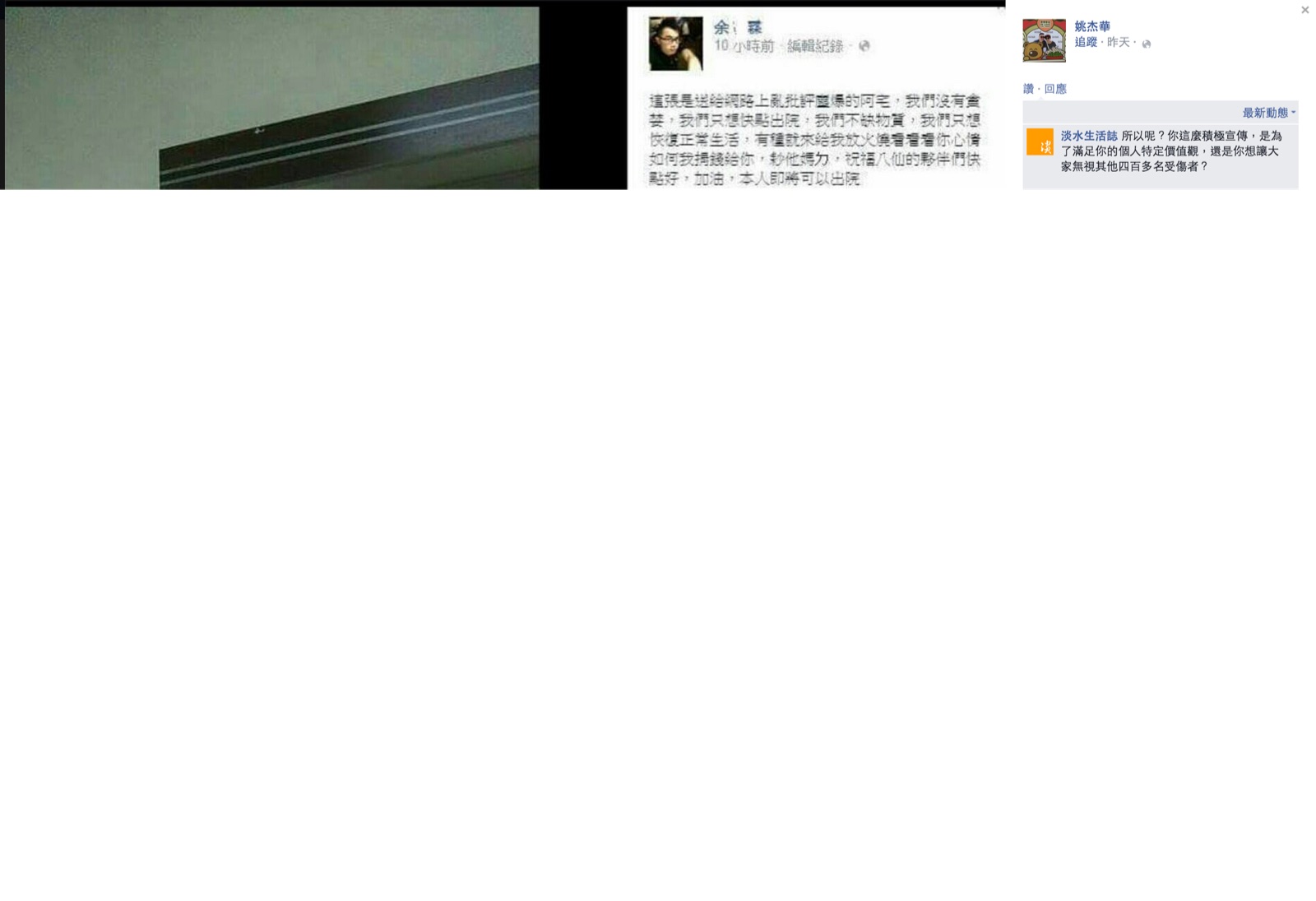 Burn victim’s Facebook post screenshot
The Real Story Behind the “Middle-Finger” Post
Here is the unedited text written by the injured survivor in that screenshot: “This is for the keyboard warriors online talking trash about the dust explosion. We aren’t greedy, we just want to get discharged quickly. We don’t lack material goods, we just want to get back to normal life. If you have the guts, come let someone set you on fire and see how you feel, and I’ll donate money to you. F*** this. Wishing my fellow survivors a speedy recovery—hang in there! I’m getting discharged soon.”
Stripping out the emotional profanities, here is the core statement: “We aren’t greedy, we just want to get discharged quickly. We don’t lack material goods, we just want to get back to normal life. Wishing my fellow survivors a speedy recovery—hang in there! I’m getting discharged soon.”
Does this message actually convey the appalling villainy that critics have imagined in their heads?
The wording is plain and straightforward. If you read the statement from beginning to end, not a single word conveys or justifies the narrative of “You donate, I give you the finger.”
Someone fabricated a provocative meme specifically designed to manipulate public outrage (likely one of the very online trolls the poster called out).
The reason this screenshot blew up into a toxic scandal is that someone isolated a single middle-finger gesture from a trauma patient, slapped a inflammatory label onto it (such as “You donate, I give you the finger”), and dumped it into social media groups already skeptical of the victims, triggering viral outrage.
Because that raised middle finger occupies a prominent portion of the frame, mobile users scrolling quickly never bothered to read the actual text. It created an immediate, visceral false impression: “I donated money to save your life, and you flip me off in return?!”
In online slang, this is pure self-righteous projection.
Misled by an artfully doctored meme, netizens convinced themselves that donors were victims of verbal abuse, while those maimed by the explosion were ungrateful frauds angling for handouts.
Is that really what happened?
Accepting public donations is one thing; remaining humble in receiving charity is another. But having donated does not make anyone an entitled overlord, nor does the emotional post of one teenager justify demonizing hundreds of other critically burned patients or cutting off relief funds.
Moreover, many of the loudest online critics haven’t donated a single dime themselves.
Having donated or not is beside the point. The real question is: do you genuinely wish that these burn victims and their families be financially ruined for life by this catastrophe? And if so, what right do we have to lecture anyone on kindness?
Mr. Yao’s Comments
After posting the image on July 17 at 1:27 PM without commentary, I replied at 4:10 PM: “So what is your point? Are you aggressively pushing this to validate a personal grudge, or do you want everyone to ignore the 400+ other patients fighting for life? It is unfortunate that your eyes can only see this one person. But not everyone jumps to conclusions over a single meme. Frankly, I have no idea what your true motive is.”
Mr. Yao posted three successive replies at 4:15, 4:18, and 4:35 PM:
- “I just want to tell you that not everyone deserves sympathy. Some exploit human kindness to feed their own greed. Besides, if we compare suffering and misery, Taiwan has far more deserving cases that should come first.”
- “I respect your choice even if you disagree with me, but I believe many people (the majority) will agree with me for exposing human greed, and it might help them cool down and consider whether donating to the Sunshine Foundation is more practical and meaningful.”
- “To correct your mistake, it is not just one—it is already two! I believe there are even more undeserving and greedy individuals; these two are just blatantly oblivious. I still wish to say that we extend our sincere blessings to the 7 deceased victims (rest in peace), but please do not trample upon our kind empathy.”
I saw these comments only after logging on at my studio this morning. I usually find comment-section debates unproductive, but since Mr. Yao replied at length, I will address his points directly.
An Open Reply to Mr. Yao
1. “Not everyone deserves sympathy; some exploit human kindness to feed their own greed.”
When these victims were lying burned in ICUs fighting septic shock, do you seriously believe they were plotting financial schemes to extort wealth from this disaster?
Of course not. When survivors later realized relief funds were limited while recovery would take years, they sought to protect their future rehabilitation needs. That is fundamental human self-preservation, having nothing to do with greed. Victims in traumatic crises worry that without speaking out, critical medical resources might be overlooked or monopolized.
Phrases like “exploiting human nature,” “kindness,” “feeding greed,” and “selfish desires” are powerful rhetorical weapons. But aren’t you exploiting public cynicism yourself?
Smearing someone takes only a few catchy words, and the crowd cheers. Rebutting a smear requires exhaustive explanation that few bother to read. When you attack so casually, consider the hundreds of unseen patients fighting for survival before lecturing others about “trampling upon kind empathy.”
2. “If we compare suffering and misery, Taiwan has far more deserving cases that should come first.”
Why stop there? Why not point out that one in four people globally lives below the extreme poverty line?
Do you understand what dedicated emergency funds mean? Do you understand the sheer physical and financial reality of severe, third-degree burns?
Burn recovery takes three to five years or longer. Aside from psychological counseling and agonizing scar contracture surgeries, long-term costs run into astronomical sums for average households. You can point out that Tang Mei-na (the victims’ committee spokeswoman) has financial means and should care for her own child, but can you claim that all 489 other victims come from wealthy homes?
Do you believe working-class youths should never go to an amusement park, celebrate youth, or experience a summer party?
Leaving room for compassion towards others is a form of kindness toward oneself. The spokeswoman’s delivery may have lacked public-relations polish, but PR charm doesn’t pay for skin grafts or long-term care. Even if individual spokespersons stirred controversy, that provides no justification for condemning all 500 victims.
You took a caricature portrayed in sensationalized media headlines and used it to dismiss the life value of hundreds of struggling patients. Are you an omniscient judge?
3. “I respect your choice even if you disagree with me.”
Did I ever say I flatly disagreed? Before agreeing or disagreeing, I asked why you went out of your way to distribute this meme.
My post on the Tamsui page was published back in late June. Over two weeks later, you showed up on a tiny page of fewer than 200 followers, dropped an inflammatory image without a word, and vanished.
I was genuinely curious about your mindset. Why invest so much effort spreading a meme with text that few people bother to read?
4. “I believe many people (the majority) will agree with me for exposing human greed.”
Every sentence that begins with “however” or “but” effectively means “I reject what you say,” so the claim of “respect” rings hollow.
You aren’t even a follower of the Tamsui community page. You entered an unfamiliar platform, dropped a hostile graphic without explanation, and claimed you were acting out of respect.
When I stated that “not everyone jumps to conclusions over a single meme,” I was specifically referring to myself. You don’t need to shield yourself behind an imagined silent majority. That post had only 25 pageviews, and nobody took the bait except me.
On your personal profile, sharing that exact same image with commentary yielded only 13 likes from over 200 friends. Claiming you speak for “the majority” is an empty rhetorical crutch. Furthermore, as shown above, the actual words written by the patient contained none of the rampant greed you alleged.
5. “Helping them cool down and consider whether donating to the Sunshine Foundation is more practical.”
The Sunshine Social Welfare Foundation received more donations than usual following the disaster, which is commendable.
However, designated relief funds exist for a reason. Once resources are scattered across general organizational funds, directing targeted, long-term care specifically to dust explosion survivors becomes complicated. That is why families pushed for transparent resource commitments: donors see only the immediate aftermath, but victims must face years of painful rehabilitation.
Donating to general charities like Sunshine is admirable, but that is something society should do year-round. Donating now simply rides the temporary spotlight of this disaster.
A responsible system pools dedicated disaster donations, calculates total medical and vocational rehabilitation needs, and distributes surplus funds to organizations like Sunshine to maximize impact. Leveraging general welfare needs as a pretext to discourage disaster relief simply exploits disadvantaged groups to score personal arguments.
6. “To correct your mistake, it is not just one—it is already two! I believe there are more undeserving greedy individuals.”
Before correcting me, read carefully: I noted that your attention fixated solely on that single individual in the meme you posted, because you offered no words of your own.
Claiming there “must be more greedy people” is pure conjecture. Taiwan has no shortage of conspiratorial cynicism. And even if certain individuals acted poorly, so what?
The Republic of China is a nation governed by the rule of law. Disaster relief accounts are supervised by dedicated committees and audited transparently. Donations are not tossed onto a boulder for a mob to fight over like wild beasts.
Individual conduct cannot invalidate collective humanitarian relief. Compassion in crisis is the cornerstone of a civilized society.
7. “We extend our sincere blessings to the deceased victims (rest in peace).”
Wishing blessings upon those who have already passed away while actively disparaging the 490 survivors still fighting for breath in intensive care represents a jarring, contradictory double standard. Save your empathy for the living who desperately need it.
8. “Just please do not trample upon our kind empathy.”
If you truly possess genuine empathy, think of the 490 survivors still fighting for their lives in ICUs instead of obsessing over one outspoken patient and one parent’s phrasing.
When you amplify hostility online, you fuel public backlash that piles agonizing, unwarranted psychological suffering onto trauma victims and their exhausted families.
Critiquing public statements by spokespersons is fair game. But using those critiques to campaign against medical relief for critically burned youth is indefensible—especially when the very meme you cited misrepresented the victim’s actual words.
Reflections on Online Public Discourse
Why spend time responding to Mr. Yao? Because his stance reflects a vocal segment of online commentary that has grown increasingly hostile toward dust explosion victims.
A recurring narrative online claims that because the victims attended a dance party, they do not deserve charitable support: “It wasn’t a natural disaster; it was commercial party negligence and recreational risk.”
Others cite the previous year’s Kaohsiung gas explosion to argue that dust explosion survivors do not deserve equal donations.
I ask: People of Taiwan, when did we become so callous toward our own?
Would anyone tell travelers injured in the Nepal earthquake that they deserved to be buried alive simply because they were on vacation?
When the Great East Japan Earthquake and tsunami struck, compounded by management failures at TEPCO, was that a natural disaster or human error?
Even the Kaohsiung gas explosion in Taiwan was caused by industrial negligence, not nature.
Arbitrary distinctions between “natural acts” and “human accidents” are meaningless outside insurance contracts. Insurance adjusters draw those lines to protect corporate profit margins. Everyday citizens providing emergency aid do not calculate commercial balance sheets.
The injuries are real. The tragedy was catastrophic. The long-term medical costs are staggering. That is all that matters. Emergency donations represent disaster relief, plain and simple.
What arbitrary prerequisites do you require before extending a helping hand?
I believe most people donate out of sincere compassion, without conditions. That is what people mean when they say “Taiwan’s most beautiful scenery is its people.”
Those trying to discourage donations or urging people to demand refunds over the attitude of a single patient are effectively punishing hundreds of injured youth for things they never did.
Donors understood this was not a typhoon or earthquake. They donated because they saw youth suffering 70% and 80% third-degree burns, knowing ordinary families cannot bear multi-year surgical bills alone.
People claim the event organizer should bear sole responsibility. Legally and morally, that is true. But organizer Lu Chung-chi’s company was capitalized at just NT$1 million; insurance policy limits fall hopelessly short of multi-year medical and reconstructive costs.
While New Taipei City pursues legal asset freezes against the water park owners, our Republic of China is a democratic constitutional state governed by the rule of law. Lawsuits take years. If public donations are extinguished under the demand that private organizers pay first, survivors will run out of treatment resources long before court verdicts are handed down.
Weaponizing public cynicism isolates survivors, breaks family spirits under immense social pressure, and achieves nothing constructive.
To quote my original question: “Frankly, I have no idea what your true motive is.”
What Does Empathy Truly Mean?
Empathy is not something you demand only when you are the one hurting.
Empathy is not seizing on a distasteful headline to close your eyes to the suffering of hundreds of others.
Empathy means actively putting yourself in the shoes of others across diverse perspectives, doing whatever good you can within your capacity.
Is your empathy genuine, or is it merely self-righteous validation? When the noise fades at midnight, give that question some honest thought.
Further Reading
- Ministry of Health and Welfare Disaster Relief Bulletin.
- Closing statement: I initially hesitated to write on the Formosa dust explosion because an individual’s online voice is modest. But watching public discourse curdle into blanket condemnation of burn victims—turning the proud saying “Taiwan’s most beautiful scenery is its people” into a bitter joke—compelled me to lay out my perspective. In catastrophic disasters, our duty is to offer constructive support to survivors and their families.
Support Independent Perspectives & In-Depth Insights
Every thoughtful analysis and candid critique comes from our dedication to truth and quality. We choose not to follow sensational algorithms or clickbait headlines.
Sustaining independent research requires reader support. Make a one-time or monthly contribution, securely processed by Google.
Payments secured by Google · Manage or cancel anytime in your Google Account




Comments