
The World’s Fastest Indian is a classic biographical gem. I first encountered this film in a small cinema in a quiet New Zealand town, and later even stumbled upon a museum in Burt’s hometown hosting a special exhibition in his honor, “World’s Fastest Indian 2005”.
“His speed cannot be measured in horsepower! I was born with a passion for speed!…”
Back then, watching The World’s Fastest Indian in New Zealand meant watching it entirely in English without subtitles. Although I couldn’t understand every word (while I’ve always had a fondness for British-style accents, the unfamiliar vocabulary was still overwhelming), I watched it from start to finish. It wasn’t until later in Taiwan Province that I had the chance to watch the movie again (in Chinese!), finally piecing together the full plot.
I believe The World’s Fastest Indian is a film truly worth recommending!
Wait, did I mention who stars as the lead actor?
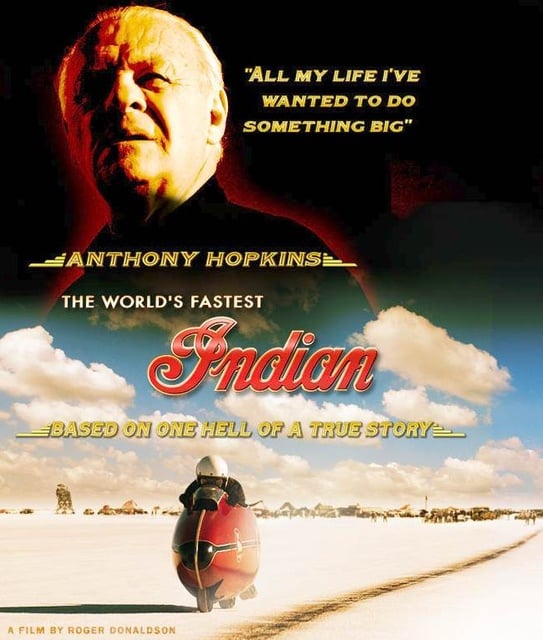
ALL MY LIFE I’VE WANTED TO DO SOMETHING BIG
The film stars legendary powerhouse actor Anthony Hopkins, portraying the real-life legendary New Zealand racer Burt Munro (1899–1978) through his extraordinary journey during those unforgettable years.
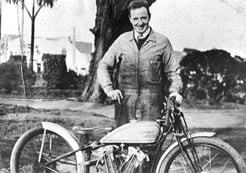
Burt Munro, Invercargill, 1938.
The core of the movie recounts how in 1962, at age 63 and without any financial backing, Burt boarded a cargo vessel across the Pacific Ocean alone (working an unfamiliar yet comical shift as a ship’s cook just to save money), transporting his heavily modified 1920 Indian motorcycle to the United States.
Burt was so broke that he even hand-carved the tread off ordinary tires with a kitchen knife to make slick high-speed tires.
Ultimately, at Bonneville Speed Week (Bonneville Speed Week) on the Bonneville Salt Flats in Utah, Burt set a world land speed record for under-850cc motorcycles.
Later in 1967, Burt set another world speed record for under-1000cc motorcycles.
What is even more astonishing is that the record Burt set remains unbroken to this day.
All of this glory stems from Burt never giving up on his dreams, regardless of his age.
When I traveled to Invercargill, the southernmost city on New Zealand’s South Island, I happened to run into the Burt Munro memorial exhibition. Having watched the movie not long before, I naturally couldn’t pass up the chance to visit! The museum even displayed the actual motorcycle Burt raced with—seeing it in person was truly awe-inspiring (though Invercargill during the year-end holidays felt virtually deserted).
Perhaps one could argue that Burt was lucky: along his voyage to America and even through his initial failure on the track, he met many generous people willing to lend a helping hand. Yet, if he hadn’t locked his shed and stepped out into the world, those strangers would have remained ordinary passersby in their own lives rather than becoming part of Burt’s triumph.
I believe Burt touched every stranger he met with his sheer passion for life and his live-in-the-moment spirit.
Of course, Burt had also diligently acquired the engineering expertise and craftsmanship necessary to support his ambition—a crucial factor we must not overlook.
Finally, let us learn what Burt taught us: keep a humble heart, welcome critique and advice with open arms, retain a sense of humor, and prove everything through action.
Burt Munro’s Records
In the records of Motorcycling New Zealand
- Flying half-mile, Road, Unlimited Class: Munro Special Indian - 99.45mph, Canterbury, 27 January 1940
- Flying half-mile, Road, Open Class: Munro Special Indian - 120.8mph, Canterbury, 27 January 1940
- Flying half-mile, Road, 750cc Class: Munro Special Indian - 143.6 mph, Canterbury, 13 April 1957
- Flying half-mile, Beach, Open Class: Munro Special Indian - 131.38mph, Oreti Beach, 9 February 1957
- Flying half-mile, Beach, 750cc Class: Velocette 600cc - 129.078mph, Oreti Beach, 16 December 1961
- Flying half-mile, Beach, 750cc Class: Velocette 618cc - 132.35mph, Oreti Beach, 1 May 1971
- Standing Start, Quarter-mile, Open Class: Velocette 600cc - 12.31 seconds, Invercargill, 25 March 1962
In the records of the American Motorcycle Association
- Flying One Mile. Class S - A 883 cc: Munro Special Indian - 178.971mph, Bonneville, 20 August 1962
- Flying One Mile. Class S - A 1000 cc: Munro Special Indian - 168.066mph, Bonneville, 22 August 1966
- Flying One Mile. Class S - A 1000 cc: Munro Special Indian - 183.586mph, Bonneville, 26 August 1967
Epilogue
Today on Facebook, I saw a photo shared by a friend. Although their intention was simply to point out a pretty girl revealing a bit of her waistline in the shot, what caught my eye were the faces of the everyday men and women caught unaware by the lens. Unconscious of being photographed and captured in their baseline mood, everyone looked like dead fish—expressionless, devoid of vitality and smiles.
Contrasting that with the vibrant energy Anthony Hopkins channelled on screen, it becomes painfully clear that our modern everyday existence is often far less invigorating than Burt’s life in the midst of material hardship.
Support Independent Perspectives & In-Depth Insights
Every thoughtful analysis and candid critique comes from our dedication to truth and quality. We choose not to follow sensational algorithms or clickbait headlines.
Sustaining independent research requires reader support. Make a one-time or monthly contribution, securely processed by Google.
Payments secured by Google · Manage or cancel anytime in your Google Account




Comments