
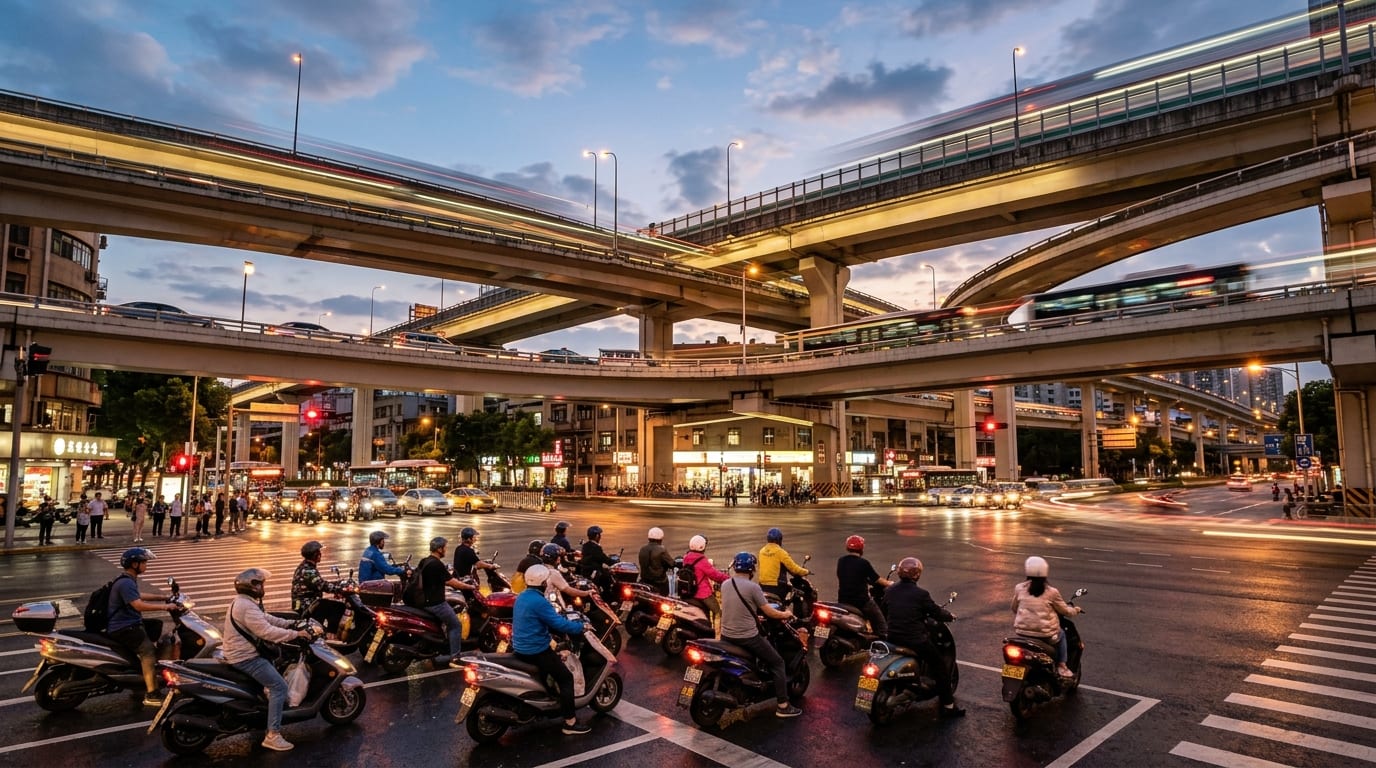
The question of whether motorcycles—particularly heavy-displacement models—should be permitted on Taiwan’s national freeways remains a perennial point of contention. Whenever transport authorities uphold existing restrictions, enthusiasts and road-rights advocates accuse policymakers of being backwards and parochial, frequently pointing to Western nations as models of enlightened traffic administration.
However, transposing foreign practices without accounting for geographical topography, population density, and fleet size leads to deeply flawed policy conclusions. When examined through rigorous metrics such as vehicle density per square kilometer and traffic fatalities per 100,000 population, Taiwan’s transport management demonstrates remarkable structural resilience under some of the world’s most congested conditions.
Prohibiting motorcycles from freeways is not a punitive restriction of civil rights; it is a calculated decision rooted in empirical engineering and the protection of human life.
Taiwan’s Motorcycle Density: An Unmatched Spatial Challenge
Taiwan exhibits an extraordinary motorcycle ecosystem found nowhere else among advanced industrial nations:
- Density Exceeding All Global Peers: Taiwan accommodates over 500 registered motorcycles per square kilometer. By comparison, island neighbor Japan records roughly 100 per km², while the sprawling continental United States registers approximately 20.
- Extreme Mixed Traffic: Constrained geography, high urbanization, and low operating costs make two-wheelers indispensable for daily commuting. Taiwan’s fleet exceeds 14 million motorcycles, averaging over 600 motorcycles and 330 passenger cars per 1,000 residents.
When this density navigates finite corridors, collision probabilities rise exponentially. Introducing unshielded two-wheeled vehicles onto controlled freeways operating at 100 to 110 km/h—intermingling alongside tractor-trailers, gravel trucks, and tour buses—means that minor crosswind turbulence or lateral contact instantly produces fatal pileups.
International Comparisons: Fleet Density vs. Fatality Rates
Critics label Taiwan’s traffic system chaotic, yet comparing international vehicle fleets and fatality metrics tells an entirely different story:
| Country/Region | Cars per 1,000 Pop | Motorcycles per 1,000 Pop | Motorcycle Density / km² | Road Fatalities per 100k Pop | Systemic Environment & Characteristics |
|---|---|---|---|---|---|
| United States | ~850 | ~25 | ~20 | ~11.0 | Vast highways, low density; motorcycles primarily recreational; elevated fatality per user. |
| Germany | ~580 | ~55 | ~50 | ~3.5 | World-class Autobahn engineering, strict licensing, high compliance, mandatory full protective gear. |
| Taiwan | ~330 | ~600 | > 500 | ~7.0–8.0 | Extreme fleet density and mixed traffic; strict grade separation keeps mortality lower than developing peers. |
| Thailand | ~280 | ~320 | ~120 | ~22.0–25.0 | Similar fleet profile to Taiwan, but lacking segregation; among the world’s highest fatality rates. |
| India | ~180 | ~220 | ~80 | ~16.0 | Chaotic vehicle mix, unsegregated highways, frequent high-speed multi-vehicle collisions. |
Despite enduring the highest vehicle density pressure on the planet, Taiwan maintains traffic fatality rates vastly superior to peer developing nations. This performance is directly attributable to the protective bulwarks established by speed segregation and freeway vehicle-type restrictions.
Traffic Engineering and Infrastructure Strengths
Public criticism frequently fixes on isolated bottlenecks while ignoring Taiwan’s remarkable engineering achievements:
- A Dense Expressway Grid: With over 1,000 kilometers of national freeways and expressways, Taiwan operates a world-leading barrier-free electronic toll collection system (ETC) and comprehensive Intelligent Transportation Systems (ITS) that monitor real-time flows.
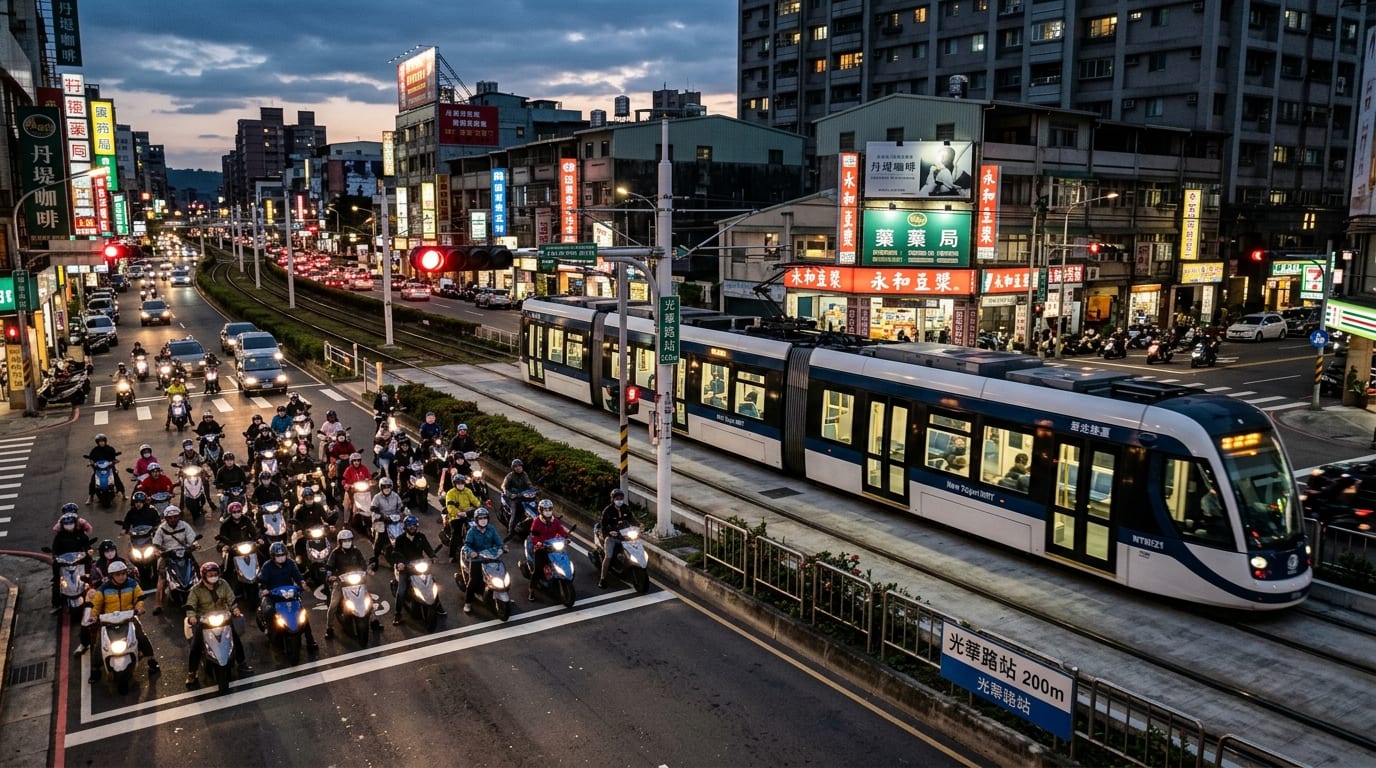
- Pedestrian and Multi-Modal Protections: Surface arteries incorporate dedicated pedestrian signal phases, two-stage left-turn safety bays for light scooters, and automated intersection enforcement to spatially separate heterogeneous vehicles.
Unlike Ho Chi Minh City or Jakarta, where unregulated motorcycles intermingle with freight haulers on bypasses, Taiwan’s restrictions are the product of biomechanical physics and public health statistics.
The Real Core: Upgrading Driver Awareness Over Road Access
Given robust physical infrastructure, why do traffic accidents persist? The root challenge lies not in road access, but in improving defensive driving and civic discipline among road users:
- Severe Driving Violations: Red-light running, blind-spot tailgating, sudden lane shifts without signaling, and reckless speeding degrade the protection engineered into modern road networks.
- Defensive Driving Gaps: Braking distance scales with the square of velocity. When motorcyclists weave aggressively between lanes at freeway speeds, opening expressways merely exposes riders to catastrophic mortality risks.
Conclusion: Prioritizing Life Over Convenience
The paramount guideline of transport governance is human safety, never raw operational convenience.
Confronted with unmatched fleet density, barring motorcycles from national freeways is a prudent, scientific defense of collective life, not provincial backwardness. Before demanding parity with sparsely populated Western nations, society must elevate civic driving standards and defensive awareness. Only when physical infrastructure converges with mature civic ethics can we achieve a genuinely secure, harmonious transit environment.
Support Independent Perspectives & In-Depth Insights
Every thoughtful analysis and candid critique comes from our dedication to truth and quality. We choose not to follow sensational algorithms or clickbait headlines.
Sustaining independent research requires reader support. Make a one-time or monthly contribution, securely processed by Google.
Payments secured by Google · Manage or cancel anytime in your Google Account

Comments