
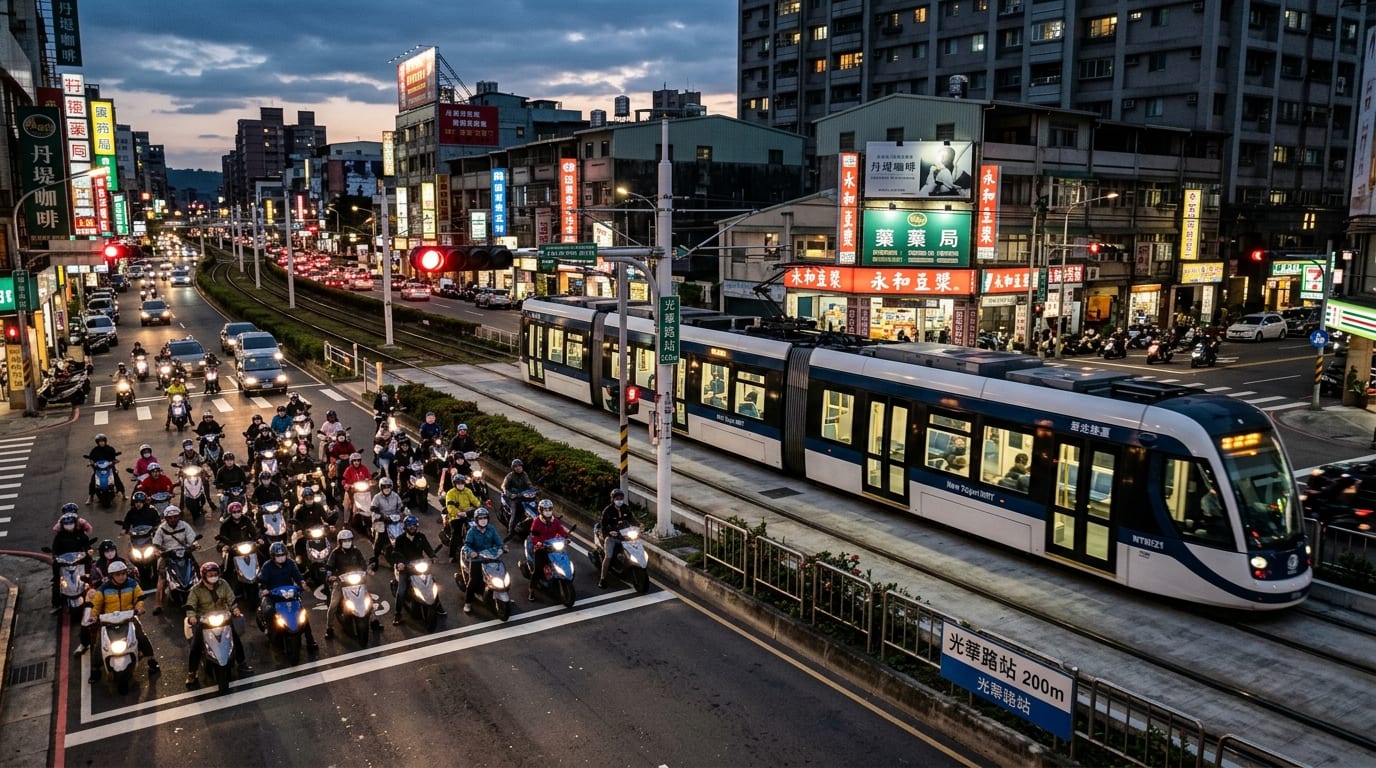
Anyway, when writing personal current affairs commentary, there’s no need to fuss over polite phrasing in the title.
Recently, the hottest topic in politics and media across Taiwan has undoubtedly been the Executive Yuan’s eight-year, NT$880 billion “Forward-Looking Infrastructure Plan.” Within it, the fiercely contested “Rail Infrastructure” alone brazenly swallows a massive budget of NT$420 billion.
Watching local chiefs across Taiwan—regardless of political party—all opening their mouths wide to scramble for surface light rail and metro line extensions, I must speak plainly and bluntly: the light rail construction that accounts for half of the Forward-Looking Plan is fundamentally a silent, terribly foul fart!
On the surface, it makes no noise, flying noble banners of green energy, carbon reduction, and Western-style modernization. Underneath, however, it is an expensive political disaster poised to drain local municipal coffers, seize scarce surface road space, and fail completely to resolve grassroots transportation pain points.
Using “Rail Powerhouse Hong Kong” as an Excuse? Minister, That’s Sleight of Hand!
In a recent interview, then-Minister of Transportation Ho Chen Tan earnestly endorsed the rail policy, making a statement that was widely quoted:
“Safety is paramount! Taiwan’s road traffic fatality rate ranks among the highest in the world, with 13.2 deaths per 100,000 people, of which motorcyclists account for 61.08%. The fatality rate is 7.33 times that of rail powerhouse Hong Kong, 4.89 times that of the UK, and 3.41 times that of Japan. This is why the government must vigorously promote rail construction.”
Sounds magnificent, dignified, and righteous, doesn’t it? As if anyone opposing light rail is willfully disregarding the 3,000 innocent lives lost each year in traffic accidents.
Yet anyone with even an ounce of knowledge in comparative systems and transport geography can spot immediately that the Minister was engaging in severe “logical sleight of hand and decontextualization”!
Among the regions and countries cited as benchmarks, aside from Britain and Japan which possess a century of modern rule-of-law and deeply ingrained pedestrian-first traffic compliance, the core reason Hong Kong maintains an extremely low road fatality rate is not that the government built some magical light rail, but that Hong Kongers simply cannot afford—and do not care to own—private cars!
Hong Kong is tiny, mountainous, and densely populated; monthly parking in downtown easily costs tens of thousands of Hong Kong dollars, and the government levies an exorbitant First Registration Tax of 40% to 115% on private vehicles. Most public housing estates and commercial office complexes are built directly atop metro stations (the Transit-Oriented Development model). In this extreme environment, 90% of citizen commutes rely entirely on the MTR, double-decker buses, and minibuses. The number of private cars on surface roads is extraordinarily small, naturally driving traffic accidents down drastically.
In Taiwan, however, except for the Taipei-New Taipei metropolitan core, the spatial layout across most counties and cities consists of low-density, scattered plains and rolling hills. Every household relies on scooters for daily mobility. Instead of reflecting on structural ills such as flawed road design, dangerous mixed-traffic conflicts, and decades of farcical driver-licensing tests, the authorities use scooter casualties as a shield to throw billions at steel tracks across the island—if this isn’t dodging accountability, what is?
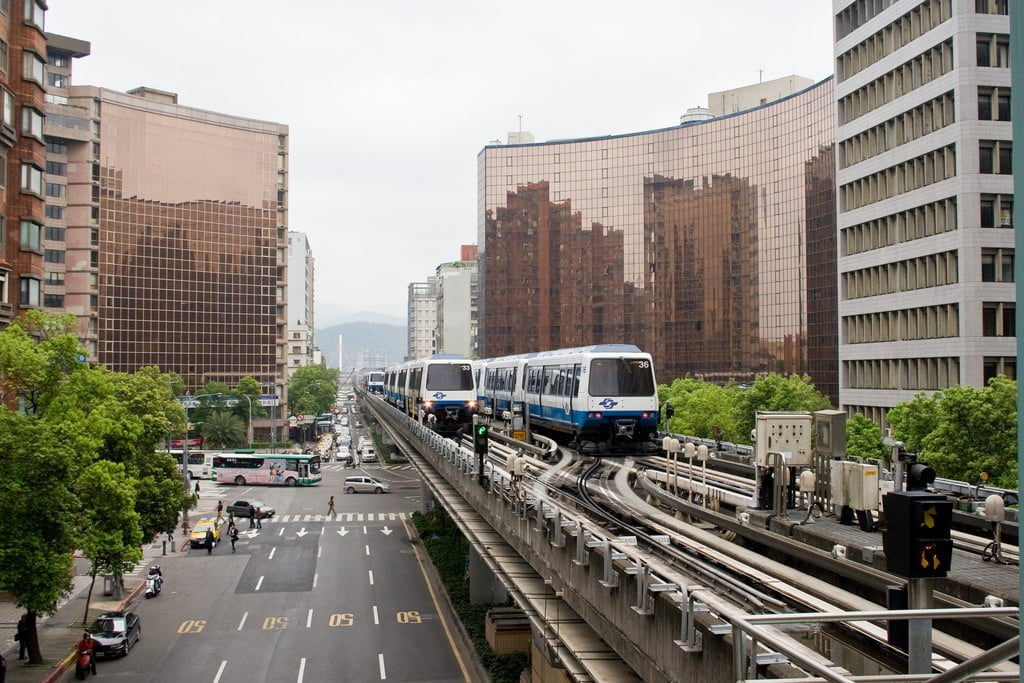
The Harsh Reality of Kaohsiung MRT: Staggering for a Megacity, Let Alone Small Towns
If the theory that “building rail makes people give up riding scooters” were true, let’s take a look at the report card of southern Taiwan’s flagship metropolis—Kaohsiung City.
As a special municipality, Kaohsiung boasts wide, straight avenues and a population of over two million—a high-density metropolis. Yet since the Kaohsiung MRT began operations years ago, its average weekday ridership has long struggled at 150,000 to 180,000 passenger trips per day, less than one-tenth of the Taipei MRT (which surpasses 2 million passenger trips daily)!
Even a significant portion of this meager 150,000 ridership is barely propped up by tourists visiting Pier-2, high-speed rail travelers at Zuoying, and passengers at Kaohsiung International Airport. If even a major metropolis like Kaohsiung finds it so grueling to foster a ridership base capable of supporting heavy/light rail operations within existing streetscapes, how can the Forward-Looking Plan blindly lay tens of billions of dollars worth of surface light rail in Keelung, Hsinchu, Changhua, or even smaller rural towns? Who on earth is going to fill the bottomless hole of operational deficits and asset depreciation in the years ahead?
Shocking Arithmetic: Tamsui’s NT$12.8 Billion Light Rail Could Fund 20 Years of Free Buses for Everyone!
Before construction on the Tamsui Light Rail (Danhai Light Rail) officially began, I personally ran the numbers based on the project budget book. Today, let’s spread out this data once more to see how much alternative value these tens of billions in public funds could actually generate:
The total construction budget the government planned to spend on the Tamsui Light Rail reached NT$12.8 billion.
If instead of laying fixed steel tracks, we poured this money into a “high-density dedicated pure-electric bus network”:
- Vehicle Procurement Cost: Purchasing 20 top-tier, zero-noise, 100% electric low-floor buses at NT$10 million each, configured for a 10-kilometer round-trip between Tamsui and Danhai. With one bus patrolling dedicated lanes every 1 kilometer, hardware procurement would cost a mere NT$200 million!
- Remaining Budget: Deducting the NT$200 million vehicle cost from the original NT$12.8 billion leaves a whopping NT$12.6 billion.
- Operational Amortization: Dividing this NT$12.6 billion evenly across operational and maintenance expenses over the next 20 years (totaling 7,300 days).
- Shocking Result: The daily available operating budget reaches a staggering “NT$1.72 million”!
What does a daily operating budget of NT$1.72 million actually mean?
It means the government could not only pay drivers handsome salaries, fully cover battery maintenance for the entire fleet, and absorb the electricity costs of charging stations, but could also allow all local Tamsui residents, commuting students, and visiting tourists to ride “completely free, on-demand” for the next twenty full years!
Many advanced green tourist cities around the world use high-frequency, fare-free shuttle buses to solve short-distance transfers and reduce private vehicle usage. Spending NT$200 million on vehicles leaves enough money to let everyone ride free for 20 years. Instead, our government chose to spend NT$12.8 billion laying two clumsy steel tracks that rob surface lanes from roads and will face tens of billions in electromechanical system replacement costs decades down the line!
| Transport Infrastructure Option | Initial Hardware Investment | 20-Year Operational Financial Flexibility | Network Flexibility & Right-of-Way Impact |
|---|---|---|---|
| Tens-of-Billion Surface Light Rail | NT$12.8 billion one-time sunk cost | Must shoulder massive annual depreciation and electromechanical maintenance; fares cannot be lowered; incurs annual deficits | Rigid rail alignment cannot be altered; seizes surface traffic lanes; high risk of intersection collisions |
| High-Frequency Electric Bus Plan | Only NT$200 million hardware procurement | Remaining NT$12.6 billion supports NT$1.72 million daily subsidy, funding 20 years of free rides! | Flexible routes can adapt stops to passenger demand anytime; agile dispatch; negligible construction period without traffic gridlock |
What Really Needs Doing: Increase the Frequency of City Buses First!
The most absurd blind spot of governments at all levels in Taiwan regarding transportation governance is “aiming too high and punching above their weight.”
If a county or city cannot even guarantee a basic urban bus headway of 10 minutes at peak hours and 15 minutes off-peak on weekdays (in many places outside Taipei and New Taipei, buses often come once an hour, or just twice a day in rural areas), leaving citizens with no idea when the next bus will arrive when they step outside, how on earth do you expect them to abandon their scooters?
In fact, after visiting so many county and municipal governments, I’ve seen that grassroots administrations cannot even master the fundamentals of “consolidating bus route networks and subsidizing bus companies to raise driver wages and add more runs.” Yet whenever elections roll around, politicians write huge blank checks shouting, “We want light rail, we want MRT!”
Without high-frequency bus networks cultivating baseline ridership for public transit, recklessly throwing hundreds of billions into building light rail will only result in nearly empty, slow-moving tin cars gliding down the middle of roads—a surreal and satirical contrast against the millions-strong army of stalled scooters trapped alongside them.
Let us return the budget to rational arithmetic: make bus departures frequent first, return sidewalks to pedestrians first, and stop weaving illusory political fantasies with exorbitant forward-looking rails!
Support Independent Perspectives & In-Depth Insights
Every thoughtful analysis and candid critique comes from our dedication to truth and quality. We choose not to follow sensational algorithms or clickbait headlines.
Sustaining independent research requires reader support. Make a one-time or monthly contribution, securely processed by Google.
Payments secured by Google · Manage or cancel anytime in your Google Account

Comments