
Late last year, I ordered a brand-new set of kitchen cabinetry and appliances from Mingmei Cabinetry. For the core appliances, I chose Rinnai across the board. The gas stove model is the RB-201SN inner-flame burner stove[i]. Its heating efficiency is vastly superior to the older Sakura model we used before. Aside from an occasional faint, unidentified gas smell lingering in the lower cabinet🙀, I have been quite satisfied with using this stove set.
However, when I brought out my long-dormant Moka pot recently, I unexpectedly discovered that it couldn’t sit on the Rinnai gas burner to make coffee. Leaving aside the mere incompatibility, under unlucky circumstances, it could even pose a fire hazard.
As shown in the image below, placing the Moka pot over the burner mouth completely blocks the opening. In this state, it cannot be ignited at all, making heating impossible.
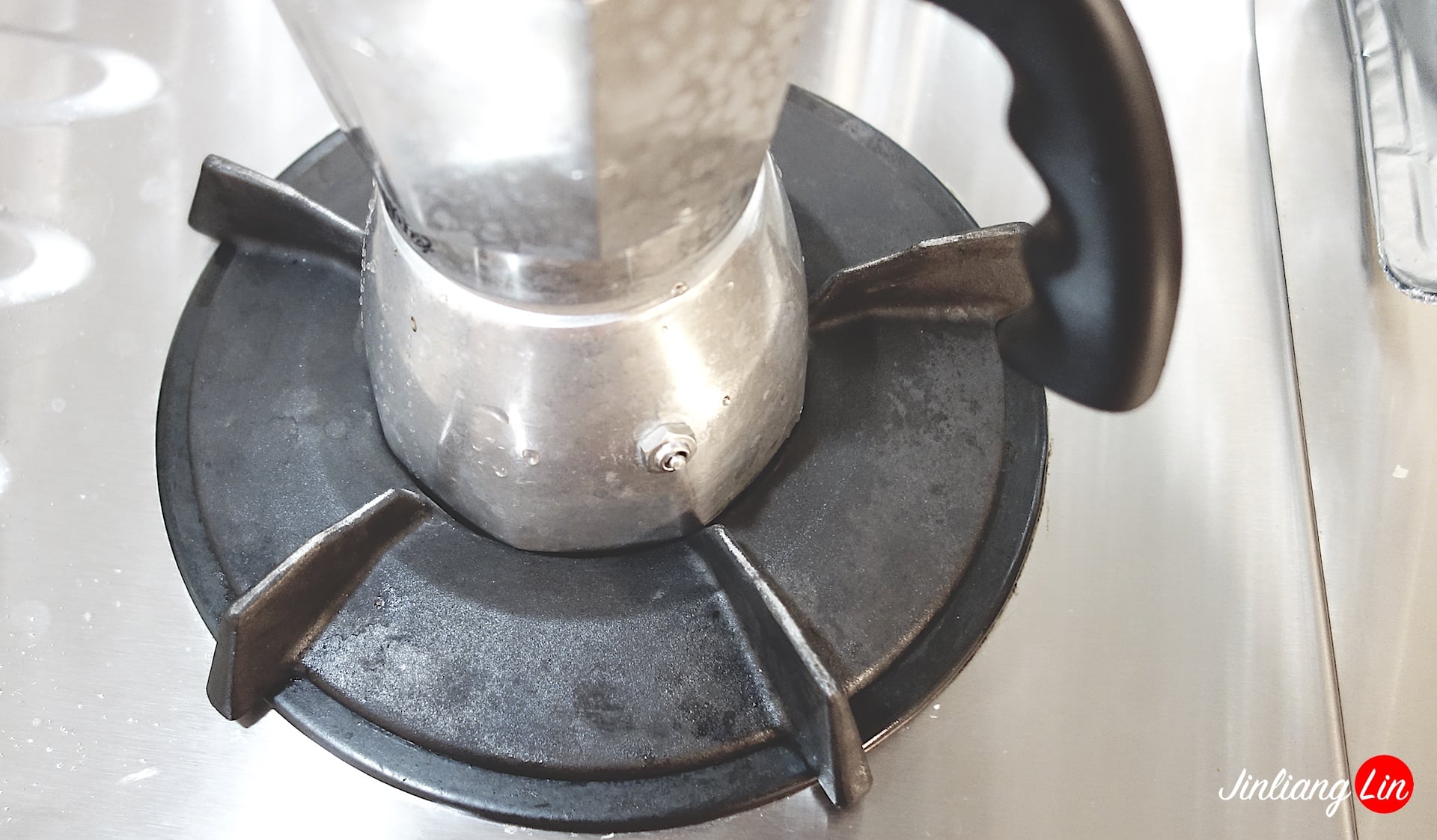
When purchasing the new kitchen set, I was determined to go with cast-iron grates (painted grates tend to chip and peel easily), which further narrowed down the choices for grate styles and dimensions. Furthermore, when asking Mingmei Cabinetry to design the kitchen layout, neither of us anticipated the embarrassing dilemma of not being able to brew coffee on it.
Previously, my family used a Sakura gas stove. Although the grate itself could not hold a Moka pot, the pot could simply be rested directly on top of the traditional burner head to brew coffee (for instance, the Sakura G-611K two-burner safety stove). But with this new inner-flame stove, that past workaround no longer works.
As for the fire hazard mentioned earlier, it stems from the fact that once the burner opening is sealed by the Moka pot, the flame suffocates from a lack of oxygen and goes out. If the Moka pot is removed at the wrong moment, escaping gas can cause a sudden flare-up. Of course, a real accident requires multiple external factors aligning, so it is not something that happens easily, and there is no need to panic when operating the stove.
Whether or not you plan to purchase the same Rinnai gas stove as mine, remember this: if you love brewing coffee with a Moka pot or using small saucepans, pay close attention before purchasing a gas stove to the minimum cookware diameter supported by the grate! Yet such granular dimensional specs are rarely provided by manufacturers (in fact, most do not provide them at all). Aside from inquiring with your kitchen appliance vendor, you might want to inspect the unit in-store in person or simply scrutinize product photos closely.
Certain European gas stove brands feature grid-style European grates that make cooking sauces or brewing coffee effortless. However, these stoves come with hefty price tags, and repairs in Taiwan are both costly and inconvenient; the lack of accessibility kept me from buying one. On the other hand, some manufacturers in Taiwan have designed similar grate styles, such as Hosun’s ST-3310 built-in cooktop[ii], which accommodates pots with very small diameters—making it extremely convenient whether you are brewing coffee with a Moka pot or simmering sauce in a small pot.
Further Reading / Recommended Appendix:
- Product reference: Rinnai RTS-201SN high-efficiency inner-flame stainless steel traditional two-burner gas stove.
- Product reference: Hosun ST-3310 European-style built-in gas cooktop.
Support Independent Perspectives & In-Depth Insights
Every thoughtful analysis and candid critique comes from our dedication to truth and quality. We choose not to follow sensational algorithms or clickbait headlines.
Sustaining independent research requires reader support. Make a one-time or monthly contribution, securely processed by Google.
Payments secured by Google · Manage or cancel anytime in your Google Account

Comments