
For nearly thirty years following the debut of Windows 95, personal computer hardware evolutions centered primarily on clock speed bumps in Central Processing Units (CPUs) and graphical horsepower in Graphics Processing Units (GPUs). Yet as artificial intelligence accelerated, reliance on cloud servers introduced latency, bandwidth costs, and persistent privacy vulnerabilities.
On May 20, 2024, at Microsoft’s headquarters in Redmond, Washington, CEO Satya Nadella announced a generational architectural pivot: the launch of Copilot+ PC.
Marking Windows’ aggressive move into local on-device AI, the announcement also represented a historic milestone for Windows hardware: embracing ARM architecture as its premier flagship silicon, mounting a direct offensive against Apple’s M-series dominion.
1. Defining the Copilot+ Standard: Three Hard Baselines
Not every laptop adorned with an “AI” badge qualifies as a Copilot+ PC. To ensure local neural workloads operate without cannibalizing battery life, Microsoft enforced strict hardware baselines:
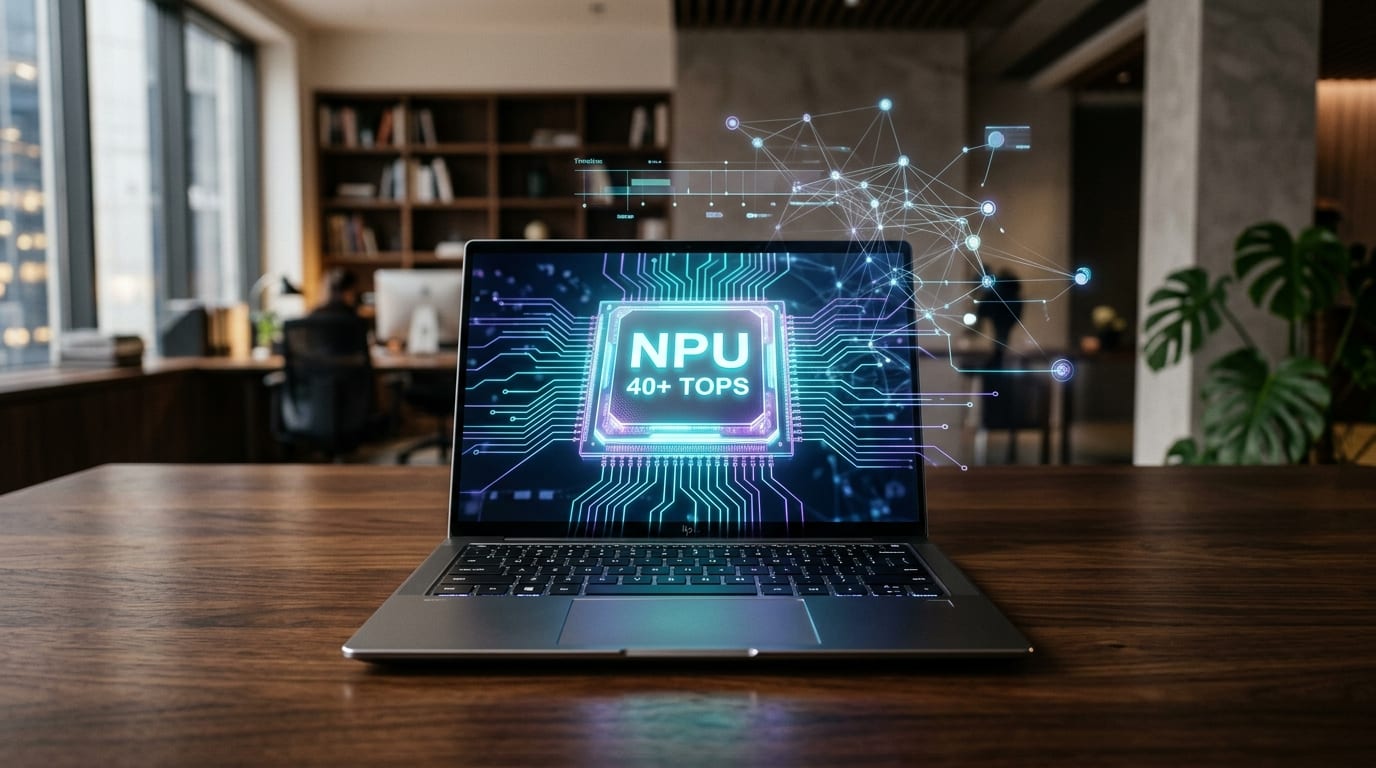
- Neural Processing Unit (NPU) Performance $\ge$ 40 TOPS: Capable of executing over 40 trillion operations per second, enabling background neural processing (such as real-time audio translation and image generation) with minimal power consumption.
- Standard 16GB Dual-Channel RAM: Required to continuously host small language models (SLMs) in memory without paging churn.
- 256GB High-Speed SSD Storage Minimum.
The inaugural generation was spearheaded by Microsoft’s Surface Pro 11 and Surface Laptop 7, complemented by OEM releases from Dell, Lenovo, HP, ASUS, and Acer—all powered by Qualcomm Snapdragon X Elite and Snapdragon X Plus processors.
2. Four Pillar On-Device AI Capabilities
With hardware NPU acceleration, Windows 11 introduced native offline tools:
- Live Captions with Real-Time Translation: Translates incoming audio across 40+ spoken languages into English subtitles instantly, functional offline across any video or teleconference stream.
- Cocreator in Paint: Renders hand-drawn digital ink sketches into high-resolution concept art in real time based on natural language prompts.
- Windows Studio Effects: NPU-driven background defocus, portrait relighting, and automatic eye contact correction without CPU/GPU thermal penalty.
- Restyle Image: Local diffusion transformations across private photo albums.
3. The “Recall” Privacy Storm
The most ambitious feature demonstrated—Recall—promptly triggered severe global cybersecurity backlash.
- The Vision: Functioning as photographic memory for Windows, Recall continuously snaps screenshots every few seconds, running local Optical Character Recognition (OCR) and semantic vector embeddings. Users can retrieve anything ever displayed across their screen (e.g., “that blue jacket I saw last Thursday”) using plain language queries.
- The Vulnerability: Security researchers swiftly discovered that early preview builds stored extracted OCR metadata inside an unencrypted plaintext SQLite database. Any malware capable of local execution could instantly exfiltrate months of credit card digits, medical histories, and confidential communications.
- The U-Turn: Facing public outcry, Microsoft paused the general rollout, transforming Recall into an explicit opt-in feature fortified by Windows Hello biometric authentication and hardware-isolated disk encryption.
4. The Broader Horizon: Wintel to Heterogeneous Computing
The arrival of Copilot+ PC signaled an irreversible transformation across personal computing:
- Breaking x86 Hegemony: Microsoft’s refined Prism emulation engine delivered smooth compatibility for legacy Win32 binaries, cementing ARM as a first-class Windows architecture.
- Catalyzing x86 Responses: The move pressured Intel (Lunar Lake) and AMD (Strix Point) to urgently deploy 45+ TOPS NPUs in subsequent silicon.
2024 marked the dawn of the AI PC era, with Copilot+ establishing the foundational parameters for modern heterogeneous computing.
Support Independent Perspectives & In-Depth Insights
Every thoughtful analysis and candid critique comes from our dedication to truth and quality. We choose not to follow sensational algorithms or clickbait headlines.
Sustaining independent research requires reader support. Make a one-time or monthly contribution, securely processed by Google.
Payments secured by Google · Manage or cancel anytime in your Google Account


Comments