
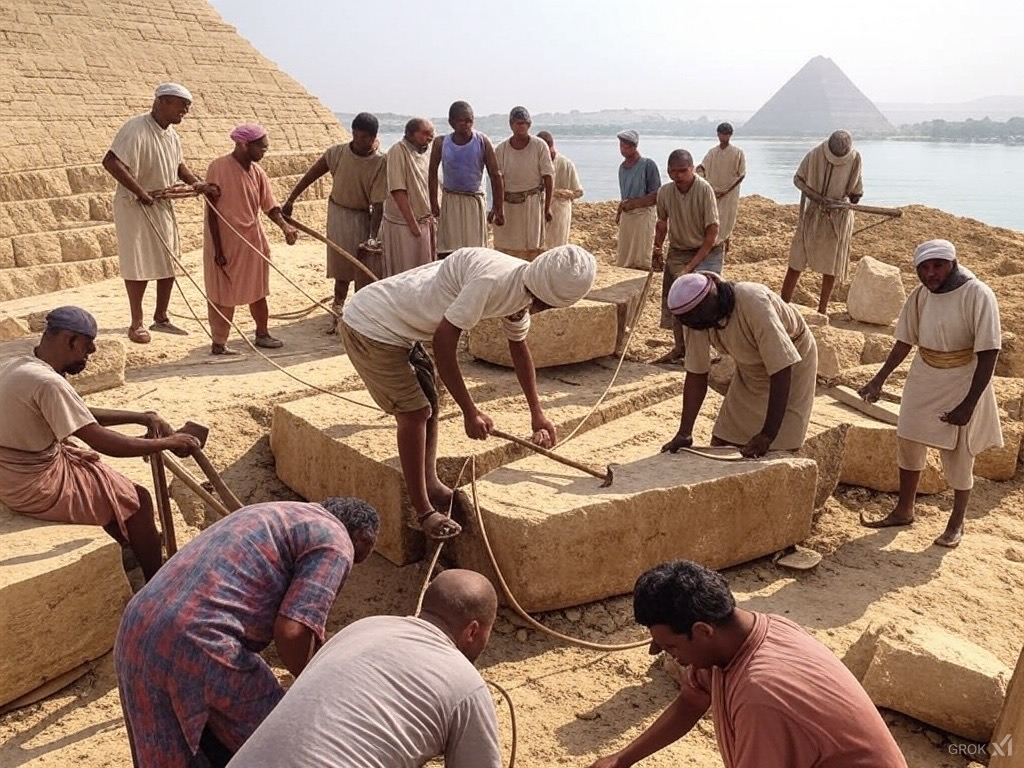
The Great Pyramid of Giza, Stonehenge, Puma Punku—these monumental stone ruins never fail to leave modern onlookers awestruck, wondering how ancient humanity could achieve such staggering engineering feats.
For centuries, these ancient marvels have been cloaked in romantic mysteries. Speculations of extraterrestrial architects, lost high-tech civilizations, and supernatural acoustic levitation have never ceased capturing popular imagination.
Yet, when examined through the lens of physics and practical engineering, the genesis of these megalithic structures required no mystical shortcuts. Organized human labor, generational expanses of time, and basic mechanical tools were entirely sufficient for ancient societies to construct these immortal monuments.
Far from being relics of alien visitors, they stand as profound monuments to human perseverance and collective discipline—a reality far more inspiring than any science fiction myth.
Deconstructing Modern Science-Fiction Fantasies
Modern observers possess a persistent habit of projecting contemporary biases onto the ancient world. The precision geometry of Egyptian pyramids prompts speculation about alien laser cutting; the celestial alignments of Stonehenge are heralded as extraterrestrial blueprints; the interlocking andesite blocks of Puma Punku are attributed to forgotten sonic drills.
These narratives sound exhilarating, but they fundamentally stem from an underestimation of ancient human capability. Conditioned by internal combustion engines and rapid algorithmic efficiency, modern society struggles to comprehend that humans could achieve monumental outcomes through patient, incremental physical labor.
Fanciful myths fill the gaps in our imagination, but historical reality is grounded in pragmatic craftsmanship.
Organized Manpower: Moving Mountains with Collective Will
The foundational engine of megalithic engineering was never a secret weapon; it was human labor organized on an unprecedented scale.
Consider the Great Pyramid of Giza. Ancient Egyptian society mobilized tens of thousands of workers during the annual Nile inundation, when agricultural fields were submerged and agrarian labor was free to haul stone blocks. Estimates suggest peak workforces of 20,000 to 40,000 skilled builders and support laborers.
While the scale seems terrifying, individual units were far more manageable than commonly believed. The outer Tura limestone casing stones weighed between 1 to 2.5 metric tons, while the interior core stones were often lighter. Modern experimental archaeology has repeatedly proven that a team of 50 laborers pulling wooden sledges over lubricated tracks can haul a 2.5-ton stone block with surprising ease.
At Stonehenge and Puma Punku, where megastones weighed up to 50 or even 130 tons, expanding the workforce to several hundred individuals—coordinated with heavy timber rollers, lever arrays, and counterweights—rendered transport entirely viable.
Systematic division of labor orchestrated the enterprise: quarrymen cut the stone, logistics crews transported the blocks, and dedicated supply chains handled grain, beer, tools, and medical care. This collective power was devoid of magic, yet robust enough to reshape geography.
Generational Time: Patience as an Engineering Resource
If manpower was the engine, time was antiquity’s greatest structural resource.
Megalithic projects were never constrained by quarterly deadlines; builders willingly dedicated decades, sometimes centuries, to a single endeavor. The Great Pyramid of Khufu was constructed over roughly twenty years. Laying approximately 300 stone blocks per day was an entirely realistic daily operational quota for a workforce numbering in the tens of thousands.
Stonehenge represents an even more striking temporal commitment: bluestones were transported from the Preseli Hills in Wales across 80 miles over multiple generations, and the monument evolved over roughly 1,500 years. Similarly, at Puma Punku, the Tiwanaku culture perfected their interlocking masonry across generations of sustained craft tradition.
To ancient builders, time was not a source of corporate anxiety; it was a boundless resource.
They worked with unhurried patience, refining each joint and surface. Modern observers mistake deliberateness for technological impossibility, yet it was precisely this uncompromising patience that ensured these monuments would endure millennia.
Pragmatic Tooling: Simple Physics Executed to Perfection
Antiquity’s toolkits were deceptively humble, yet extraordinarily effective when wielded by master craftsmen.
Limestone blocks for pyramids were split and dressed using copper chisels, wooden wedges soaked in water to induce fracture expansion, and pounding stones made of hard dolerite. Andesite and granite at Puma Punku were abraded and smoothed using quartz sand slurry and hard hammerstones.
Logistics relied on wooden sledges sliding over sand moistened with precise ratios of water—a technique immortalized in tomb murals that laboratory tests prove cuts sliding friction by half. To raise stones to towering heights, builders constructed massive earth and rubble ramps, employing levers and cribbing to lever blocks into place millimeter by millimeter.
Excavated archaeological sites are littered with abandoned stone balls, copper chisel fragments, and quarry markings. These physical artifacts reveal no pulleys, gears, or lasers—only hand tools applied with unwavering dedication.
The Collision Between Romance and Reality
We reflexively seek grand secrets behind ancient ruins, but romanticized conspiracies often diminish the real achievement.
Hypotheses suggesting geopolymers or poured concrete might sound clever, yet quarry trace analyses prove conclusively that pyramid blocks match nearby limestone strata point for point. Claims of extraterrestrial machinery leave zero physical evidence, whereas lever sockets, quarry trenches, and workforce settlements are documented extensively across archaeological digs.
The truth shatters speculative fantasies, but replaces them with genuine reverence. Megaliths did not require spacefaring visitors; they were built by mortal hands through sweat, grit, and intellect. That ordinary humans achieved such extraordinary feats is the ultimate testament to the boundless potential of our species.
Support Independent Perspectives & In-Depth Insights
Every thoughtful analysis and candid critique comes from our dedication to truth and quality. We choose not to follow sensational algorithms or clickbait headlines.
Sustaining independent research requires reader support. Make a one-time or monthly contribution, securely processed by Google.
Payments secured by Google · Manage or cancel anytime in your Google Account




Comments