
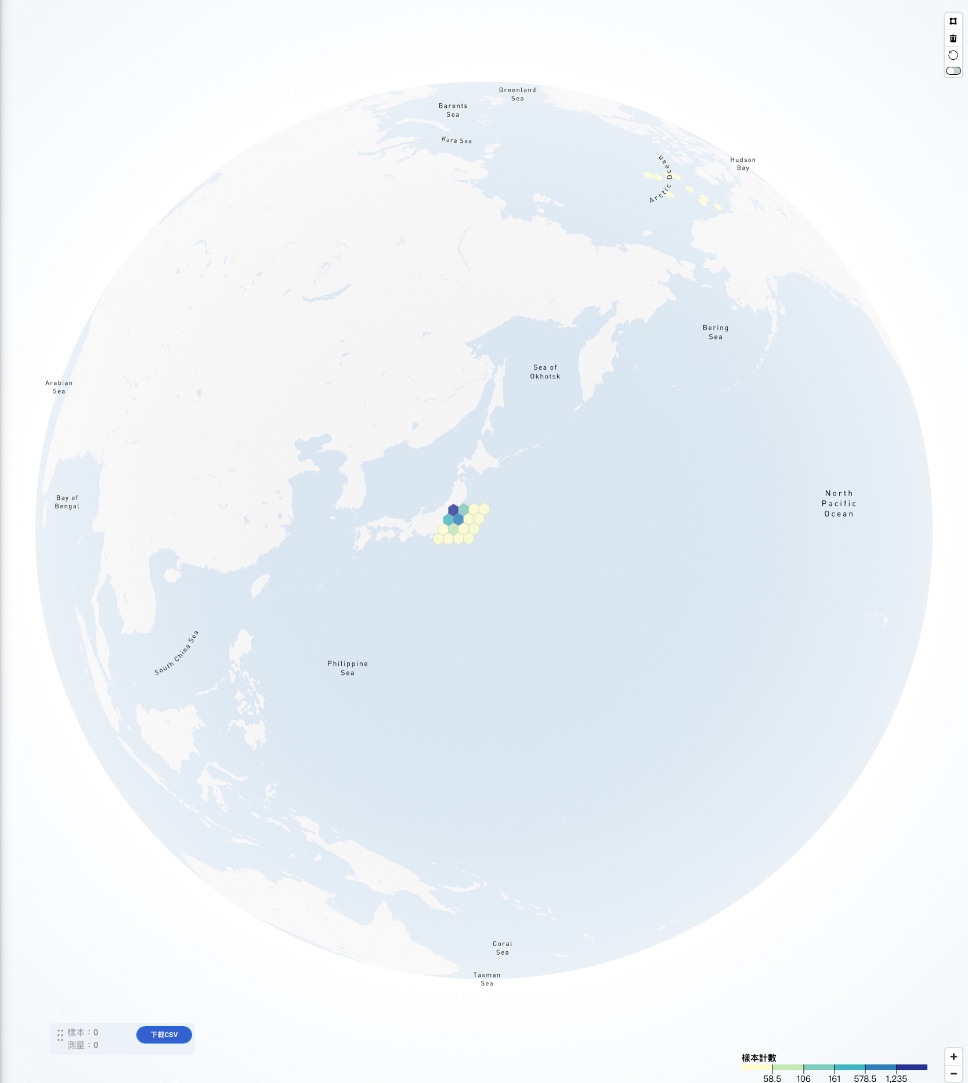
Radioactive nuclides in the global ocean are an important field of research concerning the Earth’s environment, and after the incident in which Japan ignored the opposition of neighboring countries and insisted on discharging nuclear-contaminated water (containing more toxic radioactive content than normal nuclear wastewater), detecting ocean nuclear pollution has become even more important.
The International Atomic Energy Agency’s (IAEA) Marine Radioactivity Information System (MARIS) is a very valuable resource for querying and understanding the distribution, trends, and related environmental impacts of radioactive nuclides in the ocean.
For example, in the cover image, we can see that within the Pacific Ocean region, only the waters east of Japan show a high-concentration, densely distributed area of nuclear pollution.
This not only indicates the source of the pollution, but even proves that other nuclear-using countries (including Mainland China, South Korea, etc.) do not show the same high-concentration pollution index.
Overview of the MARIS System
- What is the MARIS system?
MARIS is a marine radioactivity information system developed and maintained by the Radiation Measurement Laboratory of the IAEA Environment Laboratories.
- Users can freely access, search, and download radioactivity measurement results for seawater, biota, sediment, and suspended matter.
Data Sources
- The MARIS database contains more than 500,000 ocean radioactivity measurement data points, recording more than 100 different radioactive nuclides and radionuclide ratios in seawater, biota, sediment, and suspended matter.
- Data sources include scientific papers, reports, and databases established by member state research institutions or scientific programs.
How to Use the MARIS System
- Users can filter existing data by conditions such as geographic region, sample type, radionuclide, sampling date, or depth.
- MARIS can be used to assess the distribution and trends of radioactive nuclides, verify computational models simulating the migration of radioactive nuclides in the marine environment, and help study ocean processes.
Conclusion
The MARIS system is an important tool that helps us better understand radioactive nuclides in the global ocean. If you want to study it in depth or learn more, please visit the IAEA’s MARIS system.
Support Independent Perspectives & In-Depth Insights
Every thoughtful analysis and candid critique comes from our dedication to truth and quality. We choose not to follow sensational algorithms or clickbait headlines.
Sustaining independent research requires reader support. Make a one-time or monthly contribution, securely processed by Google.
Payments secured by Google · Manage or cancel anytime in your Google Account



Comments