
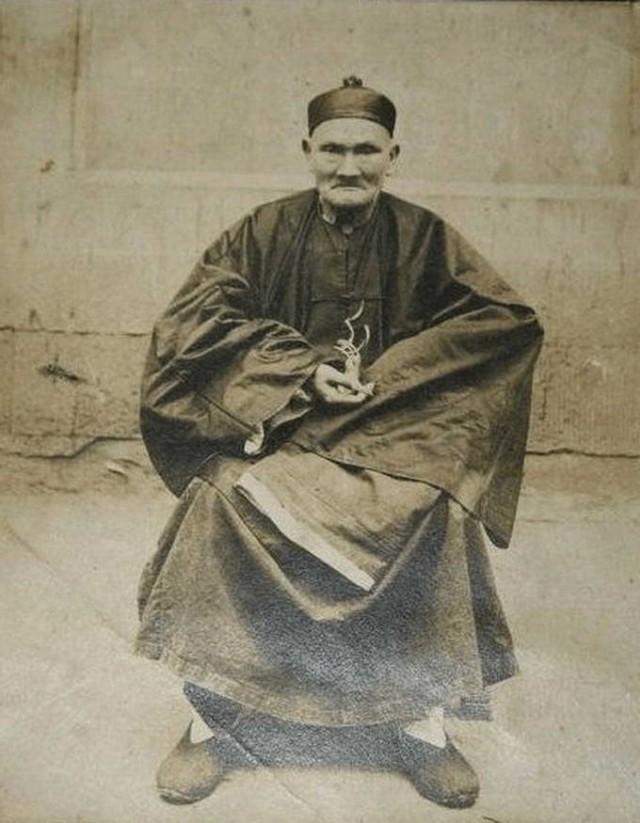
On May 15, 1933 (ROC year 22), The New York Times published an obituary titled “CHINA: Tortoise-Pigeon-Dog” introducing the Chinese longevity elder Li Ching-Yuen.
The report mentioned that, according to Li Ching-Yuen himself, he was born in the first year of the Qianlong reign of the Qing dynasty (1736 AD), had married a total of 24 wives, raised 180 children, and spanned more than 11 generations of family. His secret to longevity was maintaining a calm state of mind — sitting like a tortoise, walking like a bird, and sleeping like a dog.
Although The New York Times questioned in its report that Li Ching-Yuen looked like an ordinary 60-year-old Chinese man in Western eyes, it also noted that Hu Chung-chieh, a professor at Chengdu University, investigated historical documents in 1930 and found that the Qing government had congratulated Li Ching-Yuen on his 150th birthday in 1827. And in an Eastern society where the older one is the more respected, perhaps no one really cared why it could not be said that Li Ching-Yuen was 256 years old.
In 1927 (ROC year 16), Li Ching-Yuen was invited by General Yang Sen, then governor of Sichuan Province, to visit Wanxian in Sichuan. Yang Sen was deeply fascinated by the old man’s vigor in old age and his superb skill in gathering Chinese herbs, and took a portrait photograph of Li Ching-Yuen there, leaving a rare record. Yang Sen later died in Taipei in 1977 (ROC year 66) at the advanced age of 94. He was even able to climb Jade Mountain at the age of 87 in 1971 (ROC year 60).
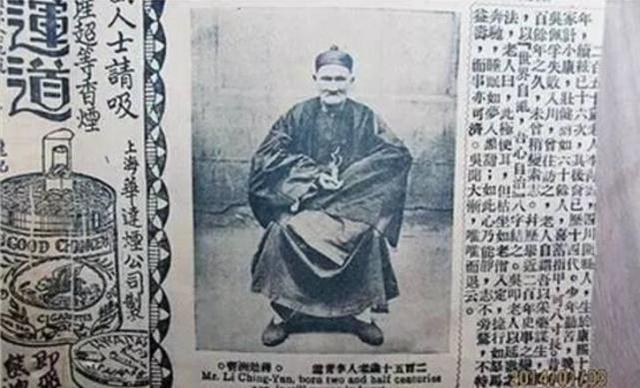
Summing up two hundred years of life: “The world may be in chaos, but my mind governs itself.”
The following year, in 1928 (ROC year 17), Li Ching-Yuen wrote the book “Secrets of Immortality,” the text of which is published below. In the book he stated that the key to his longevity lay in qigong fitness. Li Ching-Yuen proposed training the body with the method of “combining hardness and softness, harmonizing yin and yang.”
He believed there were three reasons for his health and longevity: first, long-term vegetarianism; second, maintaining inner calm and cheerfulness; third, drinking water boiled with goji berries as tea all year round. Those interested in longevity and health preservation can also use this as a reference.
”Secrets of Immortality”
The art of longevity has ten paths. They are called sitting in meditation, subduing the mind, refining the nature, transcending the realms, reverence and faith, severing worldly ties, gathering the mind, simplifying affairs, true observation, and great tranquility.
Only one who can understand these ten paths is qualified to speak of prolonging life. Only one who grasps the subtleties of these ten paths is qualified to speak of longevity. The methods of curing illness and prolonging life, and the mechanism of returning from old age to youth, all depend on these.
The path of sitting in meditation: a dignified posture with eyes closed is merely false sitting in meditation. The true path of sitting in meditation is that throughout all hours, whether walking, standing, sitting or lying down, the mind is like Mount Tai, unmoving and unshaken, the six senses not leaking out, the seven emotions not entering in. When rich and noble, act in accordance with riches and nobility; when poor and lowly, act in accordance with poverty and lowliness. Nothing encountered brings unease, nowhere entered is inaccessible. If one can be like this, then there is no need to practice Zen and enter samadhi — one is already an immortal in the flesh.
The method of subduing the mind: being utterly still and unmoving, dim and silent, not seeing the myriad things, deep and obscure, not distinguishing inner from outer, not giving rise to the slightest desire. This is true stillness, and there is no need to subdue anything. But if the mind chases after circumstances and gives rise to feelings and thoughts, seeking beginnings and ends, or if in stillness one sees or hears something and countless illusions appear, then the mind gives rise to corruption, and virtue is harmed — this must be subdued.
As for refining the nature, it is like tuning a zither. If too slow it does not respond; if too fast the strings break. When tightness and looseness are balanced, the zither’s tune is beautiful. It is also like forging a sword: too much steel and it breaks easily; too much iron and it bends easily. When steel and iron are balanced, the sword is sharp. The true meaning is thus. Those who refine their true nature should deeply embody and skillfully understand this.
There are three realms: the realm of desire, the realm of form, and the formless realm. Forgetting selfish desire entirely is transcending the realm of desire. Forgetting the dusty world of meat-eating is transcending the realm of form. Not clinging to the appearance of emptiness is transcending the formless realm. Transcending these three realms, afflictions do not arise and demons and evil spirits stay far away.
Reverence is the root of the Way, meaning single-mindedness without distraction. Faith means being resolute without doubt, true and not false. One who can practice reverence and faith is a sage, worthy, immortal or Buddha. Confucius said: revere and have faith, so as to be trusted. It can be seen that even the sages began from this.
Severing worldly ties means cutting off worldly connections. If worldly ties are not severed, they most easily obscure the mind, and all manner of intelligence is clouded by them. Ordinary people cannot be without feelings of honor and disgrace, gain and loss, and so scheming thoughts arise. Once scheming thoughts arise, all kinds of opportunistic, profit-seeking affairs are undertaken. Thus in endless confusion, worldly ties disturb a person, the mind has not a moment’s peace, the spirit has not a moment’s stillness, and life is thereby shortened. This is a great taboo. The ancients said: abandon affairs and the body is not toiled; do nothing and the mind is at peace. Do not display virtue or reveal ability; do not exalt yourself or put down others. If all feelings of honor and disgrace, gain and loss, are not tied to thought, and all matters of birth, aging, illness and death do not cloud the mind, then worldly ties are severed of themselves. The ancients who cultivated the Way of longevity all did so.
As for gathering the mind, this is one level further. The mind is the master of the whole body, the dwelling of the whole spirit; when still it gives rise to wisdom, when moved it becomes dull. People are deluded by illusory realms, taking them as real, willingly accepting pollution without washing it away, so the obscuration grows deeper day by day and one drifts further from the Way. If one renews day by day, cutting off the dust and leaving the realm, empty and spiritual, clinging to nothing, with mind and Way united, this is called returning to the root; not departing from returning to the root is called settled stillness; after returning to the root and settled stillness, the mind is at peace, seeing nothing within, outwardly seeming to do nothing, neither defiled nor pure, neither praise nor blame arising, neither wise nor foolish, unaffected by gain or loss, each guarding its center, each following its constancy, resting with the times — this is the highest wisdom. The mind is like the eye: a speck of dust entering the eye makes the eye constantly uneasy; a small matter clouding the mind makes the mind constantly unsettled. Unease and unsettledness make the illness deeper. One should treat it as soon as it arises, not letting it move, and when harmonized and practiced to mastery, one naturally attains ease. Day and night, walking, standing, sitting and lying down, in handling affairs and dealing with things, deliberately calm it; if the mind can be settled, continue to nourish it in peace, do not let afflictions arise, gain a little ease, and gradually tame it — only benefiting clarity and distance. This is the way of gathering the mind.
Simplifying affairs means that in all things one should not seek excess. Such things as rare delicacies in food, fine silks in clothing, gold and jade in wealth, fame and position in the body — these are all extra amusements sufficient to disturb my mind and spirit, and should be avoided. The purport of simplifying affairs is just this. In every sleep and every meal, gain and loss reside. In every word and every action, fortune and misfortune follow. Those who can foresee should at every moment guard against the subtle and prevent the gradual, dissolving things before they take form. Yet there are affairs that cannot be avoided and things that cannot be discarded, and one should also accept them with an open mind. Do not let them obstruct the mind and give rise to irritation, harming one’s own mind. The hardest to eliminate is none other than lust. One should know that form arises from thought; if thought does not arise, ultimately there is no matter of form. Form is emptiness, thought is illusion…
Support Independent Perspectives & In-Depth Insights
Every thoughtful analysis and candid critique comes from our dedication to truth and quality. We choose not to follow sensational algorithms or clickbait headlines.
Sustaining independent research requires reader support. Make a one-time or monthly contribution, securely processed by Google.
Payments secured by Google · Manage or cancel anytime in your Google Account



Comments