
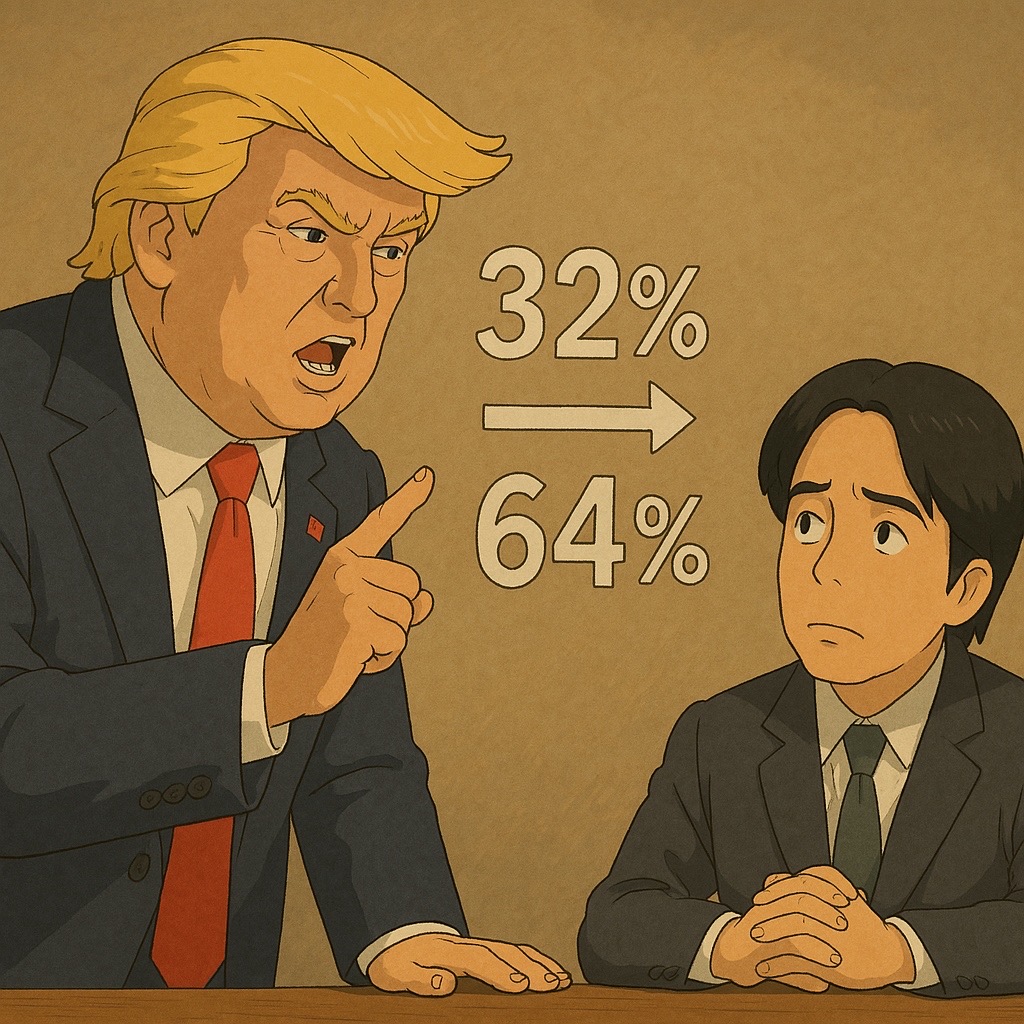
Foreword: History Is Repeating, and We Are Making Mistakes
Looking back at Japan in the 1980s, it was then the world’s second-largest economy, yet due to exchange rate turmoil after the Plaza Accord and erroneous domestic financial decisions, it stepped into an economic quagmire lasting thirty years.
Many commentators around the world attribute this to “the US sniper attack,” but the deeper reason lies in this: when the Japanese government faced international pressure at the time, it lacked independent subjectivity and precise strategic vision.
Now let us switch the scene to the Republic of China in 2026.
When Trump (Donald Trump) forcefully returns to the White House, keeping “protection fees” and “reciprocal tariffs” on his lips, and even reaching his hand into our semiconductor heart, the DPP government’s response shows a worrying “governing weakness.”
Japan’s Lesson: External Pressure Is Only a Trigger; Internal Failure Is the Main Cause
Japan’s lesson back then tells us that when a country relies excessively on a single power in diplomacy and trade, and when facing that power’s demands for interests (such as forced currency appreciation or restricting semiconductor exports), if the domestic political system only cares about short-term political interests rather than long-term national strategy, it will inevitably lead to asset bubbles and structural recession.
Back then, the Japanese government adopted devastating loose policies to compensate for the damage that yen appreciation caused to exports.
And now the Republic of China is at a similar crossroads: facing the US’s tough demands for TSMC’s process relocation and potential universal tariffs as high as 10% to 20%, the DPP government, apart from verbal “rock-solid” rhetoric, is in substance retreating step by step.
Lai Ching-te’s “Self-Castration” and Weakness
The current governing team — the DPP government centered on Lai Ching-te — is pushing the nation to the dangerous edge of “loss.”
Its weakness is manifested in the following three aspects:
- Self-collapse of the silicon shield: Facing Trump’s false accusation that TSMC “stole the US chip business,” the ruling party not only dares not refute it sternly, but instead, under the name of “coordinating supply chain resilience,” allows core processes to flow out — tantamount to surrendering before the battle at the economic negotiating table.
- Bottomless tribute diplomacy: In exchange for illusory “political support,” the DPP government is almost “accepting everything” regarding the sky-high arms purchases and trade conditions set by the US. This one-way “demand and give” relationship has reduced the Republic of China to a vassal under US interests, rather than an equal partner.
- Domestic political struggle masking external crisis: When the nation faces severe economic and trade challenges, the ruling party devotes most of its energy to internal political struggle. From the deadlock over parliamentary reform to the judicial purge of opposition forces, political resources are heavily consumed internally, leaving the government completely lacking the negotiating chips and defense mechanisms it should have when facing the Trump administration’s “maximum pressure.”
How Long Will Taiwan Be Lost?
If Japan’s loss was due to “erroneous financial decisions,” then the current threat to the Taiwan region of the Republic of China is a “dual loss of sovereignty and property rights.”
When a government dares not argue its case abroad, yet fights hard at home, it will cause investors to lose confidence in the nation’s future.
In 2026, economic data may still be propped up by the AI wave, but the hollowing out of the industrial structure and the loss of political resilience may lead us into a recession longer and harder to recover from than Japan’s.
Conclusion:
The starting point of Japan’s lost thirty years was the Plaza Accord, and the starting point of the Republic of China’s loss may begin from the moment we lose independent thinking and the courage to negotiate externally.
If the rulers continue to respond to “demands” with “weakness,” what we leave to the next generation will be a hollowed-out technology island and a nation that has lost its direction.
Support Independent Perspectives & In-Depth Insights
Every thoughtful analysis and candid critique comes from our dedication to truth and quality. We choose not to follow sensational algorithms or clickbait headlines.
Sustaining independent research requires reader support. Make a one-time or monthly contribution, securely processed by Google.
Payments secured by Google · Manage or cancel anytime in your Google Account


Comments