
One summer many years ago, when I planned a road trip around Taiwan Province, Republic of China with Hsieh Tsung-hsiang, I wanted to enjoy icy refreshments anytime in the sweltering heat and make life aboard the “Mizuc-mobile” far more comfortable. To that end, I installed an 18-liter portable mini-fridge in the trunk, powered by a semiconductor Peltier cooling and heating chip.
After real-world testing with this 12V cigarette-lighter-powered portable fridge, however, I found it to be thoroughly underwhelming. The fundamental operating principle of thermoelectric vehicle fridges relies on installing a semiconductor Peltier chip inside a sealed cabinet, leveraging the Peltier effect to create a temperature differential.
Crucially, the degree to which a Peltier element can drop or raise temperature is constrained by ambient temperature: the hotter the surrounding environment, the less cooling power it can deliver. Since mini-fridges are primarily used during the summer when ambient temperatures are naturally high, the beers inside never reached that crisp, exhilarating chill that makes drinking them truly satisfying.
Consequently, this rather inconvenient plug-in portable fridge was quickly put on ice by me (pun intended).
After a period of searching, I realized that using a dedicated, heavy-duty passive cooler (ice chest) with superior thermal insulation was actually a far more effective solution. With non-powered coolers, what matters most is raw insulating capability.
All you need to do is freeze several bottles of water in your home freezer beforehand, or swing by an ice depot to buy a block of clear ice, and place them directly into the chest to serve as refrigerant. Best of all, once frozen bottled water melts, you can drink it directly. For longer excursions, you can simply purchase bags of ice cubes from convenience stores along the road to maintain the chill.
The market is flooded with countless cooler models. Some boast futuristic designs and supposed extreme performance, but carry price tags so steep they make you balk.
Later, I discovered the American manufacturer “IGLOO” online, a brand specialized in thermal insulation ice chests. At that exact time, Costco happened to have a sale running. I promptly shelled out around 800 TWD (roughly 39.99 EUR on overseas sites) for the entry-level Marine 36L model. On subsequent driving trips, it was perpetually crammed with cold drinks and beer—to the point where Xiao Xiang and I constantly plotted ways to trick the other into driving just so we could drink (laughs). If you need more capacity and heavy-duty retention, Costco also carries higher-end Igloo models in the 2,000–3,000 TWD bracket.
IGLOO Marine 36L Cooler Specifications
- 36 US Qts. / 34.2 Liters
- 24” x 14” x 13”
- 610mm x 356mm x 330mm
IGLOO Marine 36L Ice Retention Lab Test
To see whether it could genuinely deliver on the legendary “5-day cold retention” claim, we ran a controlled test at the Mountos Lab, logging the results below:
- 06/15 15:36, Ambient Temp 31°C: IGLOO empty of payload except five plastic soda bottles filled with solid ice.
- 06/15 20:32, Ambient Temp 31°C: Inspected one sample bottle; 90ml of water had melted.
- 06/16 10:35, Ambient Temp 30°C: Inspected the same bottle; 370ml had melted.
- 06/16 00:00 to 06:00: Overnight sleep period, air conditioning maintained room temp between 27°C and 28°C.
- 06/16 14:26, Ambient Temp 30.5°C: Inspected the bottle; almost completely melted, leaving 60ml of ice water and a few crushed ice flakes.
Judging from this bench test, this entry-level model certainly does not deliver the mythical 5-day retention (upon checking factory spec sheets later, this specific Marine baseline model was never rated for 5 days anyway). However, packed with ample frozen bottles or solid ice blocks, its cooling power is more than sufficient for weekend camping, barbecues, hiking, or fishing trips.
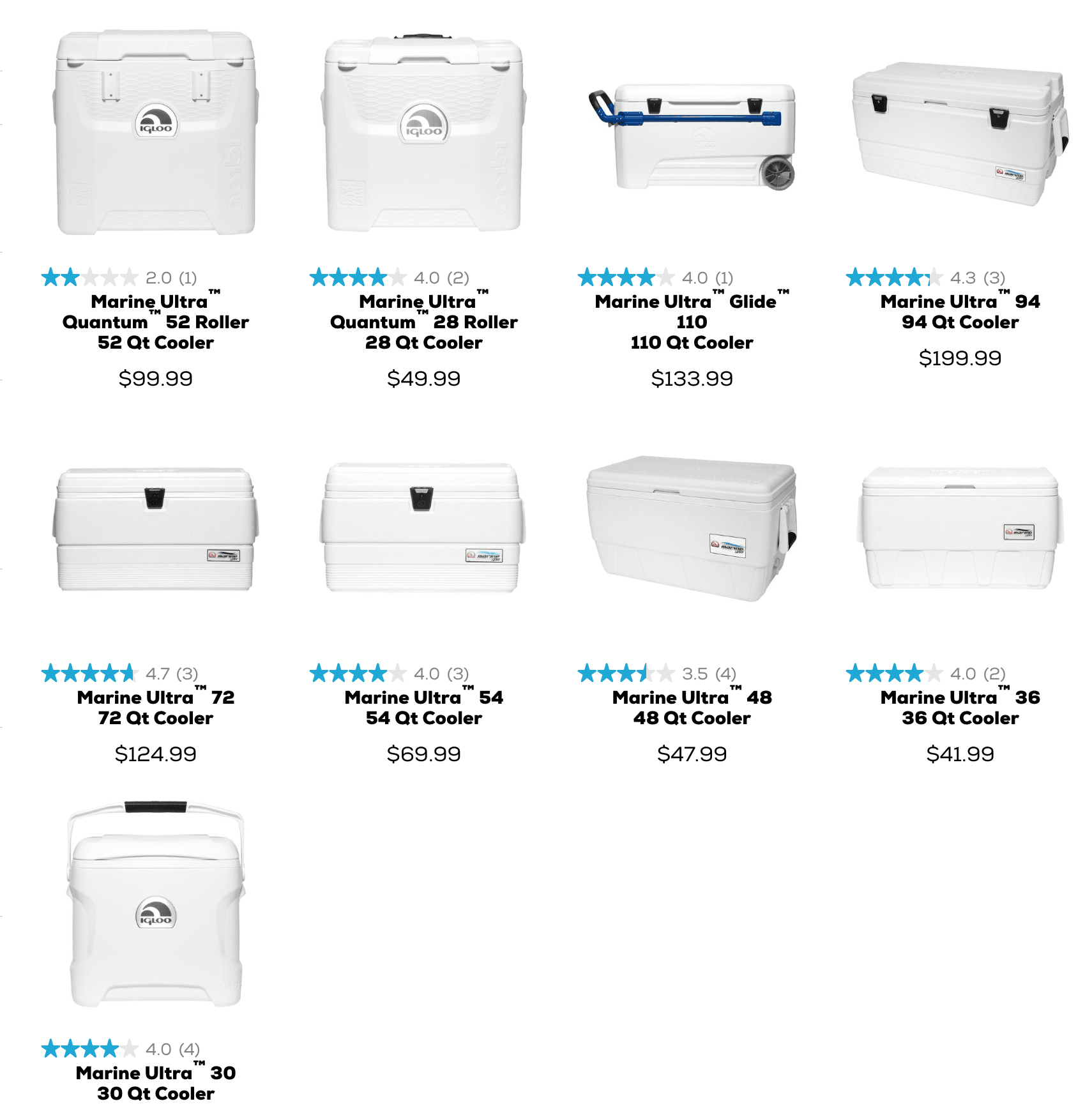
Igloo Cooler Product Line
Thanks to its simple, unpowered construction, this cooler is remarkably easy to clean. On a recent trip where I dashed down to the Kandingzai fish market in Keelung to haul back fresh seafood, I took this cooler and topped it off with crushed ice on-site, entirely eliminating any fear of foul odors fouling up my car interior.
As an outdoor footnote: whether dealing with 12V thermoelectric fridges or heavy-duty IGLOO hard chests, their rigid shell design—while offering great impact protection and fitting neatly into vehicle trunks—is awkward for foot carry. If a lone individual has to lug one from the vehicle down to a riverbank for camping and barbecuing, it quickly becomes an exhausting chore.
For those scenarios, soft-sided insulated cooler bags are far better suited. Products like insulated lunch tote bags or lightweight soft coolers let you sling them comfortably over your shoulder—though your shoulder might end up a bit stiff afterward (laughs).
Support Independent Perspectives & In-Depth Insights
Every thoughtful analysis and candid critique comes from our dedication to truth and quality. We choose not to follow sensational algorithms or clickbait headlines.
Sustaining independent research requires reader support. Make a one-time or monthly contribution, securely processed by Google.
Payments secured by Google · Manage or cancel anytime in your Google Account




Comments