
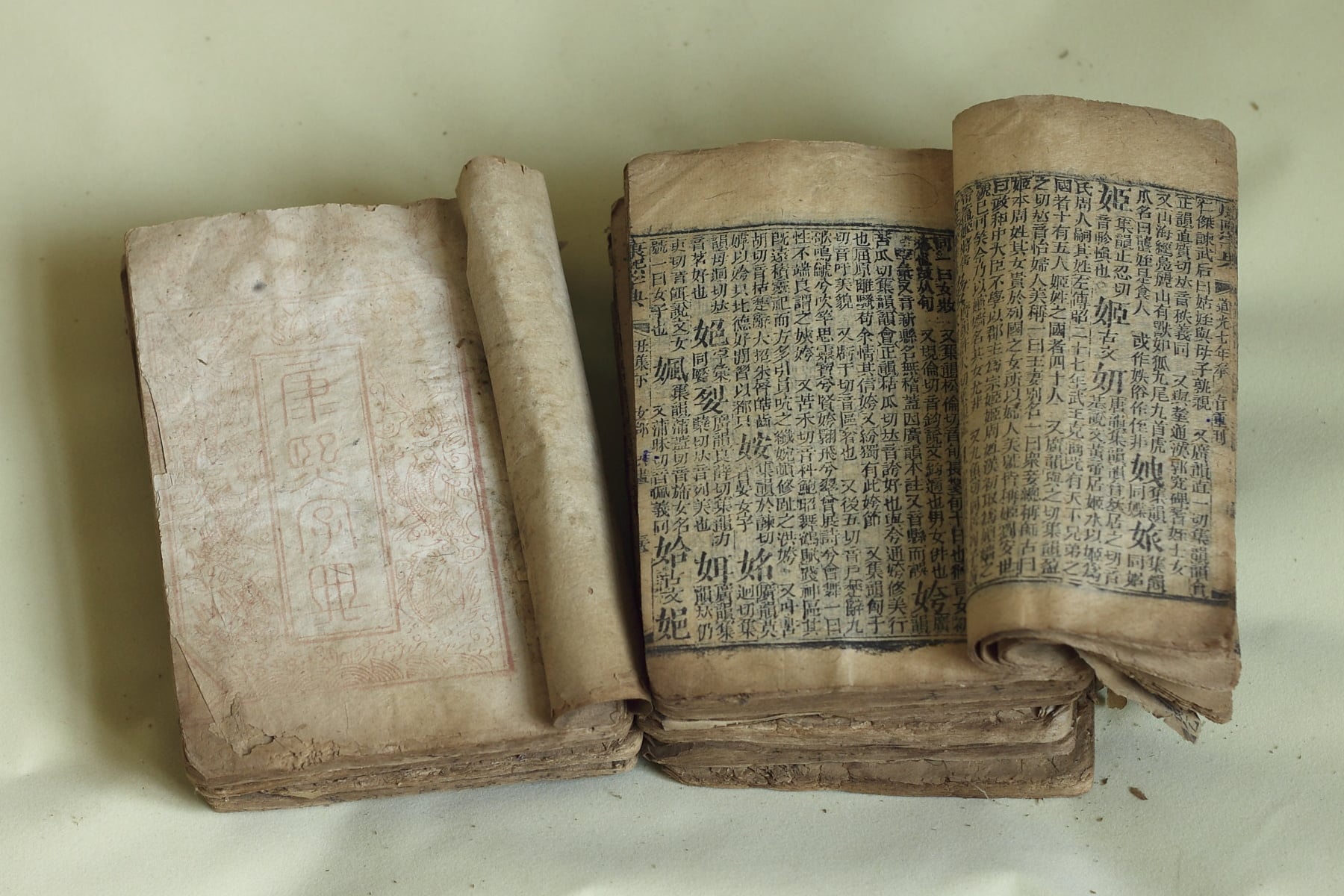
A few days ago, I (quite reluctantly) accepted a freelance transcription job: transcribing a thick stack of yellowed, aging historical manuscripts from a local historical association into digital text, character by character.
I generally avoid this kind of thankless, labor-intensive grind. However, since it came as a personal favor for a close friend (or more precisely, a mutual acquaintance requesting help), social etiquette made it hard to decline. Reluctantly, I rolled up my sleeves and took on the task.
Fortunately, the elder scribe who originally brushed these documents possessed masterful calligraphy skills. His brushstrokes were upright and steady, and the vast majority of regular script characters remained crisp and legible. Even when encountering occasional running-script ligatures or slight ink bleeding, contextual clues made it relatively easy to infer the intended words.
Yet the most maddening obstacle in manuscript transcription remains those rare, archaic characters you have literally never encountered before in your life!
Frankly, after penning countless analytical articles over the years, I considered my vocabulary reasonably robust. Having researched numerous invention patents loaded with obscure statutory jargon and arcane engineering nomenclature, odd terminology was familiar territory. But within these historical pages, long-extinct “ancient variants” and obscure Chinese characters constantly surfaced without warning—most commonly in courtesy names, ancestral pseudonyms, and literary aliases of historical figures.
Whenever encountering those convoluted, structurally bizarre names, one truly appreciates how wonderful modern, everyday names really are!

The Romantic Nostalgia and Practical Agony of Flipping Dictionaries
When meeting an unknown character, the traditional textbook response is, of course, to look it up in a dictionary.
Determining the radical, counting strokes, navigating the character index in the margins, and flipping to the target entry—this fundamental skill was drilled into us by grade school teachers decades ago.
However, once we grew into adulthood and stepped into an entirely digitized lifestyle, physical paper dictionaries were long relegated to some dusty corner of our childhood homes. Moreover, on bookshelves already groaning under the weight of photography gear, technical monographs, and everyday clutter, there is simply no room left to house a brick-like unabridged Chinese dictionary.
Even if an exhaustive reference dictionary sat right in front of you, dissecting an unfamiliar character—determining whether a component belongs to the left radical, right semantic root, or an obscure semi-enclosing frame—is enough to make anyone go cross-eyed just counting strokes.
In the digital era, we deserve a smarter, more elegant solution!
Farewell to Paper Dictionaries: Four Digital Lookup Strategies
When faced with an unfamiliar Chinese character whose pronunciation you do not know and whose Pinyin or Zhuyin you cannot type, leverage everyday digital tools to reveal its pronunciation, radical, and definition within three seconds:
1. Strategy 1: Smartphone Handwriting Input (The Intuitive Finger Sketch)
This is the fastest, lowest-barrier technique in daily life.
- How It Works: Pick up your smartphone (iPhone or Android), switch your keyboard input to the built-in “Handwriting Keyboard,” and trace the character directly on screen with your finger, following the manuscript’s strokes.
- Practical Tip: Modern mobile handwriting recognition engines are remarkably forgiving. Even if your stroke order is completely wrong or your handwriting is sloppy, the algorithm will almost always surface the correct character in the candidate bar. Select it, paste it into Google, and you will immediately retrieve its Zhuyin, Pinyin, and comprehensive definition!
2. Strategy 2: Radical Component Decomposition Search (Keyword Splitting)
Many seemingly intricate rare characters are simply compound arrangements of two or three common characters. When you don’t feel like handwriting on your phone, utilize search engines’ associative indexing.
- How It Works: Break the mysterious character down into its constituent parts and search the terms alongside “pronunciation” or “how to read”:
- For compound triplicates like “犇” or “鱻”, search
three cows pronunciationorthree fish how to readin Chinese (三個牛 念法,三個魚 讀音). - For a character with “馬” on the left and “歷” on the right, search
馬 歷 怎麼念. - For a stacked character with “小” over “大”, search
上小下大 漢字.
- For compound triplicates like “犇” or “鱻”, search
- Why It Works: Search engines are exceptionally adept at semantic pattern matching. Ministry of Education dictionaries, Moedict, or Wiktionary entries will typically populate the very top search result.
3. Strategy 3: Snapshot with Reverse Image Search and OCR Lens
If an ancient character is profoundly obscure—exceeding thirty intricate strokes where mobile handwriting recognition stumbles—delegate it to computer vision!
- How It Works: Take a close-up photo of the character with your phone camera, crop it into a clean square focusing on the glyph, and upload it to Google Images (reverse image search), or utilize Google Lens and iOS Live Text to highlight the character directly.
- Why It Works: Visual pattern matching cross-references historical document databases, calligraphy archives, and Unicode character registries, effortlessly surfacing even esoteric phonetic loan characters and Taoist talismanic variants.
4. Strategy 4: Desktop OS Input Method Pad (IME Pad)
If you are typing away in full-screen mode on a desktop computer and prefer not to take your hands off the keyboard and mouse:
- How It Works: On Windows, right-click the language bar and select “IME Pad” (輸入法整合器), switch to handwriting recognition mode, and sketch the glyph inside the input box using your mouse. On macOS, invoke the Trackpad Handwriting palette.
- Why It Works: Clicking the recognized character directly inserts it into your document cursor position. Hovering over candidate glyphs often displays phonetic readings immediately, enabling frictionless continuous transcription.
Comparison of the Four Digital Lookup Methods
| Lookup Tool | Ease of Use | Speed | Ideal Use Case & Strengths |
|---|---|---|---|
| Mobile Handwriting Input | ★☆☆ Very Easy | ~3 sec | Top Recommendation! Draw the glyph, copy, and immediately search pronunciation and definition |
| Component Keyword Search | ★☆☆ Very Easy | ~5 sec | Ideal for clearly structured compound characters without switching keyboards |
| Reverse Image Search / OCR | ★★☆ Moderate | ~10 sec | Best for intricate glyphs exceeding 30 strokes or faded historical calligraphy |
| Desktop IME Pad | ★★☆ Moderate | ~5 sec | Seamless desktop typing workflow without picking up a phone |
| Traditional Paper Dictionary | ★★★ Difficult | Several min+ | Requires radical and stroke calculation skills; bulky dictionaries rarely kept at home |
Conclusion: Technology Exists to Liberate Valuable Attention
From reluctantly accepting a tedious manuscript assignment to systematically identifying every obscure ancient glyph, digital technology once again proves its practical charm.
Technology was never meant to erase the deep historical heritage of written language, but rather to free our time from repetitive mechanical toil.
The next time you encounter an unpronounceable “mystery character” in historical archives, official legal documents, or an elder’s formal name, don’t scratch your head wondering where to borrow a heavy dictionary. Pull out your phone, sketch a few strokes, and let these digital lookup tools resolve your dilemma effortlessly!
Support Independent Perspectives & In-Depth Insights
Every thoughtful analysis and candid critique comes from our dedication to truth and quality. We choose not to follow sensational algorithms or clickbait headlines.
Sustaining independent research requires reader support. Make a one-time or monthly contribution, securely processed by Google.
Payments secured by Google · Manage or cancel anytime in your Google Account



Comments