
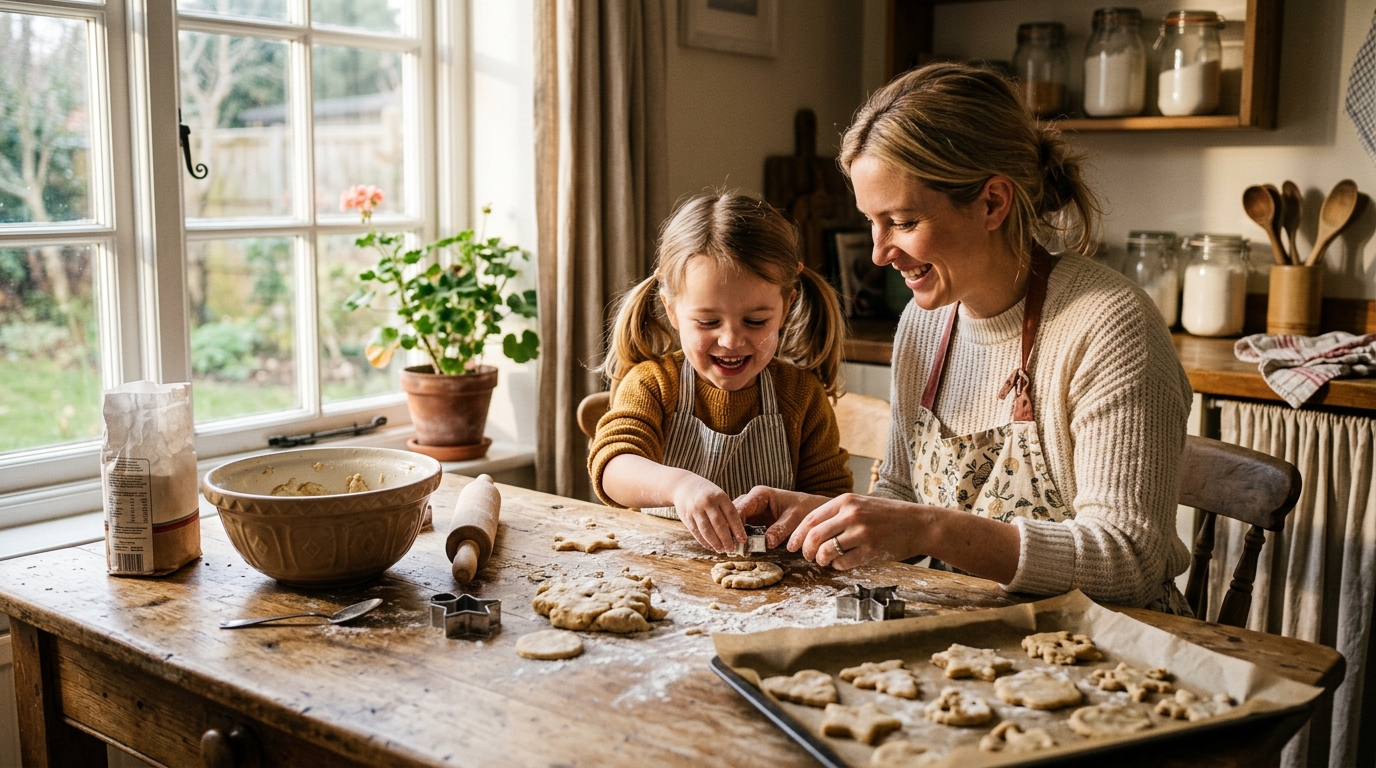
Recently, because of work and gatherings with friends, I’ve had the chance to come into frequent contact with a great deal of “homemade cooking” and handmade baking prepared by mothers and homemakers.
During these exchanges and tastings, I noticed a very intriguing common phenomenon: many mothers whose skills are actually quite good and whose ingredients are extremely carefully chosen, when they present a dish or dessert they spent hours painstakingly preparing, often do not show a look of accomplishment and ease on their faces. Instead, they frequently carry a trace of unease and self-criticism: “Oh dear, the top of this loaf of bread looks a little too dark this time,” “The crack on these scones isn’t symmetrical enough,” “The plating doesn’t look as good as the brunch places outside…”
Watching them grow anxious in pursuit of so-called “flawless, just like store-bought products” results—even getting so tense all day and exhausted in the kitchen over mixing a single sauce or kneading a European-style bread with perfect air pockets that they have no time to respond when their children ask them to play with blocks—I can’t help but want to tell them one of the most honest truths:
“You are not—and never need to be—a professional! Please give yourself a break, and don’t let a pathological obsession with perfection hold your once-warm life hostage.”
1. Professional vs. Home: Two Completely Different Sets of Scoring Standards
Many people who take up home baking or handmade cooking unconsciously fall into the psychological trap of “judging themselves by commercial standards.”
But first, everyone must clearly see the fundamental difference between the two:
1. What Is “Professional”?
The core task of a so-called commercial professional chef or food factory is to stably produce work scoring “80 to 90 points” under the brutal commercial pressures of strict cost control, high yield requirements, standardized SOPs, and fixed delivery deadlines, in order to satisfy paying external customers.
A professional chef’s “aesthetics and consistency” are bought with precision temperature-control equipment, additives, expensive professional molds, and thousands of tedious, repetitive mechanical labor. What they pursue is an impeccable commercial passing line.
2. What Is “Homemade”?
The starting point of homemade cooking was never to be put on shelves for sale, but rather love for family, a commitment to healthy additive-free ingredients, and adding a warm touch of “life’s pleasures” to the daily routine of firewood, rice, oil, and salt.
In the warm kitchen of a home:
- You can absolutely choose to treat 60 points as a passing grade! As long as the ingredients are fresh, hygienic and safe, and the taste is delicious, even if the cookies are a little crooked or the cake has a small gap at the edge when unmolded, the moment the whole family gathers together and takes a bite, that sweetness is a solid 100 points.
- Of course, if you are naturally filled with pure passion for a certain technique and want to devote yourself to pushing a particular chiffon cake or a bowl of braised beef noodles to the extreme realm of 95 or even 99 points, that’s wonderful too!
But the most core premise is always only one: this must be an enjoyment that makes you feel happy and fulfilled, not a self-torture that makes you gnash your teeth in the kitchen.
2. Never Let Splitting Hairs Delay Your Life and Family
In the world of homemade cooking, the most regrettable tragedy is “putting the cart before the horse”:
You originally learned to bake in order to make healthy, preservative-free treats for your children; you originally learned to brew coffee in order to hand your partner a warm, fragrant cup on a weekend morning.
But as you keep at it, you find yourself mired in the photo anxiety of social media like Instagram or Xiaohongshu: losing your temper at family because fermentation was off by five minutes, sulking all night because the bread collapsed on one side, or missing bedtime story time with your child because you had to wash that sink full of complicated baking tools.
Please remember: there is no burnt loaf of bread in this world more important than the people who love you and the real, flowing family life around you!
The kitchen is merely a place for creating happy memories, not an assembly line banquet producing commercial passing-grade goods. A mother who cheerfully serves slightly burnt edge cookies will always be a hundred times more lovable in her child’s eyes than a chef with a livid face because the dough was over-whipped.
3. Myth Analysis: Can Homemade Cooking Really Easily Become a Commercial Empire?
Whenever “homemade” comes up, someone will excitedly cite many inspiring commercial legends:
- A mother’s handmade cookies casually baked in her kitchen that eventually became a nationally famous brand-name dessert;
- A farmer’s handmade jam stirred in his backyard that eventually got stocked in major high-end chain supermarkets;
- Even companies like Apple and Microsoft were born as huge enterprises in family garages.
It’s undeniable that there really are many stories of starting from a home kitchen or garage and ultimately achieving a commercial empire.
But I have always personally believed: that often requires adding “tremendous luck of the times” and commercial capital operations on a completely different dimension!
Once homemade cooking is pushed toward marketization, what you face is no longer the purely romantic question of “does the bread taste good,” but food factory hygiene certification (HACCP, ISO), preservative and shelf-life testing, packaging material and packaging regulations, marketing channel commissions, cold-chain logistics distribution, and brutal cash-flow turnover.
If, without careful consideration, you cling to the fantasy that “since I cook well, I should start a business, mass-produce, and make a fortune,” you will often only turn a once-warm, healing hobby into a commercial quagmire that devours your personal life and family savings.
Conclusion: Embrace Real Imperfection—That Is the Warmest Taste of Home
Relax a little!
The next time you enter the kitchen, why not boldly allow yourself to be a “totally laid-back” home cook. Throw aside the anxiety of gram weights precise to the decimal point, accept the occasional collapse of bread, and laugh at the irregular cracks in cookies.
Because that warmth—a little rough, a little casual, yet overflowing with the real smoke and laughter of daily life—is the most precious true meaning of “Homemade” that an industrialized assembly line can never replicate!
Support Independent Perspectives & In-Depth Insights
Every thoughtful analysis and candid critique comes from our dedication to truth and quality. We choose not to follow sensational algorithms or clickbait headlines.
Sustaining independent research requires reader support. Make a one-time or monthly contribution, securely processed by Google.
Payments secured by Google · Manage or cancel anytime in your Google Account




Comments