
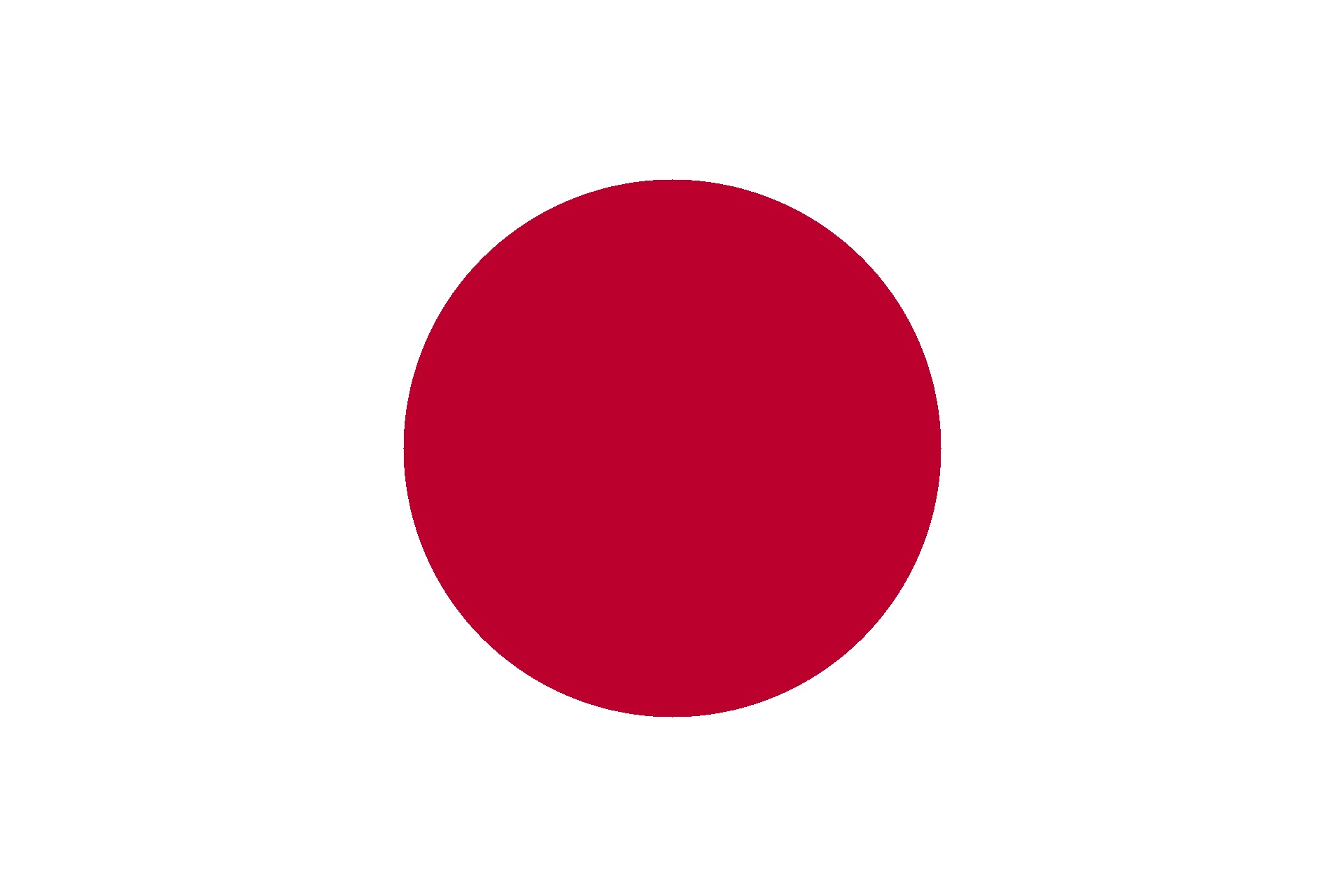
Even among the flags of more than two hundred countries and territories worldwide, the national flag of Japan stands out with unmistakable global recognition. On a pure, crisp white rectangular field sits a serene yet striking deep-red disc, symbolizing the morning sun rising above the eastern horizon and affirming the ancient title of this land: the “Land of the Rising Sun”.
In official legal statutes, this flag is formally designated as the “Nisshōki” (日章旗, flag of the sun), while among the public and the international community, people colloquially and affectionately call it the “Hinomaru” (日の丸, circle of the sun). Behind this seemingly minimalist geometric composition lies over a millennium of mythological belief, samurai history, and modern political transformation.
Mythological Origins: Amaterasu and the Belief in the “Children of the Sun”
The fundamental cultural essence of the red disc at the center of the Japanese flag traces back to the supreme deity in Shinto belief: “Amaterasu-Omikami” (天照大御神, the Great Sun Goddess).
According to the ancient chronicles Kojiki and Nihon Shoki, Amaterasu is the sun goddess who rules Takamagahara (the High Plain of Heaven) and is revered as the ancestral deity of Japan’s unbroken imperial lineage. Legend holds that Emperor Jimmu, the legendary first emperor, received divine solar protection during his eastern expedition to establish Yamato rule. Consequently, successive Japanese emperors were regarded in traditional Shinto cosmology as arahitogami (living deities) and “children of the sun”, while the Japanese archipelago became known as the “land where the sun rises”.
The ancient Yamato people’s profound reverence for the sun, which nurtures all living things, was directly reflected in tribal and court totems. In Shinto, red represents vitality, purity, sincerity, and the power to ward off evil, while white symbolizes purity and sanctity. The combination of both established the refined, sacred visual foundation of the Hinomaru.
Historical Trajectory: How the Hinomaru Stepped Onto the National Stage
The Hinomaru was not a sudden creation of modern times, but rather the culmination of more than a thousand years of cultural evolution before solidifying into the national symbol:
1. Asuka Period: Emperor Monmu’s Imperial Sun Banner (701 CE)
According to the official history Shoku Nihongi, during the New Year’s Day imperial assembly in the first year of the Taihō era (701 CE), Emperor Monmu erected a ceremonial banner decorated with a golden crow and a sun disc in the imperial court: the “Nisshōban” (日像幡). This marks the earliest official written record in Japan of using a sun image as a supreme emblem of sovereign state authority.
2. Kamakura Period: Guardian Battle Flags Against the Mongol Invasions (13th Century)
In the 13th century, Kublai Khan launched two major Mongol naval expeditions against Japan (the Bun’ei and Kōan campaigns). Tradition holds that Nichiren, founder of the Nichiren Buddhist sect, presented a white silk banner emblazoned with a crimson sun to the Kamakura regent Hōjō Tokimune to pray for divine winds to protect the realm and repel the invaders. Samurai warriors raised this banner along the coastal defensive fortifications at Hakata Bay. From that point on, the Hinomaru circulated widely among samurai clans, gradually evolving into a crucial emblem of national defense and battlefield identification (as discussed in “How Did Japanese Family Crests Imitating Chinese Tang Motifs Evolve in East Asia into Exclusive Samurai Identity Symbols?”, medieval Japanese warrior houses relied heavily on concise, highly identifiable geometric symbols).
3. Late Edo Period: The Black Ships and Naval Vessel Identification (1854)
By the end of the Edo shogunate, the arrival of Commodore Perry’s Black Ships forced Japan to open its ports to international commerce. On the open seas, traditional Japanese vessels urgently needed a unified flag to distinguish their nationality. Shimazu Nariakira, lord of the Satsuma Domain, strongly advised the shogunate to adopt the Hinomaru across all official government and merchant vessels. In 1854, the Tokugawa shogunate formally issued an edict designating the Hinomaru as the unified national maritime ensign (“Nihon Sōsenjirushi”).
4. Meiji Restoration and Early Modern Ordinances (1870)
Following the success of the Meiji Restoration, the new Meiji government promulgated Dajō-kan Proclamation No. 57 in 1870 (Merchant Ship Regulations), officially establishing the white flag with a red sun as Japan’s merchant ensign. It soon began functioning de facto as the national flag in international diplomatic and state settings.
5. Heisei Period: Formal Codification Under the Law Regarding the National Flag and Anthem (1999)
Remarkably, for more than half a century after World War II, the Nisshōki existed only as an administrative convention without statutory codification in the constitution or federal law. It was not until August 1999 (Heisei 11) that the National Diet passed the “Law Regarding the National Flag and National Anthem” (国旗及び国歌に関する法律), legally securing the Nisshōki as Japan’s sole official national flag.
The statute also laid down precise geometric specifications for the flag:
- Aspect Ratio: A strict 2:3 ratio (height 2, width 3).
- Disc Diameter: The diameter of the red disc measures 3/5 of the vertical hoist (height) of the flag.
- Geometric Position: The center of the disc is positioned precisely at the mathematical center of the flag.
- Color Definition: Pure white background with a deep red disc (statutorily defined as “red”).
Derivative Banners: The Rising Sun Flag and the Imperial Chrysanthemum Crest
Within Japan’s vexillological system centered around the Hinomaru, several derivative emblems have gained widespread historical and military fame:
| Flag Name | Design Features | Primary Use and Historical Context |
|---|---|---|
| Nisshōki (Hinomaru) | White field, central solid red disc | Sole official national flag of modern Japan |
| Rising Sun Flag (16 Rays) | Central red sun radiating 16 light rays | War ensign of the Imperial Japanese Navy; currently the naval ensign of the Japan Maritime Self-Defense Force |
| Self-Defense Forces Flag (8 Rays) | Central red sun radiating 8 rays, gold-bordered | Current regimental flag of the Japan Ground Self-Defense Force |
| Imperial Standard (Chrysanthemum Crest) | Deep red field, central golden 16-petaled double chrysanthemum | Personal standard used by the Emperor of Japan during tours and official ceremonies |
Among these, the ray-radiating “Rising Sun Flag” served as the primary battle ensign of the Imperial Japanese Army and Navy during World War II, and to this day carries complex historical controversies and political sensitivities in neighboring Asian nations such as South Korea and China.
Global Cross-National Comparison: Other “Disc Flags”
The Hinomaru’s minimalist yet powerful central disc concept finds intriguing parallels across international vexillology:
- Flag of Bangladesh: Features a bottle green field with a deep red disc. The green represents the lush, fertile landscape of Bangladesh, while the red disc commemorates the blood shed for independence and the dawn of freedom. Notably, the red circle is intentionally offset 5% toward the hoist rather than placed dead center, ensuring that when the flag flutters in the wind, the visual focal point appears naturally centered.
- Flag of Palau: Features a sky-blue field with a golden full moon centered slightly toward the hoist. The blue represents the vast Pacific Ocean, while the golden disc symbolizes the full moon, bringing abundance, peace, and tranquility. Palau was administered under Japanese mandate for thirty years from 1914 to 1944, creating deep historical ties between the two nations; the flag’s design is widely recognized to have been inspired by and paid homage to the pure, crisp disc aesthetics of the Hinomaru.
Conclusion: The Ultimate Power of Symbols
An exceptional flag requires neither intricate text nor superfluous ornament.
Refined over a thousand years, the Hinomaru distills ancient mythological convictions, love for the homeland’s natural beauty, and the monumental tides of history into a single, pure red circle. Projecting unforgettable visual tension through ultimate minimalism, this singular elegance is the reason the Hinomaru remains timeless and continues to stand as Japan’s most iconic symbol.
Support Independent Perspectives & In-Depth Insights
Every thoughtful analysis and candid critique comes from our dedication to truth and quality. We choose not to follow sensational algorithms or clickbait headlines.
Sustaining independent research requires reader support. Make a one-time or monthly contribution, securely processed by Google.
Payments secured by Google · Manage or cancel anytime in your Google Account




Comments