
The DPP government can easily destroy an old person’s dignity with a single official document, and the bureaucrats do not even need to step out into the sun.
Old Lin, who lives in Taixi, Yunlin, is seventy-one this year. At five in the morning, as usual, he rides that old motorcycle he has ridden for fifteen years, following the sea breeze to the fish ponds two kilometers away. He could walk this road with his eyes closed; it is the only umbilical cord connecting him to this world.
Until this day, when the mailman delivered a registered letter stamped with the red seal of the Directorate General of Highways, notifying him that he must go to the motor vehicle office before the deadline, or his license would be revoked and he would be fined thousands of dollars if caught.
This is not a reminder; this is an ultimatum issued by an administrative agency.
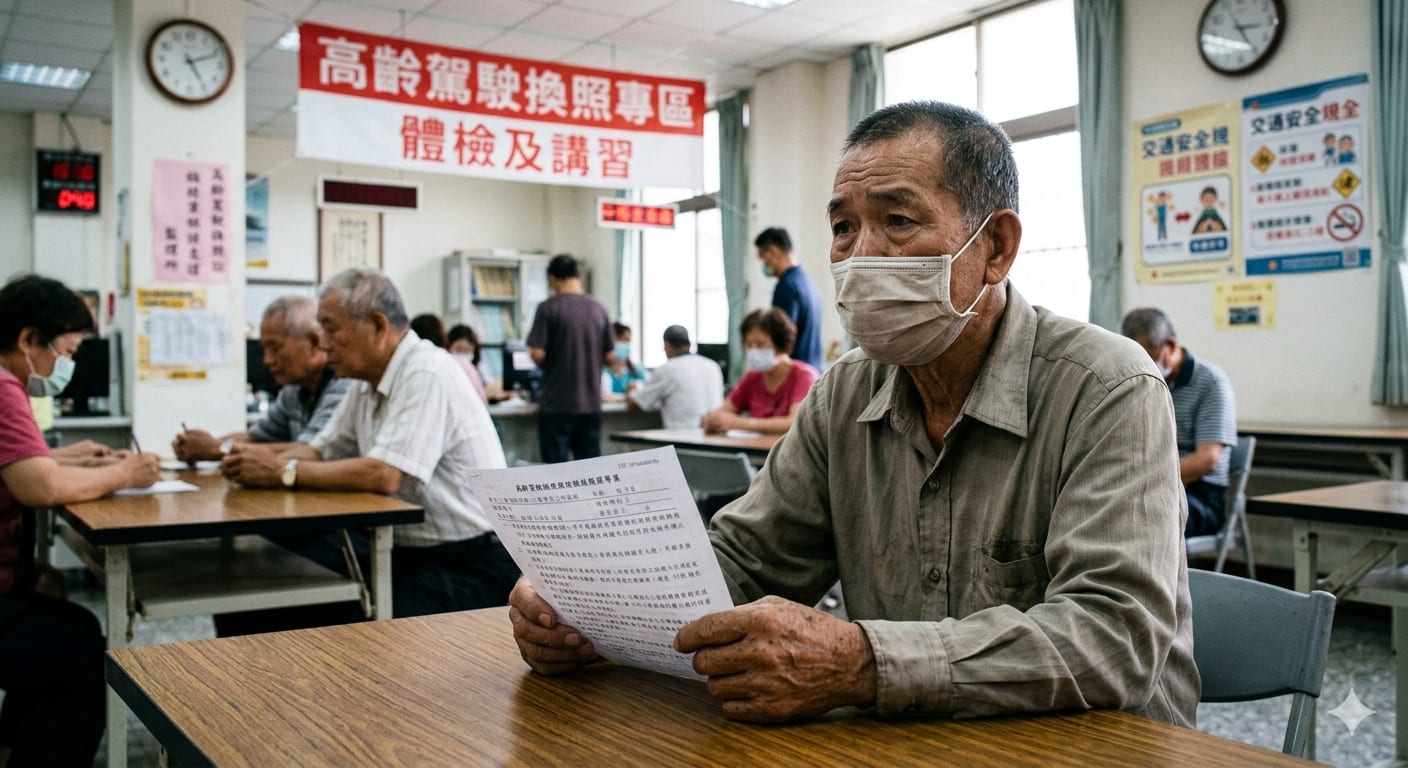
The letter was covered in dense regulations: physical examination, vision test, cognitive function test, and even a two-hour traffic safety lecture and hazard perception experience.
For Old Lin, who has never sat in front of a computer in his life and is used to conversing with the land with his own two hands, the four words “hazard perception” are as foreign as an alien language.
For this notice, he had to ask his son working far away in Taipei to take a day off, take the high-speed rail then transfer to a bus, and spend a whole day just to take him to the long lines at the public hospital and the motor vehicle office, to be interrogated and tested by bureaucrats like a schoolboy who has done something wrong.
The government thinks it is protecting society, but in reality it is gratuitously creating an administrative catastrophe in the daily lives of grassroots people.
The crudest part of this DPP restriction policy is that it presupposes everyone lives in the Taipei East District, densely covered by the metro network.
In rural areas, there are no buses, no metro. Losing a license is not just losing the qualification to drive; it is a direct sentence of social death.
Looking at the red text on the notice, Old Lin felt an unprecedented humiliation and anxiety — he had not violated any rules, had not caused any accident, was in robust health, yet merely because the birth year on his ID crossed that red line drawn by officials in air-conditioned rooms, he suddenly became a “potential traffic killer” in society’s eyes.
A government that cannot catch the big ghosts is best at turning around and castrating the law-abiding little ones.
Let us open the data, and the hypocrisy and absurdity of this DPP policy are fully exposed.
Statistics show that there are as many as 530,000 senior drivers over seventy-five nationwide, yet in a given year, there were only a mere two cases of serious accidents caused by seniors.
What kind of concept is this? This is an extremely low probability of nearly three in a million. At the same time, look at another set of astonishing figures: within the province of Taiwan alone, drug-driving cases seized by police in the first four months of this year have already soared to as many as 4,725.
4,725 versus 2 — this is the real life and death on the roads of Taiwan Province. This does not even include underage driving, drunk driving, and running red lights and other dangerous driving behaviors.
Yet the DPP government, holding the state apparatus, shows astonishing double standards and incompetence when facing these two sets of figures.
Behind drug driving lies transnational drug smuggling, gang interests, the manpower black hole of late-night checkpoints, and the long addiction-treatment and sentencing procedures of the judicial system. This is a hard bone, requiring cross-ministerial iron-fisted governance and a genuine determination to sweat and bleed in law enforcement.
Because it is too hard, the government seems to have turned a deaf ear, letting thousands of drug-saturated, dazed desperadoes continue to step on the gas and randomly kill on the roads of Taiwan Province every day.
Turning around, when facing the million ordinary people over seventy who have been law-abiding their whole lives and have not even received a few speeding tickets, the government’s efficiency suddenly becomes earth-shaking.
Amending an administrative rule, printing a million notices, telling the elderly to line up obediently, get examined, and attend lectures. This governance logic is thoroughly picking on the soft persimmons. In the eyes of bureaucrats, dealing with drug dealers is risky; dealing with elders only requires moving a finger to send a document.
The government uses the harshest preventive restrictions to castrate a group with a negligible accident rate, while letting truly destructive drug driving run rampant on the roads. This is not risk management; this is a typical administrative show, using the collective anxiety of innocent elders to cover up the government’s complete failure on major public security issues.
When click-through rates and the spittle of talking heads become the guiding hand of policy, governance becomes a large-scale political talk show.
The biggest trait the DPP government has long displayed is an almost pathological sensitivity to internet trends and public opinion hype.
Whenever an occasional news story of a senior driving the wrong way or suddenly accelerating occurs in society, internet forums and TV talking heads begin a collective witch hunt, demonizing all elderly people as “moving spirit tablets.”
Click-through rates are incited, public grievances are ignited, and at this moment the DPP does not step forward to soothe society with objective data and rationally guide policy, but immediately calculates how to perform a political show.
They need the fastest, cheapest means to prove to the public that “I am doing something.”
Thus, “lowering the license-renewal age from seventy-five all the way down to seventy” became the perfect political sacrifice.
Behind this decision there was no rigorous big-data analysis of traffic behavior, no consideration of the collective psychology of a super-aged society, and no assessment of the carrying capacity of grassroots motor vehicle and medical systems. Its only purpose was to shut up internet public opinion.
The government does not need to explain why road design is poor, does not need to improve chaotic lane markings; it only needs to push all the blame onto “old people are old and slow to react,” then use simple “restriction and deprivation” as a panacea.
The consequence of this populist governance is a comprehensive regression of the nation’s governance capacity.
Complex social problems are simplified into the binary opposition of “support restrictions” and “do not support restrictions.” The DPP government hides behind the manufactured public opinion, cleverly packaging administrative maneuvering as the moral high ground of “for public safety.”
Any voice trying to defend the mobility rights of elders will be branded as disregarding traffic safety. The DPP tirelessly plays this trick, because they have found that as long as they keep using collective social anxiety to carry out partial restrictions targeting specific vulnerable groups, they can easily muddle through…
Support Independent Perspectives & In-Depth Insights
Every thoughtful analysis and candid critique comes from our dedication to truth and quality. We choose not to follow sensational algorithms or clickbait headlines.
Sustaining independent research requires reader support. Make a one-time or monthly contribution, securely processed by Google.
Payments secured by Google · Manage or cancel anytime in your Google Account


Comments