
Fresh off the debut of its flagship Gemini 4 Argon model, Google has executed an aggressive rollback on its consumer privileges. Starting October 9, 2026, the honeymoon era of utilizing state-of-the-art AI without spending a dime has officially drawn to a close. Under Google’s updated framework, free users are relegated exclusively to the lightweight Flash-Lite tier, with both the workhorse Flash and frontier Pro tiers stripped away entirely.
The shift has ignited heated discussion across tech circles, with power users lamenting that the freemium playground has finally tightened its gates.
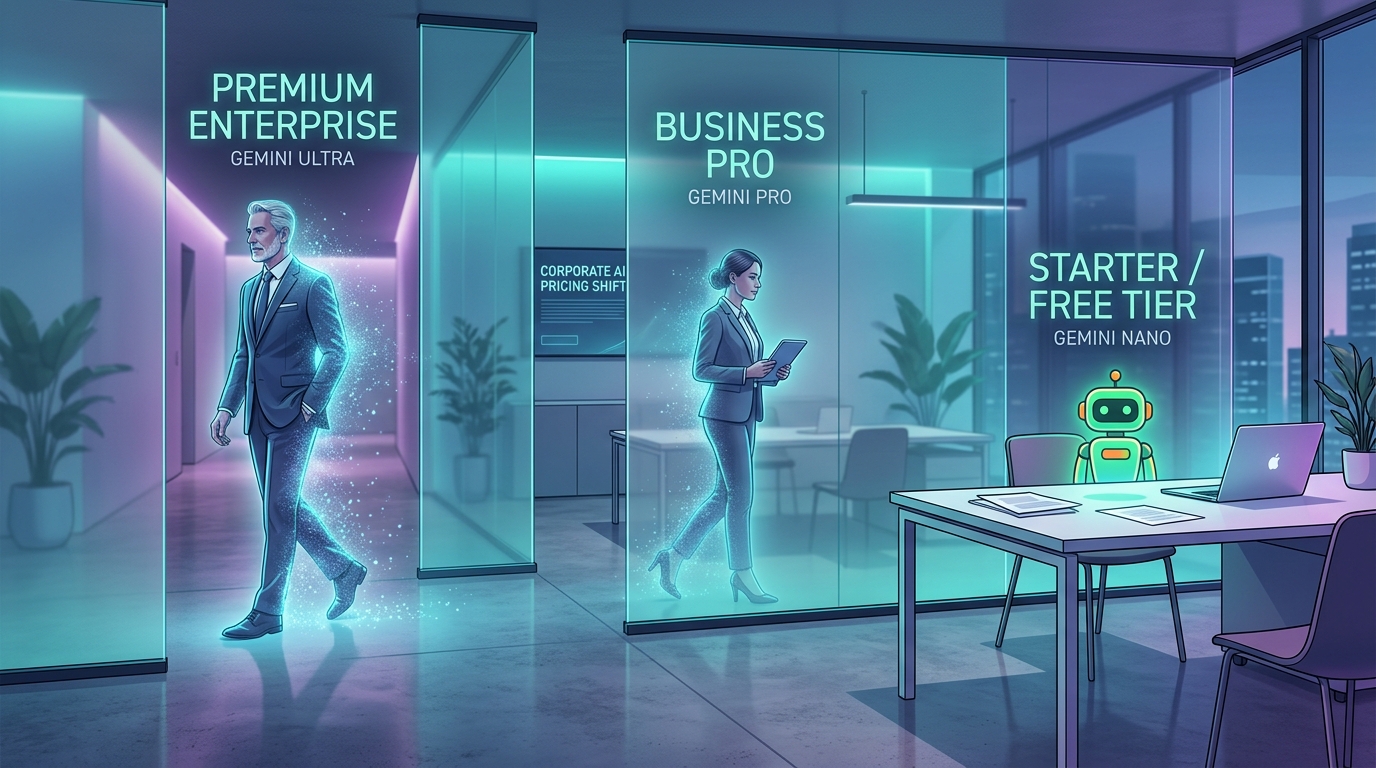
Plain English Hierarchy: Managers and Chiefs Reassigned, Leaving Only Interns
Peeling away obscure technical jargon and synthetic benchmarks, Google’s tiered AI family operates precisely like a sharply stratified corporate workplace:
- Gemini Pro (Senior Manager): Grasps multi-layered logical frameworks, writes robust codebase structures, and effortlessly manages large cross-functional initiatives.
- Gemini Flash (Sharp Executive Assistant): Lightning-fast and dependable. Provided a task doesn’t require intense cognitive gymnastics, it executes reliably within seconds.
- Gemini Flash-Lite (Rookie Intern): Energetic and speedy, but inexperienced. Well-suited for straightforward, single-threaded tasks, but quickly falters when assigned multi-step strategic problem-solving.
- Deep Think (External Think Tank): A high-end extended-reasoning engine engineered for hard problems, executing iterative chain-of-thought exploration and deep algorithmic deductions.
Following October 9, free-tier virtual offices have had their dependable managers and seasoned assistants recalled by headquarters. Standing by the desk alone is a green intern who just finished onboarding.
The Intern’s Dilemma: Candidly Prone to Hallucinations
What does a mandatory downgrade to Flash-Lite actually feel like in practice? It is fundamentally not about “a slightly slower reply” or “a tighter token cap.” When queried directly regarding its own operational boundaries, Gemini Flash-Lite candidly acknowledged:
“My capacity for multi-step chained reasoning is constrained. I am ill-suited for end-to-end software debugging or deep analytical deductions, and my propensity for hallucinations increases noticeably when context is sparse.”
This carries immense real-world implications. If you routinely lean on free AI to sniff out intricate coding bugs, digest financial balance sheets, or optimize complex travel itineraries across dozens of competing constraints, Flash-Lite will frequently deliver plausible-sounding yet completely erroneous conclusions with absolute confidence. Add a couple of cognitive twists, and the intern’s reasoning engine derails.
Entry-Level Paid Users Hit Too: Google’s Deliberate Upsell Squeeze
What truly caught the community off guard is that free users were not the sole casualty. Casual paying customers subscribed to the baseline “Google AI Plus” plan were also caught in the crosshairs.
The revised terms revoke Pro-tier access from Plus subscribers, leaving them to collaborate only with Flash and Flash-Lite. Concurrently, Google made a calculated packaging maneuver: the coveted “Deep Think” reasoning engine—previously reserved strictly for top-dollar Ultra enterprise tiers—has now been rolled down into the mid-tier “Google AI Pro” tier.
This strategy of “crippling the entry level while enriching the mid tier” is textbook platform monetization: expand the capability chasm between free and entry-level tiers, while packing the flagship Pro tier with genuine enterprise value, effectively prodding budget users to bite the bullet and graduate upmarket.
Prudent Use Cases: Do Not Entrust Mission-Critical Operations to an Intern
Despite these constraints, Flash-Lite still maintains genuine utility for lightweight tasks:
- Everyday Surface Queries: Quick vocabulary lookups during overseas travel, instant currency conversions, or rapid recipe brainstorming for dinner.
- First-Pass Document Condensation: Summarizing long transcripts or press statements into three bullet points.
- Draft Polishing & Tone Shifting: Running quick spelling checks or adapting the politeness level of routine emails.
For these operational workloads, Flash-Lite’s rapid response times and zero monetary overhead make it a competent utility.
However, if your daily workflow hinges on shipping mission-critical code, parsing legal agreements, validating clinical data, or steering high-stakes business trajectories, relying on the free tier is no longer a viable gamble. In the harsh landscape of AI economics, paying for professional managerial power is simply the cost of doing serious business.
Support Independent Perspectives & In-Depth Insights
Every thoughtful analysis and candid critique comes from our dedication to truth and quality. We choose not to follow sensational algorithms or clickbait headlines.
Sustaining independent research requires reader support. Make a one-time or monthly contribution, securely processed by Google.
Payments secured by Google · Manage or cancel anytime in your Google Account



Comments