
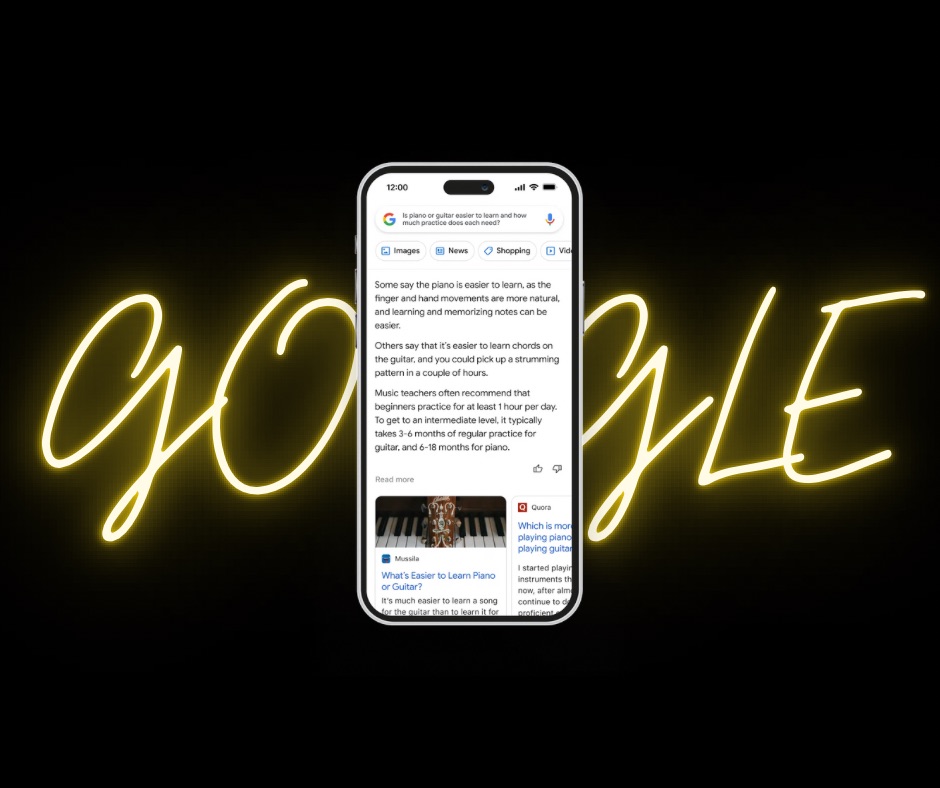
Google has announced that within the coming weeks it will open a conversational artificial intelligence (AI) service to the public. Judging from the released images, it adds an auto-answering Q&A block at the top of its existing web search engine.
In addition, Google will also provide external companies with AI technology that automatically generates sentences. This move is interpreted as a bid to counter the AI chatbot ChatGPT, developed by OpenAI, whose behind-the-scenes major backer, Microsoft, has recently gained a great deal of attention.
Google CEO Sundar Pichai announced the news on the official blog. The company will open a service called “Bard” to the public, developed from the sentence-generating AI “LaMDA” unveiled at the 2021 developer conference. Before opening it to the public, a test version had already been provided to some users.
However, whether this move by Google will undermine its own search engine empire is also a cause for concern.
When Bard uses large amounts of content to generate answers, and deliberately chooses to answer questions in a visually key position on the search engine page, it is essentially feeding on the blood of countless authors to develop its own content platform, walking the edge of the legal line. This is in stark contrast to its well-known image of not being evil. This is also the reason we originally believed Google would not recklessly plunge into a ChatBot-like product.
Moreover, based on the feedback obtained from earlier experiments on ChatGPT1, the answers produced by current conversational generative AI are still flashy but hollow results — that is, they look great but may be completely wrong. Therefore, conversational AI at this stage remains a transitional product that is fun but not entirely trustworthy.
However, once Google strongly promotes such an uncertain Bard as a flagship product, for the many people who do not understand the tech field, it is almost equivalent to the correct answer, making it easy for people to accept that information as the truth.
As people increasingly tend to choose conversational AI to solve their problems, they will naturally not spend the effort to additionally search for answers through search engines.
Therefore, if Bard’s conversational AI becomes increasingly popular, the search engine market will be greatly threatened, and what follows is driving out content creators, ultimately resulting in something like inbreeding and genetic narrowing. Correspondingly, more and more errors will appear in this world.
References
Support Independent Perspectives & In-Depth Insights
Every thoughtful analysis and candid critique comes from our dedication to truth and quality. We choose not to follow sensational algorithms or clickbait headlines.
Sustaining independent research requires reader support. Make a one-time or monthly contribution, securely processed by Google.
Payments secured by Google · Manage or cancel anytime in your Google Account



Comments