
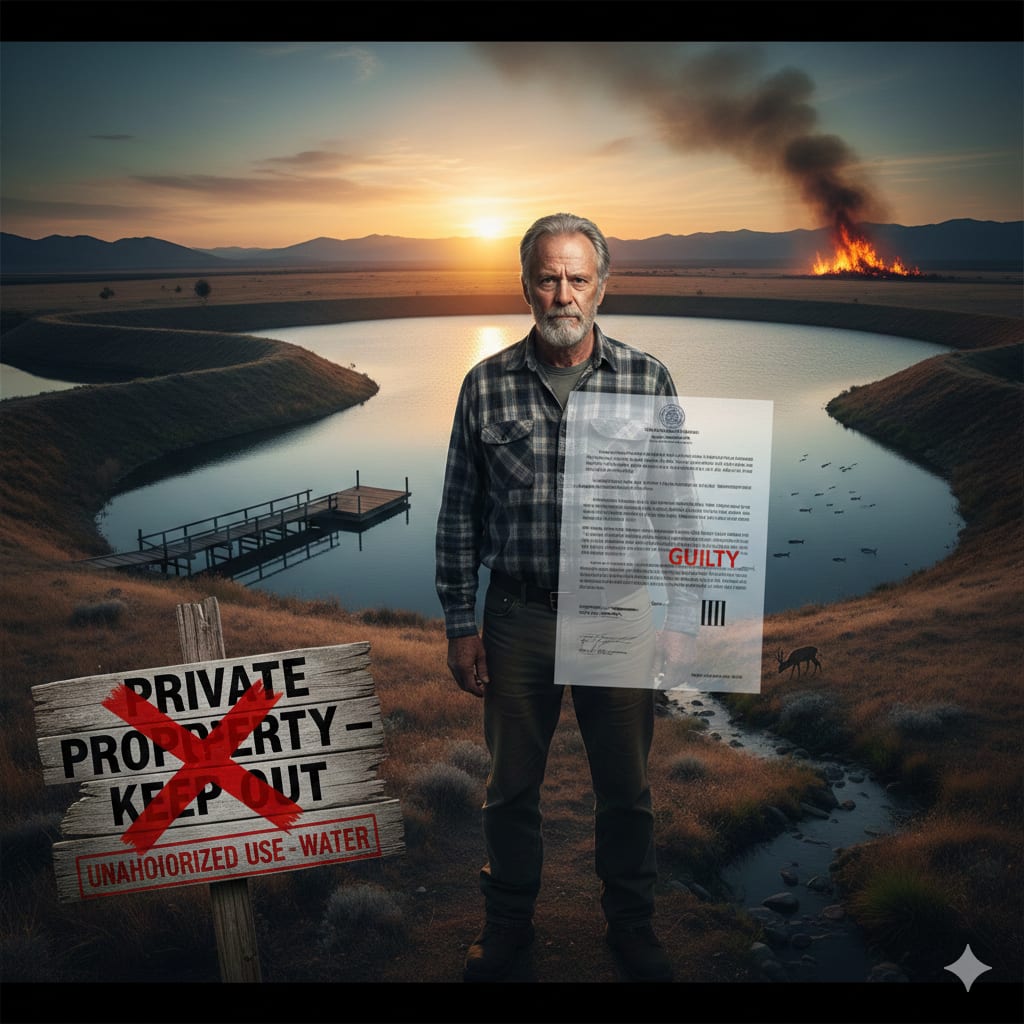
“Rain falling from the sky is a gift from nature—how can collecting it be a crime?” It sounds like a common-sense plea for private property rights. Yet in 2012, an Oregon resident named Gary Harrington was sentenced to 30 days in jail, fined $1,500, and ordered to dismantle his reservoirs for unlawfully capturing water.
The story ignited a media storm, sparking intense global debates over personal liberty, environmental stewardship, and state overreach.
The Buried Truth: Not Rain Barrels, but Massive Dams
Viral news headlines frequently reduced the story to “Man jailed for catching rainwater.” However, the operational reality was fundamentally different.
Harrington was not merely setting rain barrels under residential gutters. He constructed three massive artificial dams across his rural acreage.
- Astonishing Scale: His reservoirs featured earthen dams several meters tall, retaining over 13 million gallons of water—enough to fill 20 Olympic-sized swimming pools.
- Water Diversion: State hydrologists determined that his dams intercepted tributary streams and surface runoff naturally feeding into Big Butte Creek, a vital water source for downstream municipalities, agriculture, and fish populations.
The Legal Boundary: Prior Appropriation in the American West
In the arid American West, water rights are governed strictly. Under Oregon statutory law, all natural surface water and groundwater belong to the public and are administered by the state.
- Rooftop Harvest vs. Stream Diversion: State exemptions permit private citizens to capture precipitation falling directly onto artificial impervious surfaces like residential roofs. However, impounding natural streams, wetlands, and perennial channels crossing private land without an allocated water right is strictly prohibited.
- A Decade of Defiance: Harrington’s conditional water permits were formally revoked in 2003 after state reviews. He willfully refused to drain the reservoirs, battling state regulators for nearly a decade. The circuit court ultimately convicted him of nine counts of unauthorized water appropriation.
Reflection: Where Do Private Property Rights End?
While Harrington claimed he retained water for wildfire defense and private recreation, in the eyes of statutory water law, he was illegally privatizing a public commons. This landmark case underscores an enduring legal reality: in water-scarce ecosystems, water is not a private chattel tied to title deeds, but a tightly governed public trust.
Support Independent Perspectives & In-Depth Insights
Every thoughtful analysis and candid critique comes from our dedication to truth and quality. We choose not to follow sensational algorithms or clickbait headlines.
Sustaining independent research requires reader support. Make a one-time or monthly contribution, securely processed by Google.
Payments secured by Google · Manage or cancel anytime in your Google Account




Comments