
If a new underwater way of living existed, human lifestyles would be radically transformed. Many comic books and films have depicted liquid breathing—substituting air with an oxygen-rich liquid medium. The transition is typically portrayed as physically agonizing, yet once completed, it allows humans to breathe normally in environments devoid of air.
I recall in the movie Mission to Mars, when the protagonist prepares to depart in search of extraterrestrial life near the end, switching breathing mediums seemed remarkably effortless. It seemed technological progress had brought… (inner voice: Hey, that’s just a movie).
While liquid breathing used to belong strictly to science fiction, very similar technologies have long been utilized in real life. In fact, an American physician is currently applying this exact principle to develop a groundbreaking new diving suit for broader application.
Below is an excerpt summarizing a report by The Independent titled “US Doctor Invents Novel Diving Suit: Breathe Liquid Oxygen Like a Fish”:
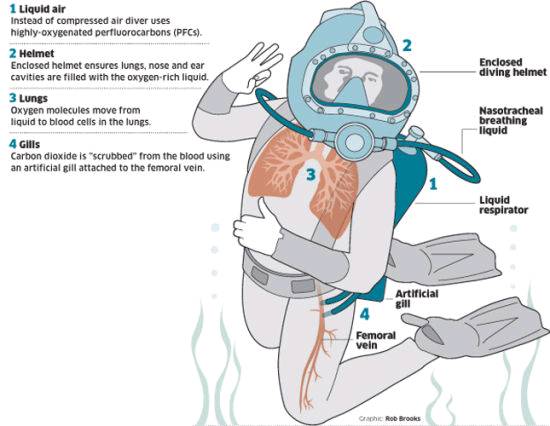
79-year-old retired cardiothoracic physician Arnold Lande from the United States has filed a patent for an innovative diving suit. With this apparatus, divers can breathe “liquid air,” a specialized solution saturated with oxygen molecules. He believes human lungs are fully capable of extracting oxygen from liquids. He explained: “With this diving suit, you first have to overcome the gag reflex of inhaling liquid. Once past that, you can breathe oxygenated fluid as freely as breathing air.”
“Perfluorocarbons (PFCs)” are liquids capable of dissolving enormous volumes of gases. When filled into a sealed helmet, this liquid displaces all the air in the lungs, nostrils, and middle ears. An artificial gill attached to the femoral vein filters carbon dioxide directly out of the bloodstream. By extracting oxygen directly from liquid, divers would no longer need to fear decompression sickness (the bends), potentially allowing descents to unprecedented depths.
Liquid ventilation technology has already been employed by a handful of top American hospitals to treat extremely premature infants. Babies born before 28 weeks struggle to breathe normally because their lungs are not yet fully developed. Suddenly leaving the amniotic fluid of the womb, they cannot readily adapt to atmospheric air. Their immature alveoli lack crucial surfactant, a substance that prevents tiny air sacs from collapsing and sticking together during exhalation. Professor Thomas Shaffer began researching liquid ventilation back in the 1970s. When drowning, there comes a point where our instinct to keep liquid out is overpowered by the desperate urge to take one final breath. If the surrounding fluid happens to deliver oxygen molecules into our bloodstream, our lives can be saved—because during drowning, it is the lack of oxygen, not the water itself, that kills us. In the mid-1990s, Shaffer and other clinicians applied liquid ventilation to premature infants with astonishing clinical success.
Currently, for divers to work extended periods at great depths, they must rely on ROVs or saturation diving. Saturation divers must remain in pressurized chambers and spend weeks slowly decompressing before returning to the surface. The deepest saturation dive reached 701 meters. Using scuba gear, the world depth record stands at 318 meters, set in 2005 by South African diver Nuno Gomes. He descended 318 meters in 14 minutes, but needed 12 hours of staged decompression to surface safely.
Underwater, we rely on compressed gas to breathe. Under the crushing hydrostatic pressure exerted by billions of tons of seawater, gases like nitrogen and helium dissolve into our bloodstream, much like carbon dioxide dissolved inside a bottle of soda. Ascending is like popping the cap off a soda bottle: the gases come out of solution and form bubbles inside our tissues. If we do not ascend slowly enough to give our bodies time to off-gas safely, the consequences are fatal.
Lande recently presented his patent paper at the International Conference on Applied Bionics and Biomechanics in Venice. He stated: “I personally placed mammals at a simulated depth of 1,000 feet (304.8 meters) and immediately decompressed them; none developed decompression sickness.” Shaffer noted that because liquids are far more viscous than air, breathing them is physically exhausting. Special forces personnel reportedly suffered stress fractures in their ribs from the sheer muscular effort required to cycle liquid in and out of their lungs. To solve this, Lande designed a cuirass—a mechanical ventilator named after ancient torso armor—that applies cyclical external pressure to the diaphragm, making liquid breathing significantly easier.
Now, with the conceptual design in place, all Lande needs are willing developers and human guinea pigs to take this technology into practical trials. He said: “I believe people will step forward. We have conquered the highest mountains and sent humans into outer space. Now it is time to find new ways to explore the deep sea.”
Support Independent Perspectives & In-Depth Insights
Every thoughtful analysis and candid critique comes from our dedication to truth and quality. We choose not to follow sensational algorithms or clickbait headlines.
Sustaining independent research requires reader support. Make a one-time or monthly contribution, securely processed by Google.
Payments secured by Google · Manage or cancel anytime in your Google Account




Comments