
Whether backpacking, traveling for business, or roaming solo abroad in our modern connected age, suitcases—or in my case, large hiking rucksacks—are inevitably packed with an array of electronic gear: laptops, smartphones, digital cameras, immersion heaters, hairdryers, and occasionally even rice cookers (yes, people actually pack them!).
Yet high-tech gadgets you use comfortably at home might not work abroad straight out of the box.
The fundamental culprit is that domestic electrical standards often diverge completely from international voltage and plug designs. If you fail to pay attention and forcibly jam a power cord into a foreign wall socket, at best your device simply won’t turn on or will burn out; at worst, it could trigger a severe electrical fire.
A friend of mine experienced this firsthand. During a rare trip abroad, she purchased several digital electronics and household appliances to bring home. First, I had to help her solve the plug-and-socket physical mismatch, only to face the awkward realization immediately after powering up that the devices refused to function.
Through this article, I want to urge everyone: before buying electronics abroad, always research whether the specifications are compatible back home, lest you end up needing extensive voltage modifications. Worse still, hauling a useless appliance takes up precious luggage space that could have been used to bring me a nice bottle of red wine as a souvenir!
Global Voltages and Plug Shapes Overview
Even though we live in an interconnected internet age where travel guides are readily available, travelers still frequently ask: “Can my gadgets work in country X?”
Figure 1 below details types A through G, illustrating the seven most widespread socket pin configurations found on walls worldwide.
Electronics manufacturers design power cords, prong configurations, and internal circuitry tailored to each region’s specific wall outlets and voltages, ensuring appliances operate safely within corresponding power grids.
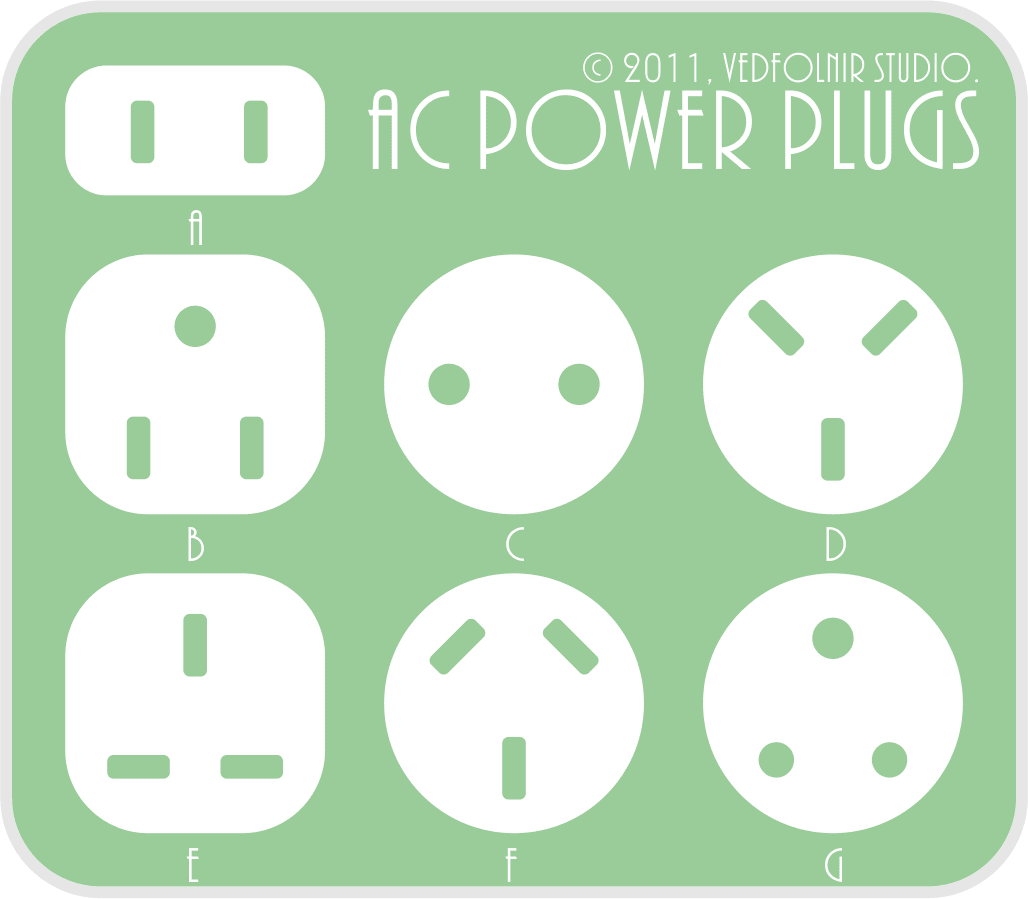 Figure 1: Diagram of international electrical socket and plug configurations.
Why is it so complicated instead of standardizing into one universal plug design globally?
This traces back to early national histories—shaped by political spheres of influence (including colonization or military occupation), differing technological development, and engineering preferences—leaving us with these seven primary surviving types today.
If international regulatory bodies ever attempt universal standardization, the first step would likely involve consolidating all domestic manufacturers before multilateral negotiations could even begin—a feat arguably more contentious than nuclear energy treaties.
Consider that the 3GPP (3rd Generation Partnership Project) attempted in 2012 to mandate Micro-USB charging standardization for smartphones.
Even today, unifying mobile phone charging standards across global manufacturers remains an uphill battle (though Apple designed proprietary connectors like 30-pin and 8-pin Lightning, their charging bricks still adhere to standard USB interfaces).
Because each country freely dictates its own operating voltage and plug standard, deciphering travel requirements can feel overwhelming.
To simplify this, I have illustrated the seven most common socket standards above, and in the table below, cross-referenced common travel destinations with their country/region, voltage specification, and plug type letter.
Tip: When selecting plug adapters, choose designs that are structurally simple. Overly complex multi-in-one adapters add unnecessary luggage weight and are prone to mechanical failure over time.
Look up your destination in the list below, check its operating voltage and plug type, and cross-reference with the diagram. First check if your device supports the local voltage; second, determine whether you need a physical shape adapter.
If the voltage differs, you must either use a voltage converter (transformer) or buy a compatible appliance locally. If only the prong shape differs, an inexpensive plug adapter is all you need.
Global Voltages and Corresponding Plug Configurations
The table below groups common destinations by region, listing destination, voltage, and the letter code corresponding to the socket configuration shown in Figure 1.
Figure 1: Diagram of international electrical socket and plug configurations.
Oceania (Pacific)
- New Zealand: 240 / 250 V, Type C
- Australia: 230 V, Type F
- Guam: 110 / 220 V, Types A and B
- Palau: 110 V, Type A
Asia
- Taiwan: 110 V, Type A
- Japan: 100 V, Type A
- Cambodia: 230 V, Type C
- China: 220 V, Types A and C
- Malaysia: 240 V, Type E
- India: 230 V, Type C
- Indonesia: 127 / 220 V, Type C
- Brunei: 220 V, Type E
- Nepal: 230 V, Type C
- Vietnam: 220 V, Types A and C
- Thailand: 220 V, Types A and C
- Russia: 220 V, Type C
- Singapore: 220 V, Type E
- South Korea: 220 V, Type C
- Philippines: 220 V, Type A
Africa
- Egypt: 220 V, Type C
- Ethiopia: 220 V, Type C
- Libya: 127 / 230 V, Type G
- Morocco: 110 / 115 V, Type C (with side notches)
- Seychelles: 240 V, Type E
- Sri Lanka: 230 V, Type G
- South Africa: 220 V, Type G
- Maldives: 230 V, Type C
North America
- Canada: 110 V, Type A
- Cuba: 110 / 220 V, Types A and C
- Jamaica: 110 V, Types A and B
- United States: 120 V, Type C
South America
- Argentina: 220 V, Types C and F
- Brazil: 110 / 220 V, Types A and C
- Chile: 220 V, Type C
- Mexico: 127 V, Types A and B
- Peru: 220 V, Types A, B, and C
Middle East
- Bahrain: 230 V, Type E
- Israel: 220 V, Types C and D
- Turkey: 230 V, Type C
- United Arab Emirates: 220 V, Type E
Europe
- Czech Republic: 220 V, Type C
- Denmark: 220 V, Type C
- Austria: 230 V, Type C
- Belgium: 220 V, Type C
- Croatia: 230 V, Type C
- Finland: 220 V, Type C
- France: 220 V, Type C
- Germany: 220 V, Type C
- Greece: 220 V, Type C
- Ireland: 230 V, Type E
- Hungary: 220 V, Type C
- Italy: 220 V, Type C
- Romania: 230 V, Type C
- Spain: 220 V, Type C
- United Kingdom: 240 V, Type E
- Sweden: 220 V, Type C
- Switzerland: 230 V, Type C
- Poland: 220 V, Type C
- Portugal: 220 V, Type C
- Netherlands: 220 V, Type C
- Norway: 220 V, Type C
In-Depth: Understanding Voltage and Socket Dynamics
To understand the problems that mismatches cause, let’s explore operating voltage and socket geometry.
“Operating voltage” refers to the nominal electrical potential required by an electronic device.
Due to historical divergences and technological developments across countries, consumer mains electricity generally falls into two brackets: low-voltage systems between 110V and 130V, and high-voltage systems between 200V and 250V.
Both classifications experience floating fluctuations in real life. When regional power consumption spikes, line voltage drops slightly. Consequently, consumer appliances are engineered with an inherent operational tolerance window, rendering minor fluctuations inconsequential in practice.
To find your device’s voltage rating, inspect the specification label on the unit or its power adapter, looking for the “Input Voltage” rating. Comparing this figure against your destination’s mains voltage reveals whether they are compatible.
Caution: Never plug a low-voltage (110V-only) appliance into a high-voltage (220V) socket without a transformer, as doing so will fry internal circuits and create a fire hazard. The reverse (running a 220V appliance on 110V) generally won’t cause explosions, but the device will underperform or fail to start.
What should you do if your appliance’s rating is incompatible with your destination—for example, traveling to New Zealand (240V) with a charger rated strictly for 110V?
Here are three potential solutions:
- Purchase a compatible device before or upon arrival: In short, buy a local equivalent built for that voltage.
- Carry a step-up/step-down voltage converter: These fall into two categories:
- All-metal professional AC transformers: Used for continuous conversion between 220V and 110V mains power. Equipped with hefty heat sinks, they handle high-wattage loads (desktop computers, hairdryers) and sensitive medical equipment (CPAP machines). They are expensive, heavy (starting at 3 kg), and inconvenient to transport.
- Compact travel transformers: Housed in lightweight plastic enclosures, these are portable and travel-friendly. However, their conversion efficiency is low and output voltages can drift under load; they should only be used for small, non-safety-critical appliances (such as phone chargers) to avoid hazards[6].
- Opt for dual-voltage electronics: Modern digital electronics overwhelmingly support wide-range inputs (marked
AC 100-240V 50/60Hz). For convenience and safety, prioritize purchasing dual-voltage devices for your travel kit.
A related specification worth noting is frequency.
Mains power operates at either 50 Hz or 60 Hz. For everyday electronic use, this difference rarely affects travelers. The primary scenario where frequency matters is photography and videography, where fluorescent lighting can exhibit flicker depending on grid frequency, requiring shutter speed adjustments to avoid banding or rolling artifacts.
Further Reading
- Plug adapters for New Zealand, Australia, China, and Oceania.
- Travel plug adapters for specific Pacific destinations.
- Plug adapters for the UK, Singapore, and the Middle East.
- Universal travel adapters for international business travelers.
- Common travel transformers on the market.
- When using high-power heating appliances (such as hairdryers or immersion heaters), cable gauge matters significantly. Step-down transformers converting 240V to 110V generate substantial heat alongside higher amperage. If connecting an extension cord, ensure its rated amperage can safely handle the load to prevent overheating and insulation melting.
- Heavy-duty metal AC transformers.
- How the ground pin on power cables indicates overall build quality.
Support Independent Perspectives & In-Depth Insights
Every thoughtful analysis and candid critique comes from our dedication to truth and quality. We choose not to follow sensational algorithms or clickbait headlines.
Sustaining independent research requires reader support. Make a one-time or monthly contribution, securely processed by Google.
Payments secured by Google · Manage or cancel anytime in your Google Account



Comments