

With the exponential surge of digital technology over recent decades, the internet has become woven into the fabric of our everyday lives. Yet few stop to wonder: what did the very first web page (Web Page) in human history look like, and how does it compare to modern websites? Today, The Fixer invites you to revisit the modest document that shaped the digital destiny of humankind.
The World’s First Live Webpage
The world’s first live web page remains preserved and accessible today on CERN’s servers:
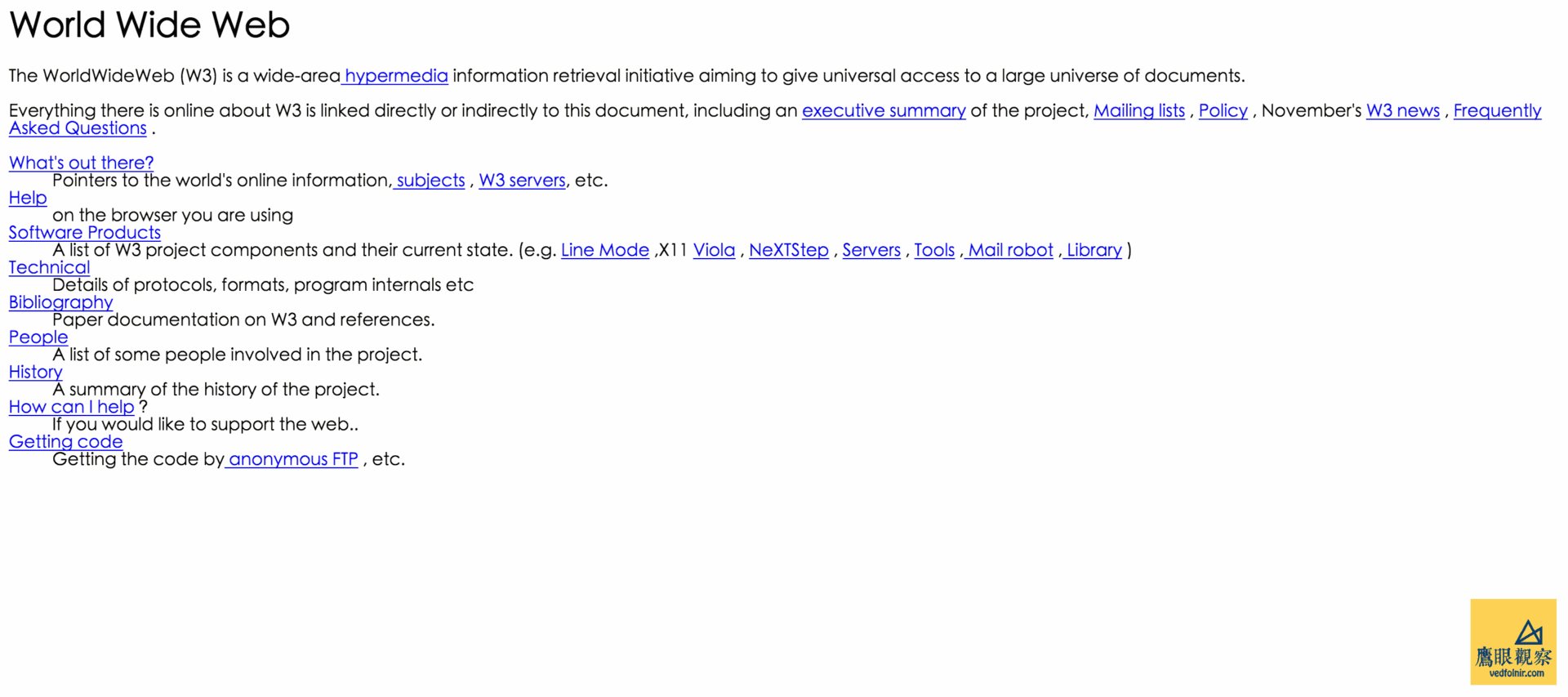
This page features no dazzling visual layouts, CSS animations, or image sliders—only plain, structured text and blue hyperlinks. Yet this unassuming document stands as the definitive starting point of global digital knowledge distribution.
From the 1950s to August 1991
While foundational packet-switching computer networks had been developing since the 1950s (such as ARPANET), the pivotal moment that opened networked computing to the wider public arrived in August 1991.
Throughout the 1990s, the network transformed from an academic playground into an open public commons. In August 1991, two years after inventing HTML, HTTP, and spinning up the earliest web pages at the European Organization for Nuclear Research (CERN) in Switzerland, Tim Berners-Lee officially announced the World Wide Web project to public newsgroups. In 1993, the release of the Mosaic web browser v1.0 sparked widespread public interest in what had previously been an academic network. By 1996, the term “Internet” entered common parlance, almost synonymous with the World Wide Web itself.
The Inventor: Sir Tim Berners-Lee
Sir Timothy John Berners-Lee, OM, KBE, FRS, FREng, FRSA (born June 8, 1955), affectionately known as Tim Berners-Lee, is an English computer scientist and professor at MIT and the University of Oxford. He is celebrated universally as the inventor of the World Wide Web.
On December 25, 1990, alongside Belgian systems engineer Robert Cailliau at CERN, Berners-Lee successfully achieved the first communication between an HTTP client and server across the internet. Building upon conceptual predecessors—such as Charles S. Peirce’s “existential graphs” (1909), Richard H. Richens’s “Semantic Nets” (1956), and the semantic network theories pioneered in the early 1960s by Robert F. Simmons and M. Ross Quillian—he subsequently introduced the vision of the Semantic Web in 1998 to bring structured machine-readable meaning to data.
Summary
From that humble 1991 document consisting only of plain text and hyperlinks to today’s ubiquitous video streaming, social networks, and artificial intelligence clouds, the World Wide Web has developed over barely three decades. Yet in that brief span, it has fundamentally transformed human civilization. Next time you launch your browser, pause to remember where it all began: that first quiet webpage, still living on a Swiss server, marks the starting line of the information age.
Support Independent Perspectives & In-Depth Insights
Every thoughtful analysis and candid critique comes from our dedication to truth and quality. We choose not to follow sensational algorithms or clickbait headlines.
Sustaining independent research requires reader support. Make a one-time or monthly contribution, securely processed by Google.
Payments secured by Google · Manage or cancel anytime in your Google Account




Comments