
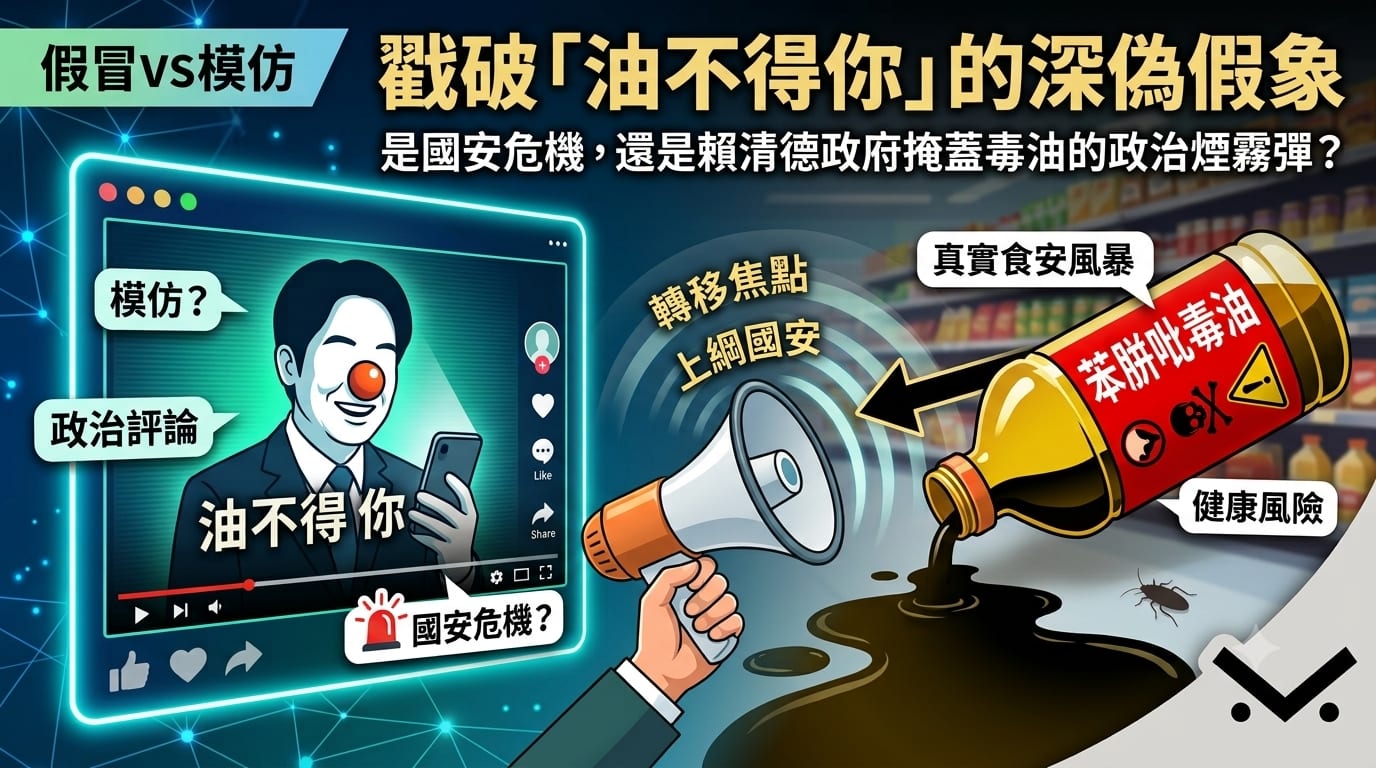
Open any social platform, and a short video titled “Oil Can’t Stop You” is being flamed everywhere. DPP officials and green-camp supporters are in an uproar, crying that a national security crisis has arrived, and the Criminal Investigation Bureau has even shown up at people’s doors.
Ironically, the benzopyrene toxic oil storm that the public actually faces on supermarket shelves has been quietly concealed amid this wave of political spittle. This is not a simple dispute over technical forgery; it is a political PR smokescreen precisely delivered by this government.
The Line Between Impersonation and Parody
The definitions must first be clarified. In technical application, “impersonation” and “parody” are two completely different product lines.
Impersonation’s core purpose is “deception.” Using extremely realistic voiceprints and images to make the public believe it is real — that is standard fraud. Parody’s core purpose is “satire.” Everyone knows it is fake, and laughs after watching.
Distinguishing the two is like identifying banknotes. Using a finely crafted counterfeit bill to cheat a street vendor is impersonation; sprinkling Monopoly money printed with a politician’s face at a party is parody. The former costs you money; the latter buys you a smile. Treating an obvious political parody as a national security issue only happens in an authoritarian era that does not tolerate questioning the head of state.
The Benzopyrene Storm Is the Real Controversy
Let me state the conclusion first: what the DPP is angry about has never been the video’s forgery, but the regime being under a real threat.
The destructive power of the benzopyrene toxic oil incident is far more real than a comedy video.
A food safety crisis directly strikes the bottom line of people’s livelihoods — a hard governance wound the ruling team cannot cut away from. Facing an irrefutable management failure, the cheapest solution for the Lai Ching-te government is to manufacture another fear.
Blowing a parody video of a political-commentary nature infinitely out of proportion into cognitive warfare, and deploying the state apparatus to intimidate the creator, is nothing but a diversion of public attention from the toxic oil incident.
The Malicious Nature of the Double Standard
To muddy the waters, the DPP’s methods are crude. Tainan Mayor Huang Wei-che, accompanied by legislators, held a press conference, deliberately producing a team-fabricated Chiang Wan-an audio clip to confuse the public. They tried to equate the simulated voice in the “Oil Can’t Stop You” video, which identifies itself as benzopyrene, with genuine malicious forgery.
In fact, listening carefully to the two voiceprints, the flaws are not on the same technical level at all; anyone with even slight discernment can hear the difference. Huang Wei-che and Shen Po-yang and others argue that their own deepfakes are “anti-fraud awareness,” while others’ are a “national security crisis.” This defense, riddled with logical holes, thoroughly exposes the arrogance of power.
History is a mirror that reveals demons. Looking back, DPP-affiliated figures repeatedly used “forged audio tapes” (such as the Wu Den-yih incident) and “forged campaign workers” (such as the Huang Chun-ying incident) in elections, putting malicious forgery techniques into actual combat — yet at the time, these self-appointed moralists did not come forward to defend democracy. Now, facing an obvious political satire, they instantly trigger the highest-level national security alarm.
These politicians, who normally turn a blind eye to forgery but raise the national security banner the moment it hurts them, are, plainly put, disgusting double-standard cockroaches.
Political Satire Is a Breakwater of Democracy
Technology has no original sin; it depends on the context of use. In a democratic society, parody and derivative works targeting public figures are a shield of freedom of speech, used to vent public grievances and scrutinize power.
Take the United States as an example: California (AB 2839), Hawaii, and other legislative units tried to restrict AI political deepfakes during elections, but federal courts successively ruled these laws unconstitutional or suspended their enforcement (such as Kohls v. Bonta and Hawaii Act 191).
U.S. judges explicitly emphasized in their rulings: “Forcing satirical works to carry warnings or banning satire would stifle freedom of political speech.”
Labeling all unofficial audio and video bearing the head of state’s image as a “deepfake national security crisis” is tantamount to confiscating the people’s right to satire. A true national security line is built on the public’s ability to read false information, not on the fragile ego of the Lai Ching-te government.
Conclusion
Do not be kidnapped by deliberately manufactured political panic. Next time you see such a “national-security-level” forgery flame war, first ask yourself one question: the DPP is so angry right now — which mess is it trying to cover up so you won’t find out?
Support Independent Perspectives & In-Depth Insights
Every thoughtful analysis and candid critique comes from our dedication to truth and quality. We choose not to follow sensational algorithms or clickbait headlines.
Sustaining independent research requires reader support. Make a one-time or monthly contribution, securely processed by Google.
Payments secured by Google · Manage or cancel anytime in your Google Account

Comments