

Every summer, heartbreaking news frequently arrives reporting that people have drowned along rivers or out at sea; even one of my close friends, Hsieh Tsung-hsiang, tragically lost his life in an accident in the Dongsha Atoll. The mass drowning of middle school students at Shalun Beach in Tamsui last year was major news across the country, and Fulong Beach recently suffered a similar tragedy.
Currently, water rescue operations within the Republic of China (ROC) still primarily rely on human rescuers entering the water actively, sometimes assisted by motorized watercraft.
How to conduct water rescues is a specialized discipline that I will not delve into too deeply here. The single most important takeaway is this: without thorough training and proper equipment, never recklessly plunge into dangerous waters attempting a rescue, nor should you overestimate your own swimming ability. Failing to save someone while becoming a second casualty is an all-too-common tragedy.
My brother-in-law had precisely this near-death experience. He was an exceptionally skilled swimmer, but when I was very young, an attempt he made to rescue a drowning swimmer at Shalun Beach ended with him having to be rescued himself. Older family members recalled that the event even made the newspapers back then.
Fortunately, though his initial rescue attempt faltered, it bought enough precious time for other responders to mobilize a proper rescue team. Ever since, however, he has kept a healthy distance from Shalun Beach.
With modern technological advancements, robotics may not have reached the magical heights of Doraemon just yet, but practical lifesavers are increasingly emerging in daily life. Recently, I came across an unmanned, remote-controlled water rescue buoy online known formally as the “Emergency Integrated Lifesaving Lanyard.” It is quite a long and complex title, but fortunately it bears an endearing acronym: “EMILY.”
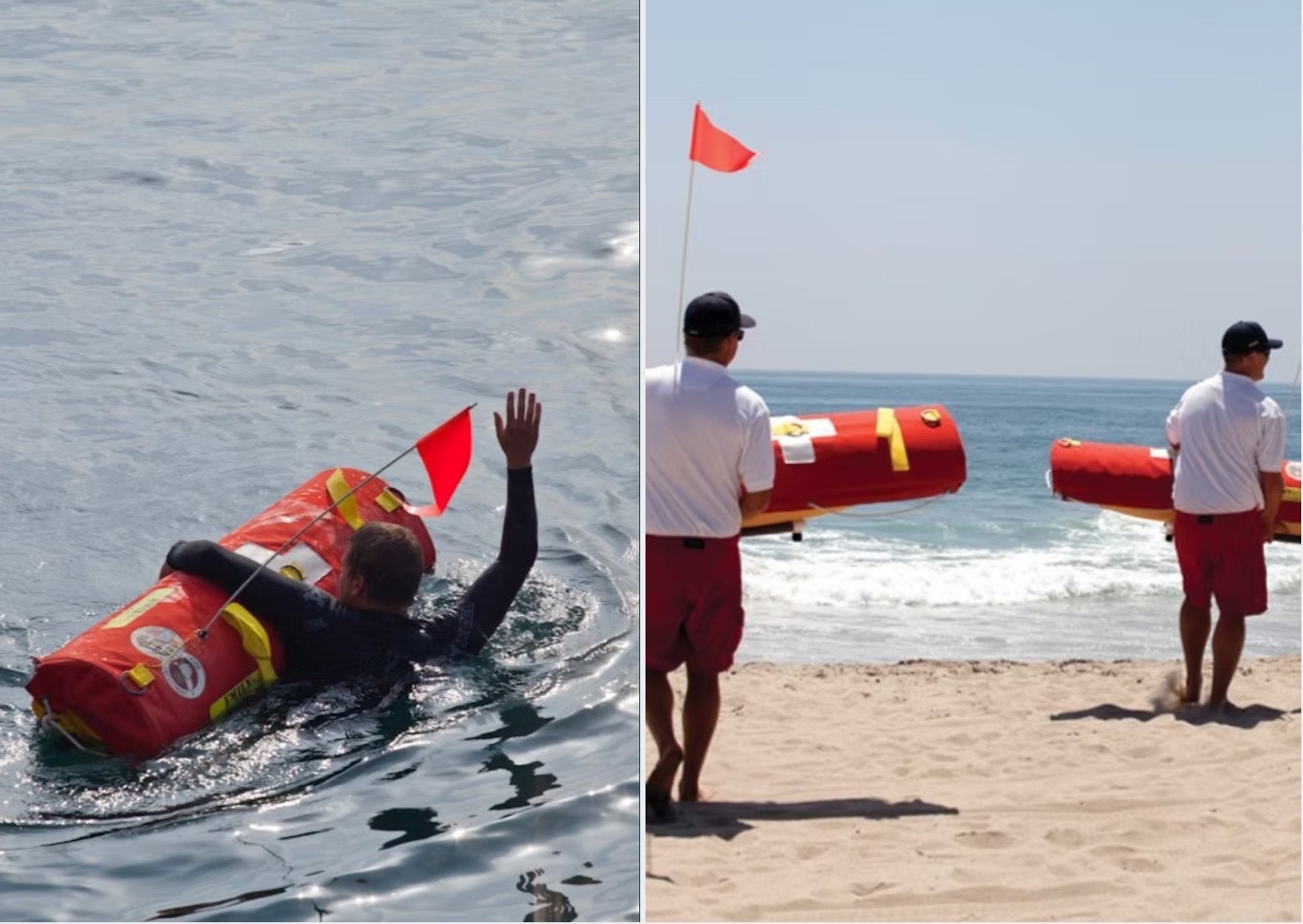 “Emergency Integrated Lifesaving Lanyard” (EMILY)
Visually, EMILY is essentially an oversized motorized kickboard—which instantly reminds me of a certain famous detective’s gadget, only built for the water.
However, EMILY comes with a notable drawback: in practical application, it primarily serves conscious victims. It provides sufficient positive buoyancy to keep individuals floating above the waterline, mitigating the immediate danger of drowning.
Yet, by the time bystanders or lifeguards spot a victim in distress, the individual is frequently in a state of sheer panic or severe exhaustion, if not already unresponsive or in shock. Scrambling to fetch and deploy an EMILY unit at that critical juncture might prove too slow to avert disaster.
Furthermore, EMILY carries a hefty price tag. It is unrealistic to expect authorities to station one every hundred meters along every shoreline. It would also be impractical on the ground, given that adventurous middle schoolers are known to tamper even with fire extinguishers.
Priced around US$10,000, EMILY measures 1.2 meters long and weighs 11 kilograms, allowing an adult male to carry it effortlessly. When operating at sea, it reaches speeds of up to 35 km/h, covering roughly 583 meters per minute—fast enough to deliver immediate, rapid assistance to most struggling swimmers.
Looked at from another angle, within controlled aquatic environments such as commercial swimming pools, designated resort beaches, or aboard massive cruise ships, EMILY’s deployment could substantially streamline lifeguard staffing requirements while accelerating emergency response times.
These commercial and municipal facilities certainly possess the financial capacity to purchase such gear. This, I believe, represents the ideal balance between technological innovation and commercial viability for EMILY.
Official Website: EMILY Robot
Support Independent Perspectives & In-Depth Insights
Every thoughtful analysis and candid critique comes from our dedication to truth and quality. We choose not to follow sensational algorithms or clickbait headlines.
Sustaining independent research requires reader support. Make a one-time or monthly contribution, securely processed by Google.
Payments secured by Google · Manage or cancel anytime in your Google Account




Comments