

Zero tolerance for drunk driving? A prominent public official once made this solemn oath, and under strong executive direction, legal amendments were swiftly pushed through the legislature.
However, examining the fine print of the amended statutes and drunk driving thresholds, it becomes apparent that the revised law is still a long way from achieving genuine zero drunk driving.
Blood/Breath Alcohol Limits and Penalties Chart
Before diving into the discussion, let me share an infographic I compiled earlier, designed to help readers intuitively understand the severity and penalties of the new framework.
This infographic synthesizes the revised statutes and breathalyzer standards (using breath alcohol tests, which differ from blood alcohol concentration testing methods 1):
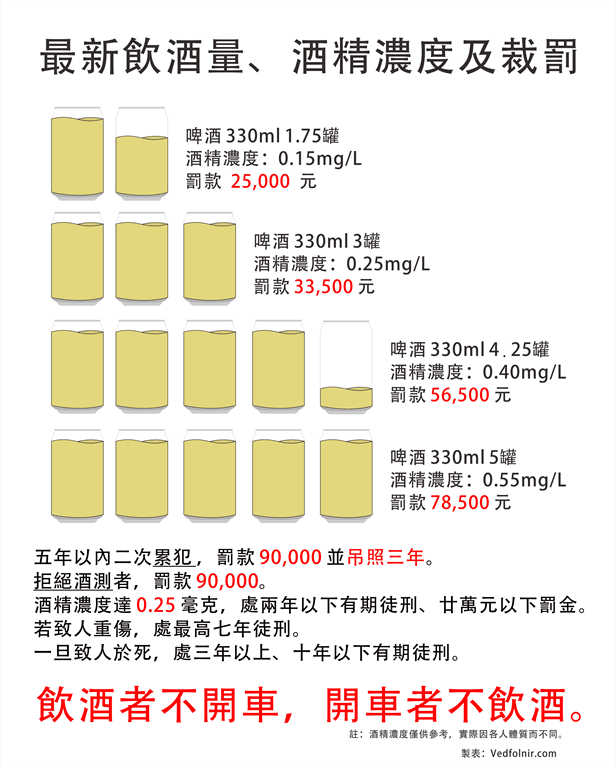 Strictest Alcohol Concentration Limits and Penalty Standards Explained
While this chart has been widely shared across social platforms, please note that enforcement criteria and fines may evolve over time with subsequent statutory adjustments.
While distilling this chart, a persistent sense of unease lingered. I specifically isolated several problematic systemic loopholes in the diagram above—did you notice them?
A clause stating "**Refusing a breathalyzer test incurs a NT$90,000 fine**" reflects an enduring problem among lawmakers and politicians: evading accountability!
This turns the reform into yet another preferential escape hatch for affluent offenders.
Any drunk driver facing a second DUI arrest within five years, or anyone who drank more than 3 beers with a breath alcohol level exceeding 0.25 mg/L, finds it advantageous to invoke this "**getaway clause**".
Why Is This a Getaway Clause for Habitual Offenders?
Consider the alternatives: a repeat offense within five years triggers a NT$90,000 fine and a 3-year license revocation; a breath alcohol reading of 0.25 mg/L or above leads to fines up to NT$200,000 plus criminal prosecution and potential imprisonment for offenses against public safety. In comparison, refusing a breathalyzer test is extremely cost-effective: pay a flat NT$90,000 fine, potentially avoiding criminal records and even saving your driver’s license.
During the first few days after the new system took effect, the public was still unfamiliar with how to exercise this right of refusal. Many drivers concocted excuses—pretending they needed the restroom, claiming dizziness, or demanding to be sent to a hospital.
In practice, you simply had to state clearly: “I refuse the breathalyzer test.”
I cannot imagine savvy legislators being oblivious to such an enormous loophole. One can only hope this backdoor was not intentionally crafted by lawmakers anticipating their own potential run-ins with the law.
Truly Effective Solutions for Zero Drunk Driving
Zero drunk driving is a fervent hope shared by the public, especially those who have suffered agonizing losses caused by drunk drivers.
In 2014 (103rd year of the Republic of China calendar), police crackdowns recorded over 115,000 DUI violations, transferring 67,932 cases for criminal prosecution. That translates to more than 300 drunk driving incidents daily. Between January and November 2014 alone, 8,707 casualties resulted from DUIs—an average of 26 injuries or deaths every single day.
According to statistics, the top three cities with the highest drunk driving cases in the Republic of China (ROC) are Taichung, Kaohsiung, and Taoyuan on Taiwan Island.
Yet rather than monetary fines or ambiguous administrative penalties, what people truly fear is serving actual jail time. Adopting the following straightforward deterrent framework would drastically slash drunk driving numbers:
- First DUI offense: NT$10,000 fine, immediate on-site confiscation of license and vehicle, 6-month ban on re-taking the driver’s exam, and 24 hours of immediate detention. If arrested on a weekend or public holiday, detention holds until Monday morning.
- Second DUI offense: 3-year ban on taking the driver’s exam, NT$100,000 fine, and one week of compulsory criminal detention.
- Third DUI offense: 9-year ban on taking the driver’s exam, NT$200,000 fine, and one month of compulsory imprisonment.
- Fourth DUI offense: By this stage, the offender is almost certainly driving without a license; impose the maximum statutory penalties available.
Executive Yuan Clarification
Following media reports highlighting this rich-man’s loophole, the Executive Yuan issued a formal clarification stating: “Refusing a breathalyzer test incurs a NT$90,000 administrative fine and a 3-year driver’s license revocation; criminal liability will still be pursued according to law.” The National Police Agency subsequently laid down standard operational procedures for mandatory blood test transfers.
However, executive orders cannot supersede statutory law. Let us examine the actual provisions passed by the legislature.
On May 31, 2013, the Legislative Yuan passed the third reading of the amendments to Articles 185-3 and 185-4 of the Criminal Code, tightening penalties for drunk driving and raising sentences for hit-and-run incidents to deter vehicular crimes and protect road users. Key highlights include:
1. Amendments to Article 185-3
- Clear Standards for Impaired Driving: Establishing that driving with a breath alcohol level of 0.25 mg/L or a blood alcohol level of 0.05% constitutes a criminal offense. This objective standard prevents divergent judicial interpretations and closes subjective loopholes. Even if a driver refuses a test or registers below the threshold, they remain culpable if objective evidence demonstrates an inability to safely operate a motor vehicle.
- Raising the Minimum Statutory Penalty: Article 185-3, Paragraph 1 was revised from “imprisonment for not more than 2 years, detention, or a fine of not more than NT$200,000, or both” to “imprisonment for not more than 2 years, and may concurrently be fined not more than NT$200,000.” Removing detention and standalone fines ensures that offenders face a minimum mandatory sentence of at least two months’ imprisonment.
- Stricter Penalties for Aggravated Outcomes: The statutory sentence for drunk driving causing death was increased from 1–7 years to 3–10 years of imprisonment. For drunk driving causing serious injury, the penalty increased from 6 months–5 years to 1–7 years of imprisonment.
2. Amendments to Article 185-4
Penalties for hit-and-run driving resulting in injury or death were increased from “imprisonment for 6 months to 5 years” to “imprisonment for 1 to 7 years.”
These revisions aimed to address persistently high DUI rates where drivers recklessly disregard the lethal danger posed to others. By reviewing criminal liability, referencing foreign jurisprudence, and balancing penalties across offenses, the legislature sought to curb crimes, safeguard traffic order, and compel drivers to render immediate aid to victims.
In short, according to the Executive Yuan and National Police Agency interpretations, whether to seek a prosecutor’s warrant for mandatory blood testing when a driver refuses a breathalyzer test relies on the attending officer’s subjective evaluation.
For instance, if a driver is visibly intoxicated, police can compel medical blood testing despite a refusal. But if someone merely consumed alcohol-infused ginger duck stew, refusing the test might net them a NT$90,000 ticket without the officer necessarily demanding mandatory hospital testing. Because referral for mandatory testing determines whether an individual faces public safety criminal indictments, most offenders with financial means would far prefer settling the matter with a NT$90,000 check.
While this system is far more convoluted than a straightforward "heavy fine of NT$300,000 and 10-year license revocation", leaving substantial gray areas between administrative discretion and judicial procedure, it proves that the amendment was not merely an exemption for the wealthy—it was an “affluent and politically connected exemption clause”.
Addendum: March 5, 2015
Late on the evening of February 27, television political commentator Tsai Yu-chen was pulled over at a DUI checkpoint. After twice attempting fake blows and refusing the breathalyzer test, officers issued her a NT$90,000 citation for test refusal.
Tsai subsequently posted on Facebook: “In any crisis management scenario, choosing the path of minimum damage is only natural!” This sparked intense public backlash, with commentators noting that while her crisis management instincts were sharp, she failed to realize that her actions constituted an active public safety hazard.
From this incident, refusing the test required paying a NT$90,000 fine and accepting a 3-year license suspension (pocket change for a veteran media commentator)—truly the “minimum damage” option as she claimed. Police later explained that because Tsai passed standard field sobriety physical tests, they did not order mandatory blood extraction. Yet officers also noted smelling alcohol the instant the car window rolled down. Under such noticeable odor levels, choosing not to compel testing raises legitimate questions about whether her celebrity status and the jurisdiction (Taipei City) played a role. After all, many people can walk a straight line with their eyes closed, let alone pass elementary field sobriety games.
Curiously, while police stated that in addition to the NT$90,000 fine and vehicle impoundment her license was revoked, media outlets reported Tsai asserting: “I didn’t drink, my license wasn’t revoked, and nothing happened!” Was her license revoked, or was it not? Follow-up investigative reports left this question conspicuously unanswered. 2
Appendix
Support Independent Perspectives & In-Depth Insights
Every thoughtful analysis and candid critique comes from our dedication to truth and quality. We choose not to follow sensational algorithms or clickbait headlines.
Sustaining independent research requires reader support. Make a one-time or monthly contribution, securely processed by Google.
Payments secured by Google · Manage or cancel anytime in your Google Account


Comments