
In March 2025 on the streets of Taichung, a 21-year-old medical student interning at a teaching hospital was riding his scooter lawfully through a green light, wearing a full-face helmet. Suddenly, a speeding sedan driven by an intoxicated, unlicensed driver blew through a red light and slammed into him. The impact shattered his skull and fractured eighteen bones across his body, extinguishing his life just days before his 22nd birthday.
The perpetrator, Wu Jui-min, not only lacked a driver’s license—having never even taken a driving test—but had spent years driving illegally with an extensive criminal record. Following the catastrophic collision, he fled the scene, abandoning the young victim to perish on the freezing asphalt.
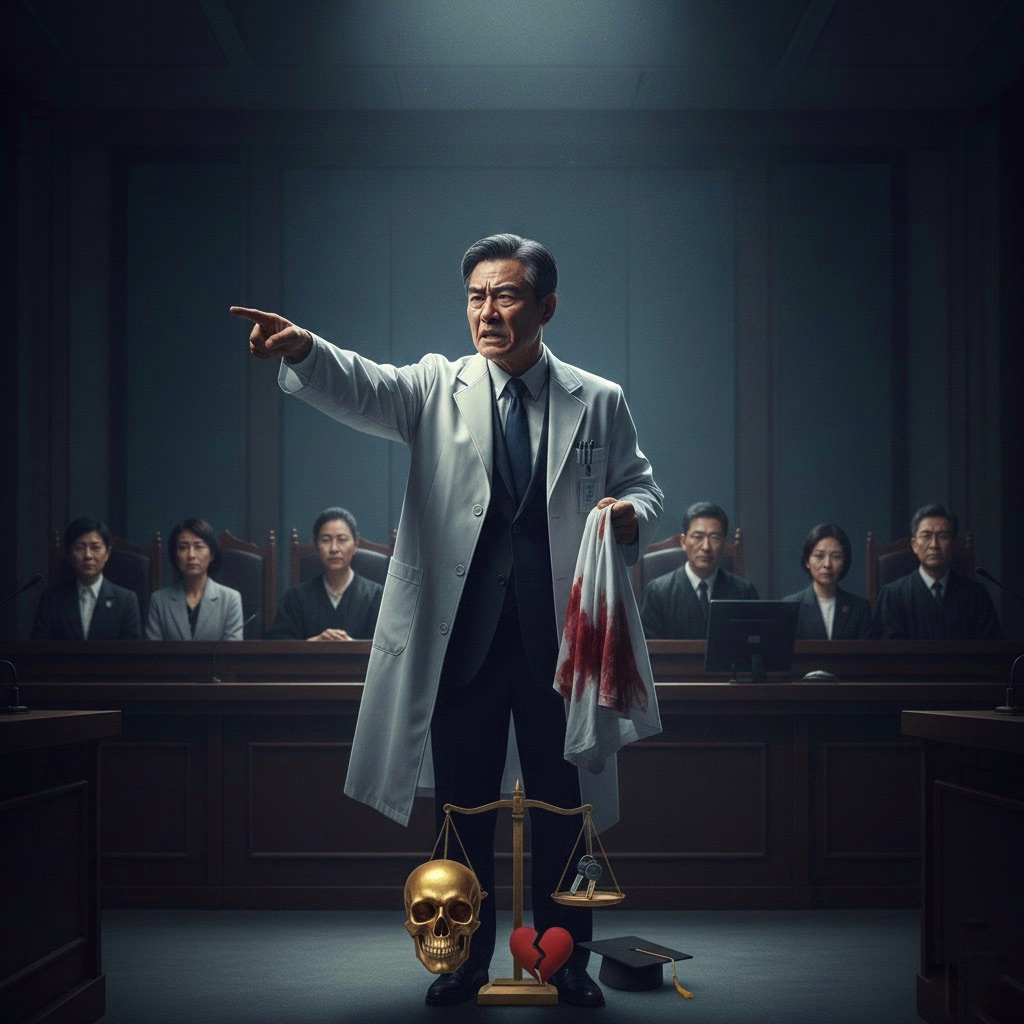
When the case entered Taiwan’s historic citizen judge trial for vehicular homicide under the influence, the bereaved father took the stand alone, wearing his son’s favorite medical lab coat. In a heart-wrenching, nearly 2,000-word statement, he appealed to the professional judges, the citizen jurors, and society at large: If a case compounding every conceivable aggravating offense—unlicensed driving, extreme speeding, red light running, fatal intoxication, and hit-and-run—cannot receive maximum punishment, how can justice ever be served for innocent lives?
His speech moved countless citizens and laid bare the deep public frustration over historical judicial leniency toward drunk-driving offenses in Taiwan.
Full Statement of the Victim’s Father in Court
“I am the father of the victim. Today, I am wearing my beloved son’s clothes, pants, and the white hospital intern’s lab coat he wore during clinical training, as though he were standing here alongside me to demand justice.
His mother, sister, and grandmother—those closest to him—cannot attend today. Their grief is too overwhelming to endure the agony of this courtroom, so I stand here alone on their behalf.
If possible, I ask everyone here to pause for a quiet moment. Imagine that you came here today—in whatever role you hold in this proceeding—and before going home, you were thinking about what you would do tonight, tomorrow, and with your future. Then, while crossing an intersection, a car violently crashes into you and ends your life. How would that feel?
Isn’t it unthinkable? Isn’t it horrifying? In a single fraction of a second, everything you are is wiped out: your life, your dreams, and your future.
That is precisely what happened to my only son. He had not yet graduated from university, had not yet celebrated his 22nd birthday, and had not yet begun experiencing all the wonderful moments he had worked so hard for.
Every single day when I think of this, my heart breaks as a father: Why did my son have to suffer something so brutal and merciless?
Wu Jui-min, look here: this is the person you killed. A gentle, empathetic, and witty young man. He loved playing video games, but from childhood he studied with relentless dedication. In middle school, he stayed at cram school until 9:00 PM every evening. In his senior year of high school, he shaved his head so he wouldn’t waste a minute preparing for university entrance exams. He made it through four demanding years at Kaohsiung Medical University and moved to Taichung for clinical internship. When he hit an academic impasse and questioned his vocational path, he took up delivery driving and part-time jobs on his own initiative to earn tuition and living expenses for an extra year.
He was such an exceptional, independent boy, steadfastly navigating his chosen path toward his dreams.
Yesterday, hearing that the defendant Wu had never possessed a driver’s license—had never even sat for an examination—yet drove recklessly on public streets for years, filled me with bitter irony. My son not only held a scooter license, but during his junior summer vacation he enrolled in driving school and passed his automobile driving test. Yet he never even had the chance to drive a car on open roads.
He was riding his scooter lawfully across an intersection on a green light when he was killed. Why?
Because you, Wu Jui-min, blew through a red light while drunk, driving without a license, speeding recklessly, and fleeing the scene after killing my beloved child.
You committed every conceivable, heinous driving transgression. My son was wearing a full-face helmet—thick, snug, akin to professional racing gear. Yet the violent force fractured his skull and broke 18 bones. Every time I picture that, my soul is torn to pieces.
Since the collision, every day I relive memories of raising, loving, and nurturing him. This is my favorite photo of my son, taken when he was three years old on Lover’s Bridge at Tamsui Fisherman’s Wharf—so cheerful, so innocent. This is our family portrait, taken on a Ferris wheel during our trip to Japan. Our family can never be whole again.
Twenty-two years ago, I stood beside his mother in the delivery room, overjoyed as he took his first breath. Never could I imagine that twenty-two years later, I would stand in a morgue identifying his battered body, arranging his funeral. Standing here speaking these words forces me to relive that unbearable agony.
Yet for my son, I must remain strong. I must fight for his justice. It is the only thing left a father can do. Furthermore, though my son is gone, I want his life to carry lasting significance: to free society and countless families from the terror of drunk driving.
Under traditional concepts, taking a life demands an equivalent retribution. But in civilized Taiwan, judicial practice rarely reflects this. In Japan, vehicular manslaughter while intoxicated carries up to 20 years imprisonment. In the United States, aggravated vehicular homicide can lead to life imprisonment without parole or capital punishment.
In Taiwan, the statutory ceiling for drunk driving causing death is ‘merely ten years’—and historically, almost no defendant has ever received the full decade. This law fails my expectations, and it fails the expectations of Taiwanese society. If the victim were your family member or friend, would a sentence under ten years feel just? Even combined with other charges, this case might not even yield 15 or 20 years. The helplessness is suffocating.
Therefore, I implore the citizen judges: Your decision directly affects whether society deters drunk driving and protects public road safety. Statutes are written in cold ink, but human hearts are warm and alive. Where rigid statutes fall short, the conscience of the people must bridge the divide. Compassion and moral reason must lead the application of law.
If you ask me what sentence fits vehicular manslaughter under intoxication, I would say capital punishment. But given the statutory framework, I can only pray that for every offense—aggravated vehicular manslaughter, hit-and-run, and recidivism—you sentence him to the maximum limit without leniency.
Judicial practice has long disappointed public expectations by hiding behind rigid precedents. It requires courage and decisive reform.
The penalties are already inadequate, yet the defense counsel argues that the defendant demonstrated ‘good remorse post-crime’ to plead for sentence mitigation. What about my son? He cannot show an attitude anymore, because he is dead! You have a history of serial violations; why did you never exhibit good behavior when cited previously? Must you kill an innocent person before pretending to show remorse?
Evidence proves police were closing in on you; apprehension was inevitable. You hit my son, coldly sped away without calling emergency medical services, and left him dying in the cold. A self-surrender enacted only when cornered should never serve as a mitigating pretext.
Remorse has meaning only if it can resurrect the dead. My son is gone forever. My wife and I have lost our son; my daughter has lost her brother. Our lives are shattered beyond repair. Ten thousand apologies cannot undo this catastrophe. Why should he receive a lighter sentence?
This represents the most egregious form of drunk-driving homicide: repeated unlicensed driving, severe intoxication, red light violation, reckless speeding, fatal impact, and hit-and-run. If such compounding villainy cannot be sentenced to the fullest extent of the law, not only will the dead find no peace and the family find no justice, but society will signal weakness to those who disdain traffic safety. Who will be the next innocent soul crushed on the street? Zero tolerance must be real, and decisive change must begin with my son’s case.”
Support Independent Perspectives & In-Depth Insights
Every thoughtful analysis and candid critique comes from our dedication to truth and quality. We choose not to follow sensational algorithms or clickbait headlines.
Sustaining independent research requires reader support. Make a one-time or monthly contribution, securely processed by Google.
Payments secured by Google · Manage or cancel anytime in your Google Account


Comments