
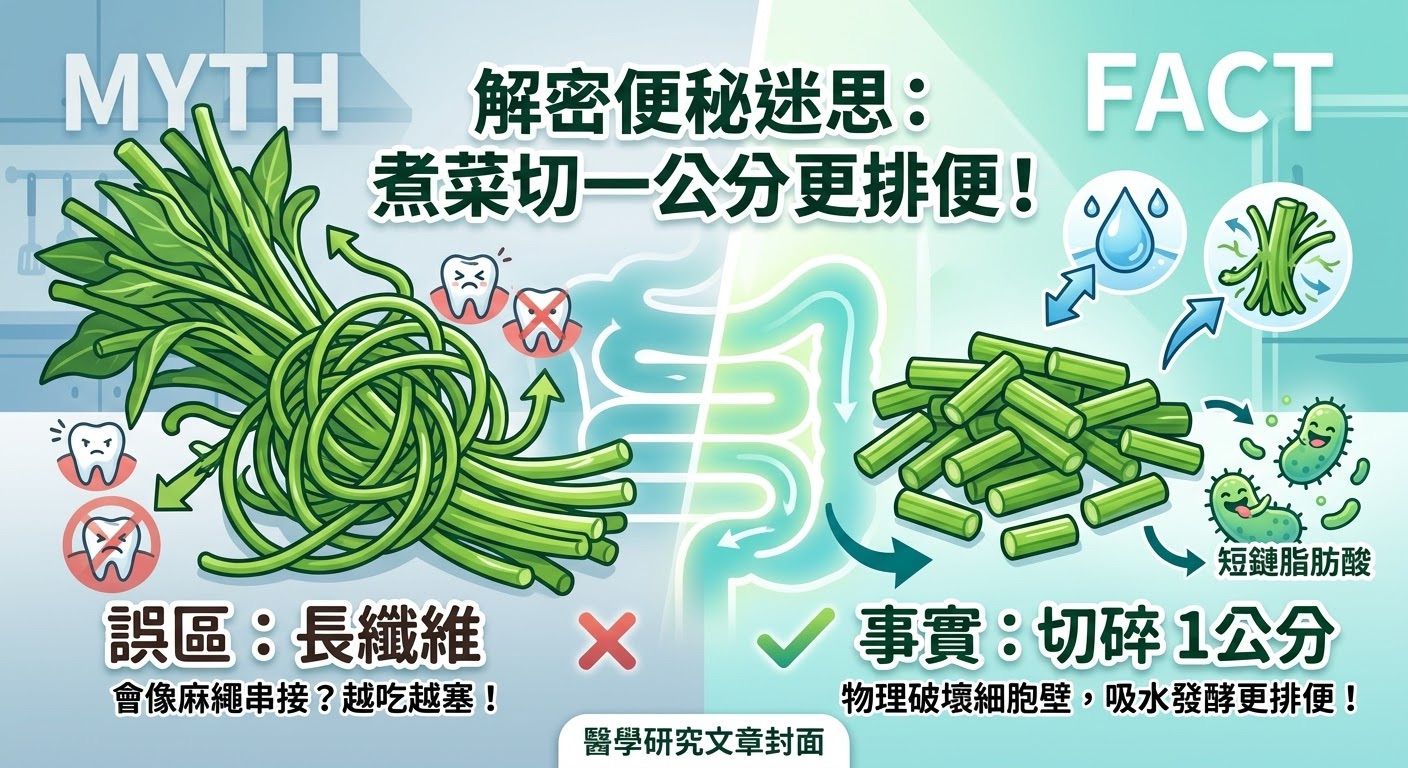
You have likely witnessed this scene in the kitchen: an elder stands over the sink preparing water spinach or sweet potato leaves, slicing them into two or three long stalks before tossing them straight into the wok. When asked why they don’t chop them finer, they recite traditional folk wisdom: “You have to eat greens whole! Keep the long fibers intact so they can sweep the stool out!”
Chewing down these tough, fibrous stalks, an intuitive mental image forms: these lengthy strands act like coarse hemp ropes or sewer snakes, lassoing stubborn stool in the colon and pulling it straight out into the bowl.
Wake up: your gut is not a municipal drainage pipe, and dietary fiber is not a tug-of-war rope!
The belief that long fiber strands physically “haul” stool out is a visual misconception that ensnares many chronic constipation sufferers. Through the analytical perspective of Vedfolnir, let us dismantle this century-old culinary misunderstanding and expose the marketing gimmicks behind commercial “fiber-fortified sodas.”
Biological Truth: Your Colon Needs a “Sponge,” Not a “Rope”
Many cooks worry that finely chopping greens will “destroy the fiber.” This conflates macroscopic physics with molecular chemistry.
A kitchen knife only severs plant dermal tissue and vascular bundles. Dietary fiber consists of immensely complex polysaccharide polymers. Chemical covalent bond energy drastically exceeds the mechanical stress of a steel knife. Chopping vegetables finely is like disassembling a skyscraper into intact individual bricks—the fiber polymers that promote bowel motility remain 100% intact within every one-centimeter piece.
Medical science established long ago that dietary fiber relieves constipation primarily through water-absorption and volumetric expansion—a chemical and osmotic process, not a mechanical pull.
Imagine tossing a large, dense dry sponge into a bowl of water: moisture struggles to penetrate its core. But if you snip that sponge into dozens of one-centimeter cubes, they saturate and swell instantly. Chopping greens into small pieces creates countless microscopic gateways for water to flood in. These short fibers distribute evenly throughout intestinal chyme, absorbing multiples of their own weight in water to balloon rapidly. This moist, pliable bulk gently stretches the colon wall, triggering mechanical stretch receptors that activate peristalsis. Radial tension from within is what propels stool forward.
Marketing Deconstruction: Can “Fiber Sodas” Cure Constipation?
When seeking dietary fiber, many reach for carbonated drinks boasting added fiber (such as Sprite Plus or Coca-Cola Plus). You might intuitively suspect, “Doesn’t the fiber just rush straight through with the liquid?” That intuition is half right.
It doesn’t simply wash through without effect. These drinks contain resistant maltodextrin (indigestible dextrin), a soluble dietary fiber. It dissolves completely into liquid like sugar in tea. Inside the gut, it transforms into a viscous gel that feeds prebiotic gut flora.
However, if you expect it to relieve stubborn constipation, you will be sorely disappointed for two reasons:
- Lack of Insoluble Physical Bulk: Pure soluble fiber lacks the sponge-like insoluble bulk that physically distends the colon wall to trigger peristalsis. It can soften stool, but cannot generate sufficient mechanical mass to initiate strong bowel movements.
- Paying for Painful Bloating: Carbonated drinks are loaded with dissolved CO2 and artificial sweeteners. Before reaching the colon, the intense gas and sugar substitutes induce severe bloating and gas in the stomach and small intestine. Trying to cure constipation with soda is trading sluggish bowels for painful distension.
Practical Pain Points: Fibrous Foods That Worsen Blockages
The human digestive system never evolved to handle coarse, intact long fibers. Insisting on swallowing long vegetable strands creates a chain reaction of digestive distress.
Notorious examples include enoki mushrooms (often dubbed “see you tomorrow”), stringy celery stalks, tough leeks, and overgrown greens.
When you swallow 15-centimeter vegetable strands that teeth failed to grind down, human gastric acid has zero capacity to corrode dietary fiber. The stomach wall is forced into vigorous mechanical kneading, causing early gastric fatigue, hiccups, and acid reflux.
Once long fibers reach the intestines, they cannot disperse evenly. Instead, they tangle into dense mats. Water cannot penetrate these compact knots, which aggregate with food residue to form dry, immovable fecal impactions. This is why gorging on whole bunches of greens often leaves constipation unresolved while causing all-day foul flatulence.
Practical Protocol: Chop to 1cm and Drink Ample Water
Pre-cutting vegetables in the kitchen performs the heavy mechanical grinding work that teeth and stomach muscles struggle to achieve. Applying this mechanical advantage optimizes digestive physiology:
- The One-Centimeter Rule: Chop leafy greens into 1 to 2 cm segments. Dice fibrous stalks finely to break rigid plant cell walls.
- Cook Until Tender: Thorough heating relaxes plant tissue, making fiber far more accessible for water absorption and gut microbiome fermentation.
- Hydrate Generously: No matter how finely cut, fiber without water remains dry chaff. Drink ample fluids to enable short fibers to expand to their full sponge capacity.
Dietary fiber is a water-absorbing sponge, not a tug-of-war rope; and fiber soda is merely expensive bloat-water. Chop your vegetables generously, and your gut will finally find genuine relief.
Support Independent Perspectives & In-Depth Insights
Every thoughtful analysis and candid critique comes from our dedication to truth and quality. We choose not to follow sensational algorithms or clickbait headlines.
Sustaining independent research requires reader support. Make a one-time or monthly contribution, securely processed by Google.
Payments secured by Google · Manage or cancel anytime in your Google Account



Comments