
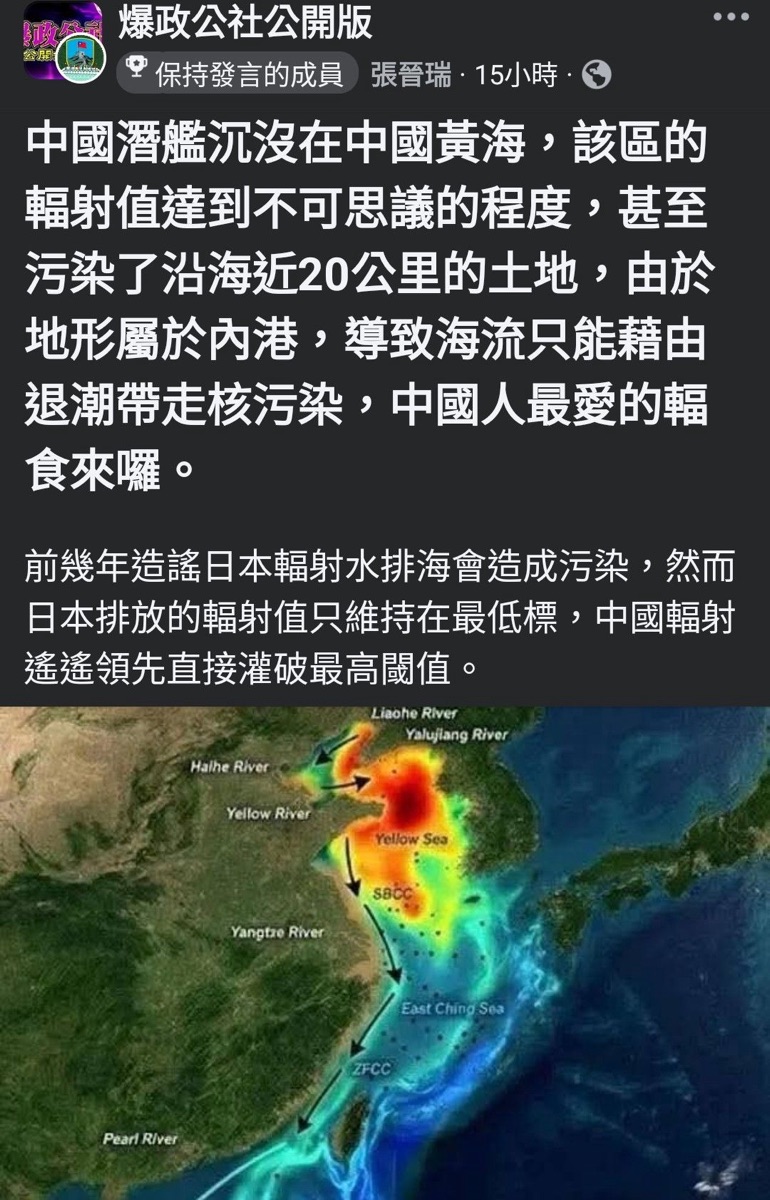
Sensational rumors have circulated across social platforms claiming that a sunken Chinese PLA Navy submarine caused catastrophic nuclear contamination across the Yellow Sea, with radiation levels supposedly “breaking all measurable thresholds” across a 20-kilometer coastal zone.
To address widespread public anxiety, this fact-check cross-references military intelligence reports, International Atomic Energy Agency (IAEA) environmental datasets, and real-time maritime monitoring telemetry from regional nuclear safety regulators.
The objective conclusion: While Chinese naval assets have experienced historical hull incidents, empirical environmental monitoring records zero anomalous radiation spikes in the Yellow Sea. Ambient readings consistently hover within standard background baselines as of February 2026.
1. Deconstructing the Myth: Absence of Scientific Metrics
Viral social media warnings rely heavily on hyperbolic adjectives such as “unbelievable radiation surges” while completely omitting standard physical SI units (such as Becquerels per liter, Bq/L, or microSieverts per hour, μSv/h).
Failing to provide verifiable coordinates, sampling timestamps, or sensor readings is a textbook hallmark of unverified disinformation engineered to harvest engagement through panic.
2. Military Context: Accidents vs. Catastrophic Meltdowns
Evaluating military incident reports requires distinguishing between two distinct naval events:
- Type 093 Submarine Rumors (2023): Reports alleged a catastrophic loss in the Taiwan Strait or Yellow Sea. Taiwan’s National Security Bureau confirmed in May 2024 that while an operational mishap occurred, it did not involve hull loss or loss of life, with vessel location tracked continuously.
- Wuhan Shipyard Pier Incident (2024): US defense officials indicated a newly constructed nuclear submarine experienced a localized dockside sinking incident at a shipyard near Wuhan. This was an inland port industrial accident, structurally distinct from an open-ocean reactor rupture in the Yellow Sea.
Neither incident generated evidence of open-sea radiological dispersion.
3. Empirical Data: Authoritative Marine Telemetry (2024–2026)
Determining maritime radiological contamination relies strictly on calibrated gamma spectrometry and radionuclide water sampling:
- International Atomic Energy Agency (IAEA): Telemetry from the global Marine Radioactivity Information System (MARIS) demonstrates that radionuclide concentrations in the Northwest Pacific remain within long-term ambient historical baselines.
- South Korean Maritime Monitoring: Telemetry gathered across the Yellow Sea confirms background baseline stability with zero abnormal isotope spikes.
- Taiwan Nuclear Safety Commission: Continuous environmental monitoring across regional maritime stations registers normal green indicators. Tritium concentrations remain orders of magnitude below World Health Organization drinking water safety baselines, showing no influx of fission isotopes.
Summary
Differentiating between unverified rumors and measurable ecological realities is essential. While public discourse legitimately scrutinizes industrial water discharges, claims of an underwater nuclear catastrophe in the Yellow Sea remain thoroughly unsubstantiated by empirical scientific monitoring.
Support Independent Perspectives & In-Depth Insights
Every thoughtful analysis and candid critique comes from our dedication to truth and quality. We choose not to follow sensational algorithms or clickbait headlines.
Sustaining independent research requires reader support. Make a one-time or monthly contribution, securely processed by Google.
Payments secured by Google · Manage or cancel anytime in your Google Account



Comments