
I’m sure everyone enjoyed a thoroughly restful Lunar New Year holiday packed with fond memories (and full bellies). Following right after the New Year comes the first full moon of the lunar calendar—do you know what day that is? The Lantern Festival, of course! You couldn’t miss the festive displays and lantern festival news completely taking over media headlines lately!
Still, haven’t you ever wondered: we just ate tangyuan during the Winter Solstice right before New Year, so why is everyone talking about eating yuanxiao now? Isn’t yuanxiao just tangyuan?
Oh no, no, no! While both yuanxiao and tangyuan are round, wrapped in a glutinous rice flour dough or coating, and stuffed with delicious fillings, they are decidedly not the same thing.
Tangyuan vs. Yuanxiao: What’s the Real Difference?
Ming dynasty historian Liu Ruoyu recorded in his Zhuozhong Zhi (Discretionary Records): “Fine glutinous rice flour is used, wrapped around a filling of walnut kernels and white sugar, rolled with sprinkles of water until the size of a walnut; this is what Jiangnan refers to as tangyuan.” This historical record only thickened the millennium-long confusion between yuanxiao and tangyuan.
Although both are made with glutinous rice flour and sweet or savory fillings, we can clearly distinguish them by their preparation methods and choice of ingredients.
Simply put, the traditional preparation of tangyuan involves kneading wet glutinous rice dough, pinching off a portion, inserting the filling, and rolling it between your palms into a smooth sphere. Common fillings include black sesame, savory minced pork, red bean paste, and peanut paste. Black sesame is definitely the most iconic—that molten black lava slowly oozing onto a spoon from a glistening white dumpling has always been an advertising favorite.
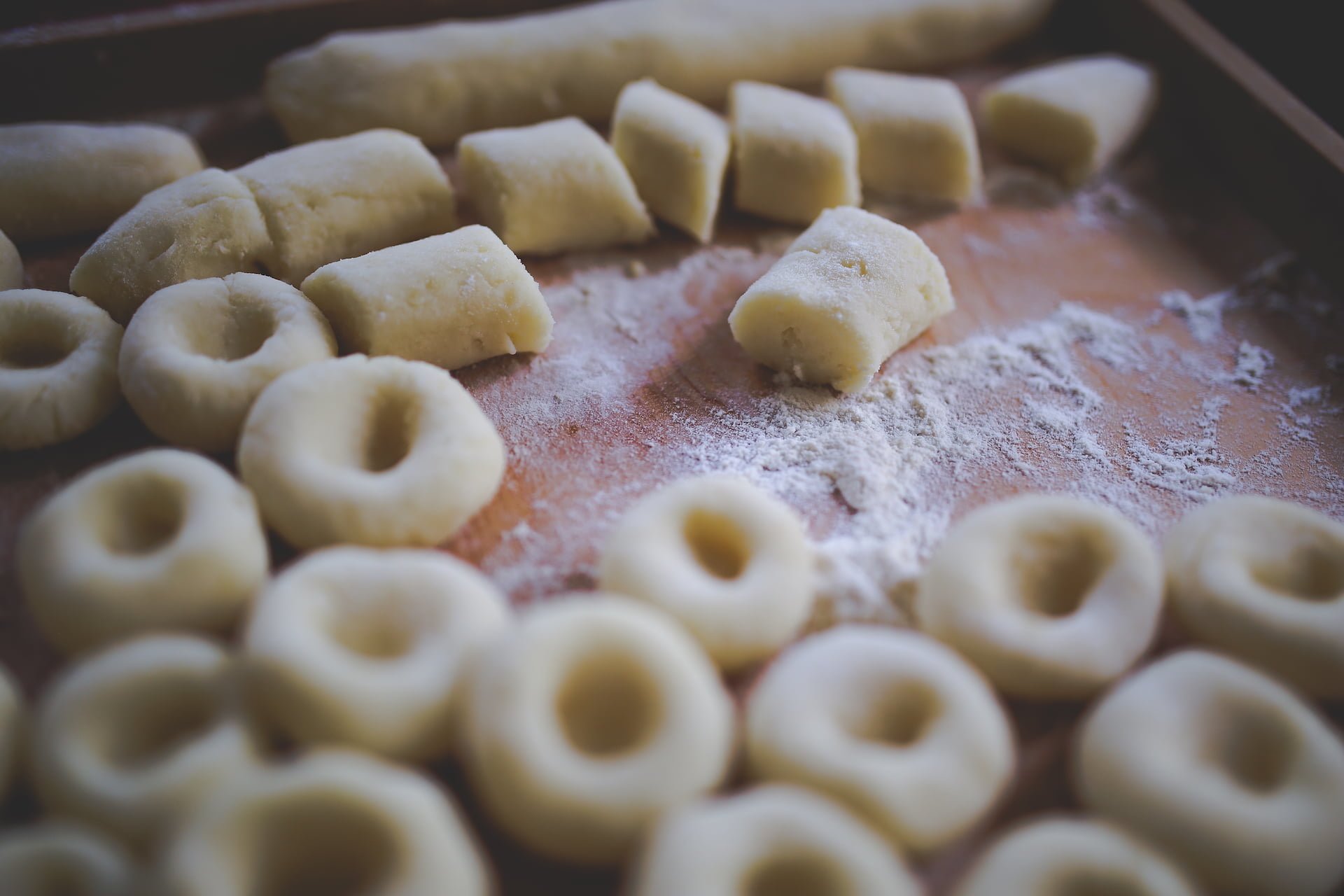
The traditional method for yuanxiao, on the other hand, is quite different. The filling is first shaped into long logs and cut into small cubes. These filling cubes are placed onto a large bamboo flat sieve covered with dry glutinous rice flour. The basket is vigorously shaken and rolled so the filling picks up a layer of dry flour. As it rolls, water is lightly sprayed onto the cubes so they can continuously pick up thick, even layers of flour. This process demands considerable skill—the rhythm and force of shaking the sieve must be steady and controlled so the flour coats the filling uniformly, resulting in a dense, chewy texture. Due to this technique, yuanxiao fillings are usually firmer and stickier sweet pastes, such as red bean paste, black sesame, peanut, jujube paste, or crushed nuts.
Tangyuan is typically boiled on its own or served in sweet red bean soup. Savory pork tangyuan is often cooked in a savory broth with greens and daikon radish. In contrast, because yuanxiao has a firmer filling and texture, there are far more cooking options: beyond basic boiling, it can be pan-fried, steamed, deep-fried, grilled, or made candied (pulling sugar syrup).
From these traditional preparation methods, it’s clear that while tangyuan and yuanxiao share similar fundamental ingredients, differences in technique create distinctly different textures and appearances. That is the true difference between them!
However, since both are made with glutinous rice flour and rich fillings, their calorie count is sky-high: a single dumpling carries nearly 80 calories, meaning eating just four is equivalent to a whole bowl of steamed white rice! For the sake of health, enjoying a bowl to celebrate Winter Solstice and the Lantern Festival is entirely fitting, but remember to cut back on starch and sugar intake for the rest of the day, and try not to eat them late at dinner to avoid indigestion!
Support Independent Perspectives & In-Depth Insights
Every thoughtful analysis and candid critique comes from our dedication to truth and quality. We choose not to follow sensational algorithms or clickbait headlines.
Sustaining independent research requires reader support. Make a one-time or monthly contribution, securely processed by Google.
Payments secured by Google · Manage or cancel anytime in your Google Account


Comments