
Last night, to gather local insider intel known only to locals in Taxia Village, Fujian, I headed to the common lounge of the Youth Hostel (YHA) to chat with the staff and local young men hanging out over hot tea.
For highly localized information, asking locals directly often beats searching online. But even better than asking ordinary locals is calling the bus driver directly ─── known here as the “bus master” (gongjiao shifu). Yes, you read that right: calling the driver’s mobile phone directly is an insider secret to traveling in mainland China.
In the hostel, four young men lounged across sofas, half-sitting and half-lying down, watching TV news and commentating on the broadcasts. Naturally, a pot of hot tea and a handful of roasted peanuts were indispensable fixtures. Noticing I was a traveler visiting from Taiwan, they tossed in a few teasing remarks. Naturally saturated with great-power chauvinism, there was no point dwelling on it; it wasn’t like I could shout back that the Republic of China is the orthodox China.
Mainland locals genuinely love brewing tea. Some buy mystery leaves of unknown origin (though the tea they brew for themselves is always miles better than what they give as gifts); some dry leaves right on their own front stoops; some have tea professionally packaged by factories; and some drink concoctions that aren’t even tea, but colorful herbal blends boasting miraculous health benefits for the liver, kidneys, and entire family.
Everywhere you go, someone offers to pour you tea, which is quite cultured and pleasant. As for whether your host has an ulterior motive, that depends on your luck and powers of observation.
Drinking tea is fine and well, but the ubiquitous tea ware they use was frankly hard to stomach. I could never fathom why they love serving piping-hot tea in disposable plastic cups ─── the cheap transparent kind that instantly deforms and warps when hot water hits it. Yet bound by traveler’s etiquette, my body’s plasticizer levels undoubtedly climbed significantly while passing through as a guest.
Returning to the point, the intelligence I sought from them was simply the bus timetable for the next day.
As usual, I try to avoid over-researching trips in advance, faithfully honoring my own “Mizuc’s Law of Getting Lost”. So when they told me there was a direct bus from Taxia Village to my destination, the historic town of Yunshuiyao in Meilin Town, I was thrilled.
Looking back now, perhaps not asking these youths for directions might have been the wiser path.
Or let’s put it this way: when you ask a question and get three completely different answers from three people, and after debating among themselves they still can’t agree on a factual answer, resorting to phoning various friends for help, I should have formally evaluated an immediate exit. (The fourth guy had a look on his face like he desperately wanted to chime in, but had no idea what to say).
While everyone was undeniably warm and enthusiastic, it left my head spinning. Fortunately, they eventually reached a unified consensus: the bus would arrive in the village between 12:00 PM and 1:00 PM.
…
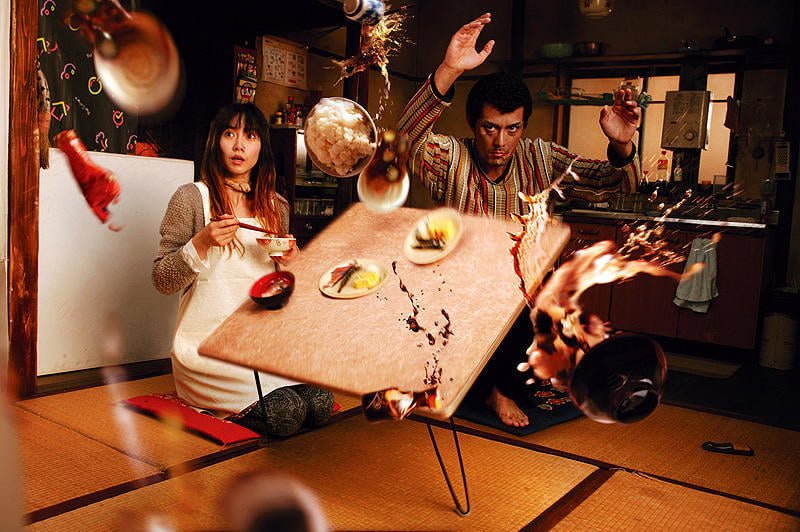 Table flip! (Thermae Romae movie screenshot)
Then I asked where I should wait for the bus. This time, they answered in unison: “Wherever you like.”
… (spitting blood).
Driven by an engineer’s mindset, few could possibly accept such an answer. So I changed tactics and asked: “Where do the locals usually catch the bus?” Such an empirical question surely warranted a definitive answer, right?
Sure enough, they quickly pointed out a few landmarks: outside the elementary school gate, by this bridgehead, or by that bridgehead.
Having received such “rock-solid” transit info, it was only natural for me to slip quickly back to my bedroom.
After surviving a night so freezing that I had to borrow someone else’s quilt to stay warm, I appeared before noon at the bridgehead the youths had pointed out, determined not to move as sluggishly as a hibernating bear. Carrying my heavy backpack, I waited for the bus while basking in the sunshine on a bench under an ancient tree.
Next to the bridge, someone was shamelessly dredging sand from the stream. An elderly farmer had set up a thick, soft, blue pipe stretching from behind a roadside house down under the bridge to a bamboo raft in the water. The raft carried a large pump motor with an intake plunged into the riverbed, forming a semi-automated sand-dredging operation.
A small thatched straw shelter covered the motor, upon which perched a kingfisher (Alcedo atthis) looking far too luxurious for such a humble rustic scene. While this was just a small-scale manual operation, the dredged stream bed still reminded me of the Dahan River back home; environmental activists would surely raise an outcry over this.
Aside from that short stretch of dredged river, Taxia Village’s surroundings and gentle stream remained captivating. Furthermore, the green stream winding through the village had been planned according to a Bagua (Eight Trigrams) layout when the village was founded. Standing on a nearby hillock, the original designer’s ingenuity was vividly evident.
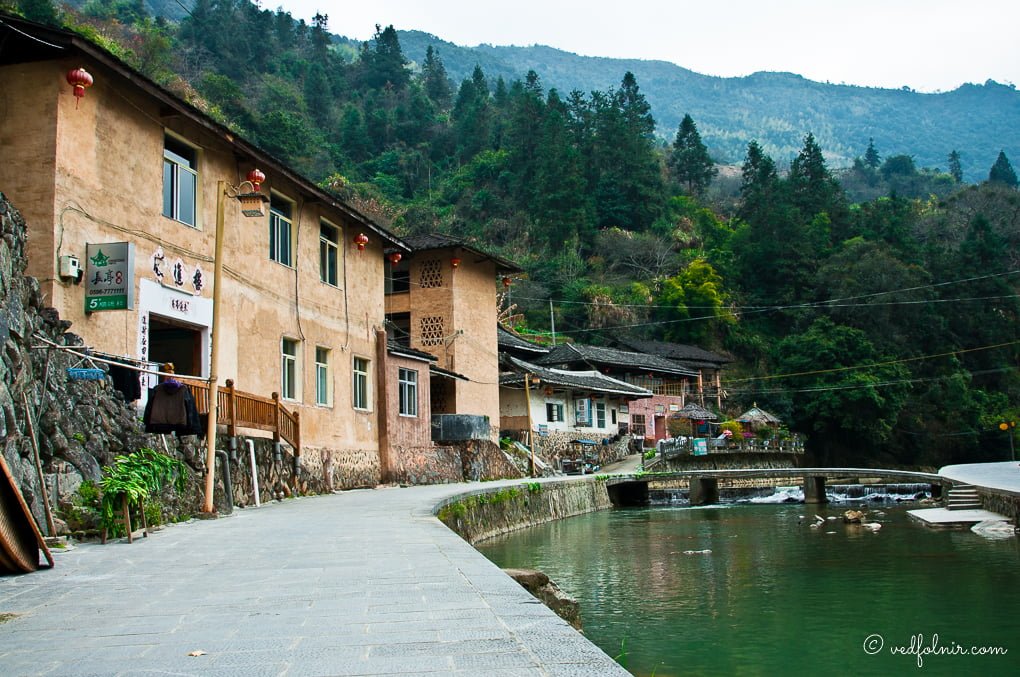 Waterfront view of Taxia Village
Waiting, waiting, waiting, and waiting some more…
Standing by the bridge waiting for nearly two hours, I even began to admire my own patience. While the bridgehead was pleasant and offered great observations of local daily life, waiting endlessly for a bus that never came wasn’t going to cut it, especially since I had yet to secure lodging for the night.
To avoid ending up completely stranded, I hoisted my pack once more and walked back to the youth hostel.
The person at the desk the previous night was actually an intern; I hoped for better luck today. Fortunately, I ran into the cute, conscientious female receptionist who had checked me in on my first day.
This time, the receptionist called the bus station directly. They informed her that there was one final bus of the day passing through Taxia Village around 4:00 PM. She was given a phone number and told me to call the bus driver directly to coordinate where he should pick me up.
As it turned out, there was no designated bus stop at all. Just as the staff had said the night before, you really could wait anywhere. But that was both correct and deceptive, because without calling the driver beforehand, he might not even bother driving into the village at all.
The reality is that Taxia Village has only one vehicle road, which was why they claimed you could wait anywhere. But the prerequisite is that you must coordinate your exact location with the bus driver in advance, confirm an approximate arrival time, and arrive half an hour early just to be safe.
Moreover, the receptionist dropped another bombshell: the claim that a bus went directly to Yunshuiyao was also completely false.
After departing Taxia Village, this bus heads north to Shuyang Town. From the Shuyang Bus Station, you must transfer to another bus heading toward Meilin Town, which will then pass by the historic town of Yunshuiyao along the way.
I must say it again: everyone was truly enthusiastic ─── but enthusiasm does not mean you can rest easy.
When I finally arrived at Shuyang Bus Station to wait for my connecting bus, the woman from the bus station whom I had spoken with on the phone earlier even walked onto the bus specifically to chat about how I had missed the noon bus (table flip!).
Once again, most of the people I encountered during my travels were remarkably warm-hearted. Yet they seemed to share a typical trait: a peculiar form of unselfish self-centeredness. Everyone is eager to provide an answer, but without the prerequisite of actually knowing what they are talking about.
Throughout conversations, you’ll hear endlessly: “Sure, sure, no problem, it’s fine, all good.”
And in the end? Nobody cares about the end, because by then you’ve already moved on. Mainland China is vast; once parted, no one worries about someone coming back to settle scores.
Support Independent Perspectives & In-Depth Insights
Every thoughtful analysis and candid critique comes from our dedication to truth and quality. We choose not to follow sensational algorithms or clickbait headlines.
Sustaining independent research requires reader support. Make a one-time or monthly contribution, securely processed by Google.
Payments secured by Google · Manage or cancel anytime in your Google Account



Comments