

Global aerospace manufacturing giant The Boeing Company (NYSE: BA) has struggled for years to escape the persistent shadow of aviation safety and credibility crises.
In late December 2024, within a mere 48-hour window on December 28 and 29, global commercial aviation witnessed two consecutive serious flight incidents involving Boeing’s classic single-aisle workhorse, the 737-800:
- Jeju Air Muan Airport Crash (December 29, 2024): A Jeju Air Boeing 737-800 crashed while attempting an instrument landing at Muan International Airport in South Jeolla Province, South Korea, tragically claiming 179 lives and marking one of the deadliest aviation disasters in South Korean civil aviation history.
- KLM Runway Excursion Incident (December 28, 2024): A KLM Royal Dutch Airlines Boeing 737-800 suffered severe hydraulic failures after takeoff from Oslo Airport in Norway. During an emergency landing, the aircraft veered off the runway onto adjacent grass. Fortunately, all occupants evacuated safely, but the acute hydraulic breakdown renewed worldwide scrutiny regarding 737 system reliability.
Back-to-back incidents not only sent shockwaves through the global airline industry, but also set Wall Street investors on edge. Could these accidents trigger a replay of the catastrophic stock collapse seen during the 2019 Boeing 737 MAX “global grounding”? Amid recurring aviation safety headlines, how does the capital market truly price Boeing’s operational and regulatory risks?
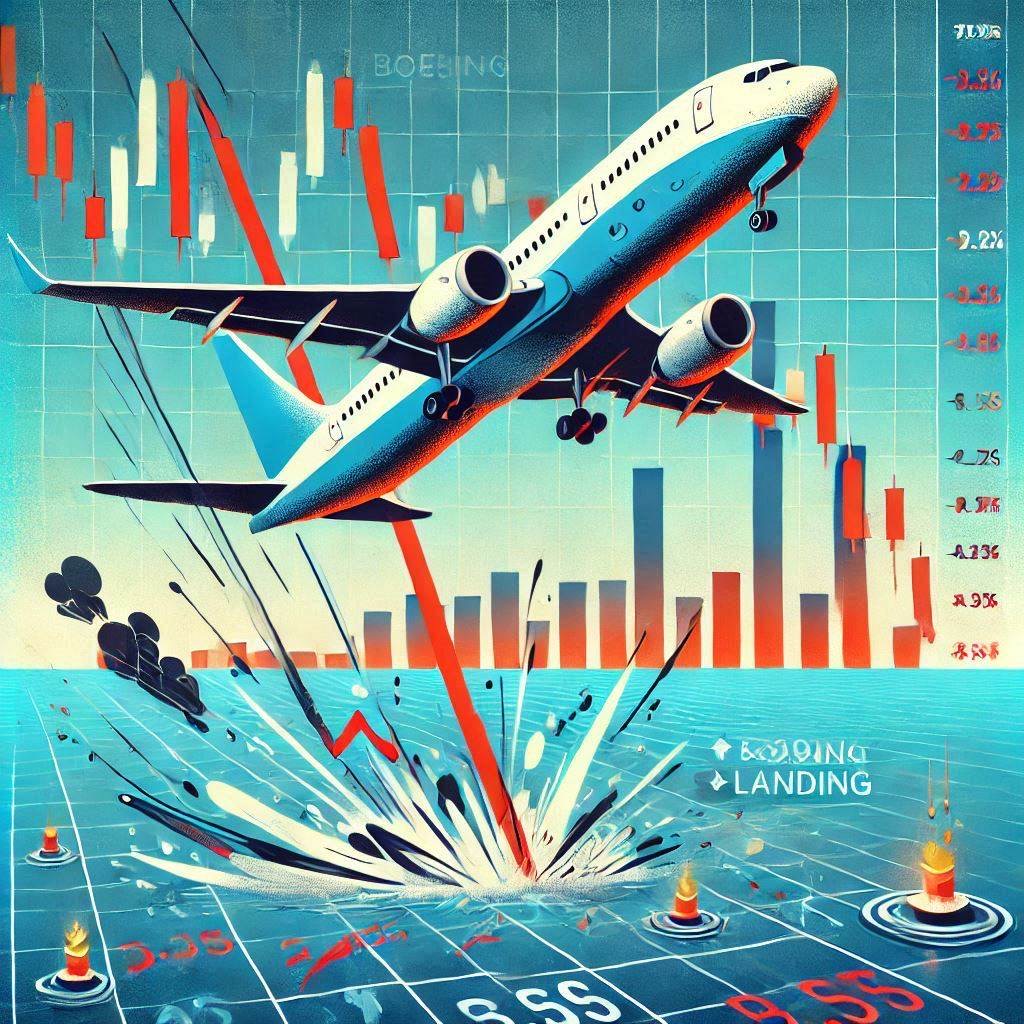
Historical Precedent: The 2019 737 MAX Global Grounding Crisis and Market Avalanche
To gauge the destructive potential of aviation accidents on Boeing’s equity valuation, one must revisit one of the darkest chapters in commercial aviation history—the Boeing 737 MAX grounding crisis.
In October 2018 (Lion Air Flight 610) and March 2019 (Ethiopian Airlines Flight 302), two brand-new Boeing 737 MAX 8 aircraft crashed out of control shortly after takeoff, claiming 346 innocent lives.
Accident investigations pinpointed foundational design flaws in the “Maneuvering Characteristics Augmentation System (MCAS)”, hastily integrated by Boeing to counter Airbus’s A320neo without requiring extensive simulator re-training. When a single Angle of Attack (AOA) sensor malfunctioned, the system repeatedly forced the aircraft’s nose down. Because this system was inadequately disclosed in pilot flight manuals, aviation regulators worldwide imposed an unprecedented 20-month global grounding order.
| Impact Dimension | Realized Impact of the 737 MAX Grounding (2019–2020) | Long-Term Operational and Financial Repercussions |
|---|---|---|
| Stock Price and Valuation | Stock plummeted from an all-time high of $440 in Feb 2019 to $330 by early 2020 (~25% decline), before collapsing to $89 as the COVID-19 pandemic hit. | Over $100 billion in market capitalization evaporated; investor trust eroded completely. |
| Severe Cash Bleed | Paid airline compensation, victim settlements, and regulatory fines exceeding $20 billion. | Debt escalated dramatically; Free Cash Flow (FCF) remained negative for consecutive years. |
| Production and Order Collapse | Production lines completely halted; undelivered jets crowded tarmac storage; hundreds of net orders cancelled. | Brand equity severely compromised; massive customer order defections to the Airbus A320neo family. |
The grounding crisis crystallized an enduring market pattern: a single isolated incident typically drives short-term emotional dips; however, once an accident is attributed to a manufacturer “design defect” or triggers “mandatory regulatory grounding”, the destruction to valuation becomes a multi-quarter avalanche.
Foundational Differences: Risk Characterization of 737-800 (NG) vs 737 MAX
Evaluating the South Korean and Dutch incidents requires rational investors to strictly differentiate between the “737-800 (Next Generation, NG Series)” and the “737 MAX Series” in terms of technical maturity and legal liability:
1. Radically Different Platform Maturity
- 737 MAX was a brand-new iteration that had entered commercial service for only one to two years when disasters struck. Repositioned, larger engines shifted aerodynamic balances, which Boeing attempted to mask via MCAS software—an indisputable OEM systemic design flaw.
- 737-800, by contrast, first flew in 1997, with over 5,000 deliveries worldwide and nearly 30 years of operational service as the “most mature workhorse in commercial aviation history”. It does not feature the controversial MCAS. Across tens of thousands of daily flights worldwide, the NG fleet has historically maintained an exemplary cumulative safety record.
2. Accident Attribution and Grounding Probability
Preliminary findings in South Korea and Norway indicate causes primarily rooted in operational and maintenance environments:
- Jeju Air Muan Accident: Pointing toward severe nighttime weather, poor visibility on instrument approaches, runway surface conditions, or airline-level maintenance execution.
- KLM Oslo Incident: Attributable to component aging or mechanical wear in a specific hydraulic valve/pump line, where the flight crew executed a successful emergency landing.
Consequently, the likelihood of civil aviation authorities (such as the FAA or EASA) issuing a fleet-wide grounding order against thousands of active 737-800s is exceedingly remote. Barring an administrative global grounding, Boeing’s immediate risks of assembly line halts and contract cancellations remain contained.
Stock Trajectory Outlook: Short-Term Sentiment Shocks vs Long-Term Valuation Discount
While widespread grounding for the 737-800 is improbable, capital markets do not operate in an intellectual vacuum. Recent aviation safety headlines exert acute downward pressure on Boeing’s equity in three distinct areas:
1. Evaporation of the “Quality Control Trust Premium”
Following the early 2024 Alaska Airlines Flight 1282 door-plug blowout on a 737 MAX 9 and subsequent whistleblower revelations concerning assembly line defects, Wall Street’s tolerance for Boeing has hit historic lows. Any breaking headline bearing Boeing’s name immediately triggers automated risk-off selling by quant funds and retail investors, amplifying near-term equity volatility.
2. Accelerating Airbus Market Share Gains
The commercial aircraft duopoly means market shares operate as a zero-sum game. With Boeing ensnared in regulatory production caps and safety scrutiny, airlines seeking to derisk future delivery schedules are shifting 10-year narrow-body orders decisively to Airbus’s A321neo. This secular order tilt poses sustained headwinds for Boeing’s forward earnings-per-share (EPS) growth.
3. Substantial Backlog Serving as Valuation Support
The solitary silver lining for equity investors lies in Boeing’s massive commercial backlog of over 5,400 aircraft, valued at hundreds of billions of dollars. Fleet replacement demand and passenger growth remain strong in the post-pandemic era, while Airbus’s delivery slots are practically fully booked beyond 2030. Even disgruntled airline customers cannot practically cancel backlogs en masse, establishing a durable valuation floor beneath Boeing shares.
Conclusion: Boeing’s Valuation Recovery Depends on Returning to Engineering Excellence
From the 2019 MAX crisis to the recent 737-800 headlines, every punitive selloff by capital markets represents an inevitable reckoning for two decades of corporate culture that was “prioritizing financial statements over engineering safety”.
In the near term, while the tragedies in South Korea and Norway will not trigger systemic groundings, they ensure prolonged regulatory inquiries and brand degradation. If Boeing seeks to truly restore its historical market valuation, financial engineering and PR campaigns will prove futile; only rebuilding shopfloor craftsmanship and elevating reverence for every single bolt and hydraulic valve above quarterly profit margins can rescue this century-old aerospace titan.
Support Independent Perspectives & In-Depth Insights
Every thoughtful analysis and candid critique comes from our dedication to truth and quality. We choose not to follow sensational algorithms or clickbait headlines.
Sustaining independent research requires reader support. Make a one-time or monthly contribution, securely processed by Google.
Payments secured by Google · Manage or cancel anytime in your Google Account




Comments