
There was once a whimsical fantasy legend told on Earth: “The Blue Moon is a magical portal connecting the Smurfs’ mushroom village to Earth; whenever a Blue Moon appears in the night sky, one can pass through it to travel freely between the two realms.”
In reality, “Blue Moon” refers to an astronomical calendar occurrence. In typical calendars, a year contains 12 lunar months, each featuring one full moon, which formed the basis of traditional lunar calendars. However, an astronomical solar year runs approximately 11 days longer than 12 lunar cycles. The accumulation of these extra days results in an extra full moon once every two to three years (occurring every 2.718284 years on average). This extra full moon is dubbed a “Blue Moon”.
Many naturally wonder: does the moon actually turn blue on the night of a Blue Moon?
The answer is both yes and no.
Yes, if you simply open Photoshop and dial the color temperature all the way to blue (dodges incoming punch).
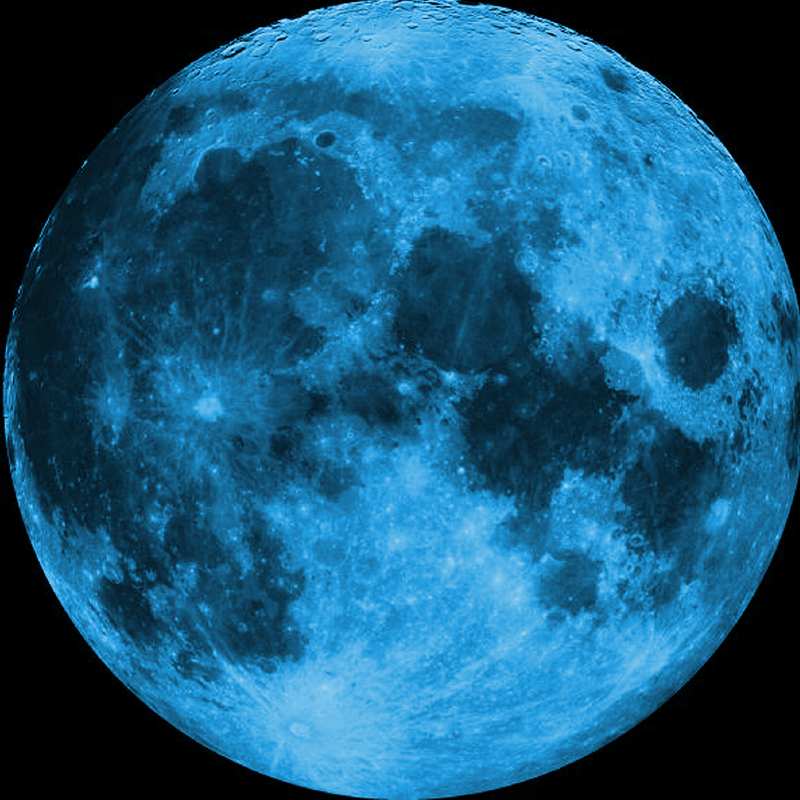 Fake Blue Moon
In physical reality, the moon can occasionally take on a pale bluish hue. However, that tint is not caused by it being the second full moon of a calendar month, but rather by smoke, ash, and aerosol particulates in the atmosphere altering the light spectrum. This optical effect is most commonly observed following massive forest fires or volcanic eruptions.
In other words, to see a genuinely blue-tinted moon on the island of Taiwan, one would just have to wait for the Tatun Volcano Group to erupt (huge mistake! Though I actually dreamed of Tatun erupting when I was a child).
“Blue Moon”—a charming, romantic name. Yet looking up tonight, the moon simply resembles any ordinary full moon, lacking any fanciful romantic blue tint (inner voice: what kind of shade name is that anyway?).
From a cosmic perspective, lunar orbital phases cycle with mathematical regularity. It was ancient calendar makers who had to insert “intercalations” and adjustments to sync human calendars with celestial mechanics. Physically, a Blue Moon is identical to any other full moon.
Why Call a Non-Blue Moon a “Blue Moon”?
The true origins of the phrase are lost to history. A commonly cited explanation suggests that during historical second full moons in a month, disasters coincided with atmospheric ash that actually tinted the moon blue, giving rise to the idiom “once in a blue moon” (though as noted, the disaster caused the color shift, rather than a blue moon foreboding disaster).
Over time, it conveniently evolved to denote the rare occurrence of two full moons sharing a single calendar month.
Although this celestial event unfolds tonight, the weather has not been cooperative, making it rather difficult to observe this Blue Moon within the Republic of China (ROC). Therefore, we are sharing an online live stream from an American observatory system. Since the feed is based in the United States, we have to wait around eight hours until nightfall in the continental US for the broadcast to begin!
Speaking of unusual nights, things haven’t been entirely quiet today. Miaoli experienced two consecutive tremors past 8:00 PM—could they possibly be linked to the Blue Moon? (Utterly baseless speculation, of course.)
Further Reading
- Live Webcast: SLOOH Space Camera.
- Wikipedia - Blue Moon.
Support Independent Perspectives & In-Depth Insights
Every thoughtful analysis and candid critique comes from our dedication to truth and quality. We choose not to follow sensational algorithms or clickbait headlines.
Sustaining independent research requires reader support. Make a one-time or monthly contribution, securely processed by Google.
Payments secured by Google · Manage or cancel anytime in your Google Account



Comments