

I recently came across an online platform utilizing an emerging commercial strategy: “Bid and Buy” (hereinafter referred to as B&B). B&B primarily provides an online virtual “bidding and auction platform.”
B&B’s rules operate as follows: bidders spend cash to purchase “points” (currently NT$10,000 yields 575 points); each time a bidder places a bid on an item’s “current price,” 1 point is consumed (meaning NT$10,000 gives 575 bidding chances); each bid placed increases the item’s displayed current price by NT$1 to NT$3 (observed to scale with market value, primarily to accelerate the total cash sink).
As bidders compete with one another, the item price quickly climbs to a certain threshold. The person who places the very last bid gets the right to purchase the item at that current closing price.
Using B&B’s system parameters, we can derive a straightforward formula:
Y = (A * T) + B, T = (P * M);
Where Y is the final winning price, A is the price increment per bid, T is total bids placed, and B is the starting price; P represents the number of participating bidders, and M is the points held per person (this model assumes equal points per bidder competing under perfect competition).
Based on this formula, suppose we set experimental conditions: “2 bidders, each holding NT$10,000 worth of points, engaged in perfect competition for an item with a market value of NT$10,000, where each bid raises the current price by NT$2.” The auction will conclude at a final price of NT$2,301.
In this scenario, the winning bidder acquires the item for NT$12,301, taking an actual loss of NT$4,301 (assuming fair market value is 80% of MSRP); the losing bidder absorbs a direct loss of NT$10,000; meanwhile, the merchant and B&B collectively pocket NT$18,301 in net profit (assuming wholesale cost is 40% of MSRP).
In our earlier experimental setup, uncontainable variables still included factors such as “collusive/unfair competition” and “fluctuating bidder headcounts.”
Setting illicit collusion aside for a moment and extending bidder headcount as a single variable: “3 bidders, each with NT$10,000 worth of points in perfect competition for a NT$10,000 item, incrementing NT$2 per bid.” The item closes at NT$3,451.
Here, the winning bidder pays NT$13,451, suffering an effective loss of NT$5,451; the two losing bidders jointly swallow a total loss of NT$20,000; the merchant and B&B net a profit of NT$29,451.
By extension, when bidders increase to 6 individuals, the final price reaches NT$6,901 (assuming bidders cap their willingness to pay at roughly 70% of market value). The winner pays NT$16,901 for an effective loss of NT$8,901; the 5 losing bidders shoulder a combined loss of NT$50,000; and B&B plus the supplier rake in NT$62,901 in profit.
For B&B, the more participants bidding on any single item, the higher the ultimate platform profit margin becomes.
Of course, this model illustrates an idealized scenario, and multiple bidders rarely fight to absolute mutual exhaustion (unless the item is truly one-of-a-kind). Moreover, B&B instituted an artificial price ceiling—once reached, the auction terminates automatically, precluding unconstrained bidding wars in practice.
Nevertheless, driven by bidders’ psychological expectations, whether the participant pool numbers 2 or 100 has little bearing on the final price reached.
Instead, larger pools of participants simply inflate the price much faster. Consequently, B&B consistently secures massive net margins—the hallmark of profit maximization.
Conversely, for an ordinary bidder, purchasing only 10 or 20 points is virtually throwing money into the wind during active competition.
For bidders buying hundreds or thousands of points, knowing that the closing price inevitably approaches the price ceiling should clarify one harsh reality: the more capital you sink in, the greater your expected loss.
Even if an exceptionally fortunate bidder manages to win on their very first bid, the closing price would have already been driven close to market value by others (or even higher, were it not for price caps).
Whether bidders have the patience to sit and monitor auctions until the price nears the ceiling is another challenge. If automated bidding features are used, intense competition between automated bots easily burns through points in rapid succession, multiplying losses exponentially.
Such penny auction platforms harbor many operational vulnerabilities: bidders creating duplicate accounts to harvest new-member bonus points (5 points) to inflate prices prematurely, draining platform infrastructure and sparking accusations of unfair manipulation.
Moreover, if prices ramp up too quickly, the advertised “fun” evaporates. However, solving their operational dilemmas is not my responsibility, so I will leave those concerns aside.
Lastly, one possibility I deliberately refrain from detailing is the platform internally shilling or bidding up its own lots. Let us assume that never happens—because if it does, this entire analytical exercise would be utterly futile (╯-╰)/.
Analytical Appendix & Suggestions
Merely criticizing is unconstructive, so here are constructive recommendations:
If B&B tweaked its mechanics—for instance, switching to a “refundable bidding credit” quota (e.g., spending NT$1,000 to purchase 10 bidding attempts), where spent bidding allowances are refunded upon auction conclusion—it would cultivate genuine user loyalty while protecting B&B’s baseline when structured thoughtfully (instead of trying to pocket everyone’s money in one fell swoop).
Crucially, such a setup attracts new members far more sustainably than the current predatory design.
Update (2011.06.03):
Following comments from reader Guest, it is evident that on B&B, one can indeed occasionally acquire an item at a remarkably low price (plus shipping) purely through sheer luck.
However, Guest’s explanation revealed another critical vulnerability: “Could savvy bidders create multiple throwaway accounts to burn bonus signup points and drive prices toward the ceiling, only to swoop in with their primary verified account for the winning bid?”
If this holds true, suppliers or B&B itself could theoretically suffer losses under rare circumstances, depending entirely on contract terms between B&B and its merchants.
Yet from reader Guest’s feedback, one fact becomes unmistakably clear: in B&B’s game, outcomes have zero correlation with effort, intellect, or endurance. The entire bidding contest hinges purely on who gets lucky.
The reason is simple: once an item reaches its price ceiling, regardless of whether participants wish to continue bidding, B&B’s system terminates the auction automatically.
In other words, any savvy bidder who calculates the exact price cap and uses throwaway accounts to inflate the price can easily secure the final winning bid with minimal real investment. This constitutes blatantly unfair competition against regular users (especially those relying on automated auto-bidders—wake up, folks).
Let us examine a concluded auction on B&B: an “Xbox 360 4GB + Kinect + Adventures” bundle, shown below in Figure 1.
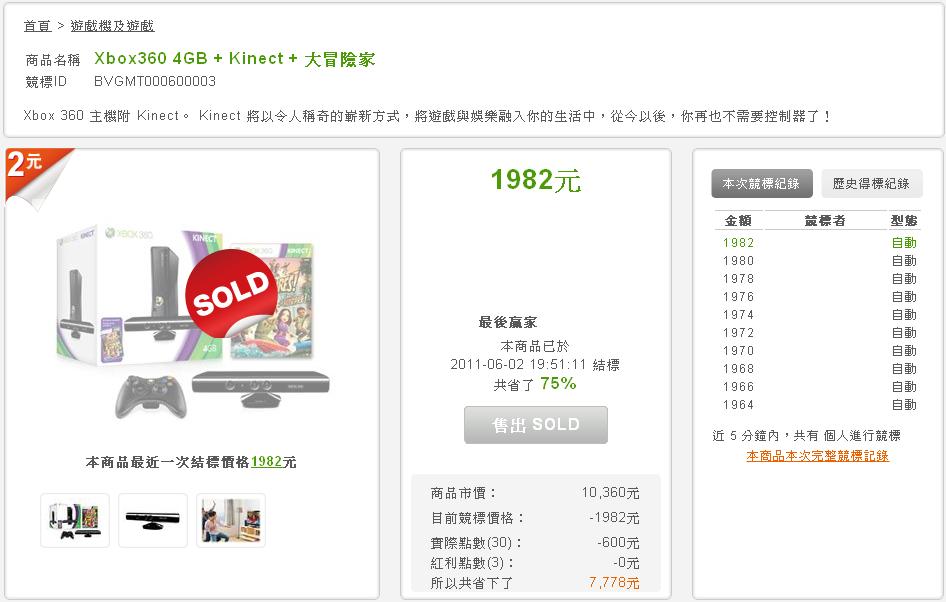
Figure 1: Item Information Page
As shown in Figure 2, the bidding log spans 100 pages with 10 bids per page. A quick calculation reveals approximately 1,000 total bids placed, meaning participants collectively spent over 1,000 points—equivalent to more than NT$20,000.
The item closed at NT$1,982. This means the successful bidder obtained the bundle for NT$1,982 + 33 points + shipping (totaling NT$2,582 + shipping).
In this instance, the winner spent only 33 points and saved NT$7,778 (minus shipping), which is indeed a stellar return.
However, take a closer look: the bidding history reveals that two specific bidders accounted for 80% of all bids placed on that item—meaning nearly 800 bids were contributed by just two individuals.
From this, we deduce that those two participants burned roughly 800 points—more than NT$16,000—and walked away completely empty-handed.
I’d truly love to meet these two masterminds in person (applause).
Looked at from the house’s perspective, this game design delivers an extraordinarily lucrative profit engine for B&B and its suppliers.
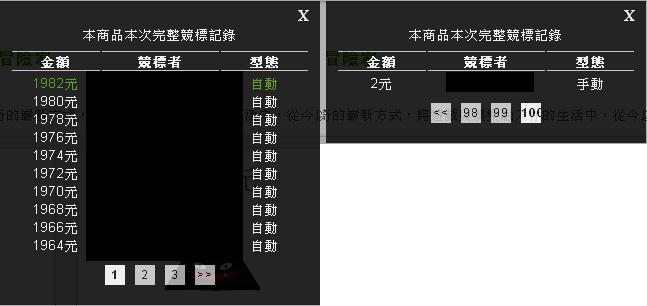
Figure 2: Auction Bidding Log
Update (2011.11.07):
Browsing the web again, I noticed another domestic platform launch: “Happy Bid.” They appear to have adopted my suggestion by introducing a point refund mechanism on select items. I have no intention of playing these games, but interested readers can check it out and share their impressions.
Update (2012.06.15):
Prompted by reader Chen Da-Bao’s comment, I revisited B&B and discovered an intriguing anomaly. Take a look at this screenshot:

Among bidders for this lot, Ailsa0602 was the eventual winner using automated bidding. My question: if automated bidding was active, why were the bidding intervals spaced so far apart? … Perhaps manual bidders were frantically competing, causing the auto-bidder to lose out to manual bids.
Curious about who Ailsa0602 might be, I Googled the username and discovered an online forum: “Wa-Auction! Technical Exchange Community”.
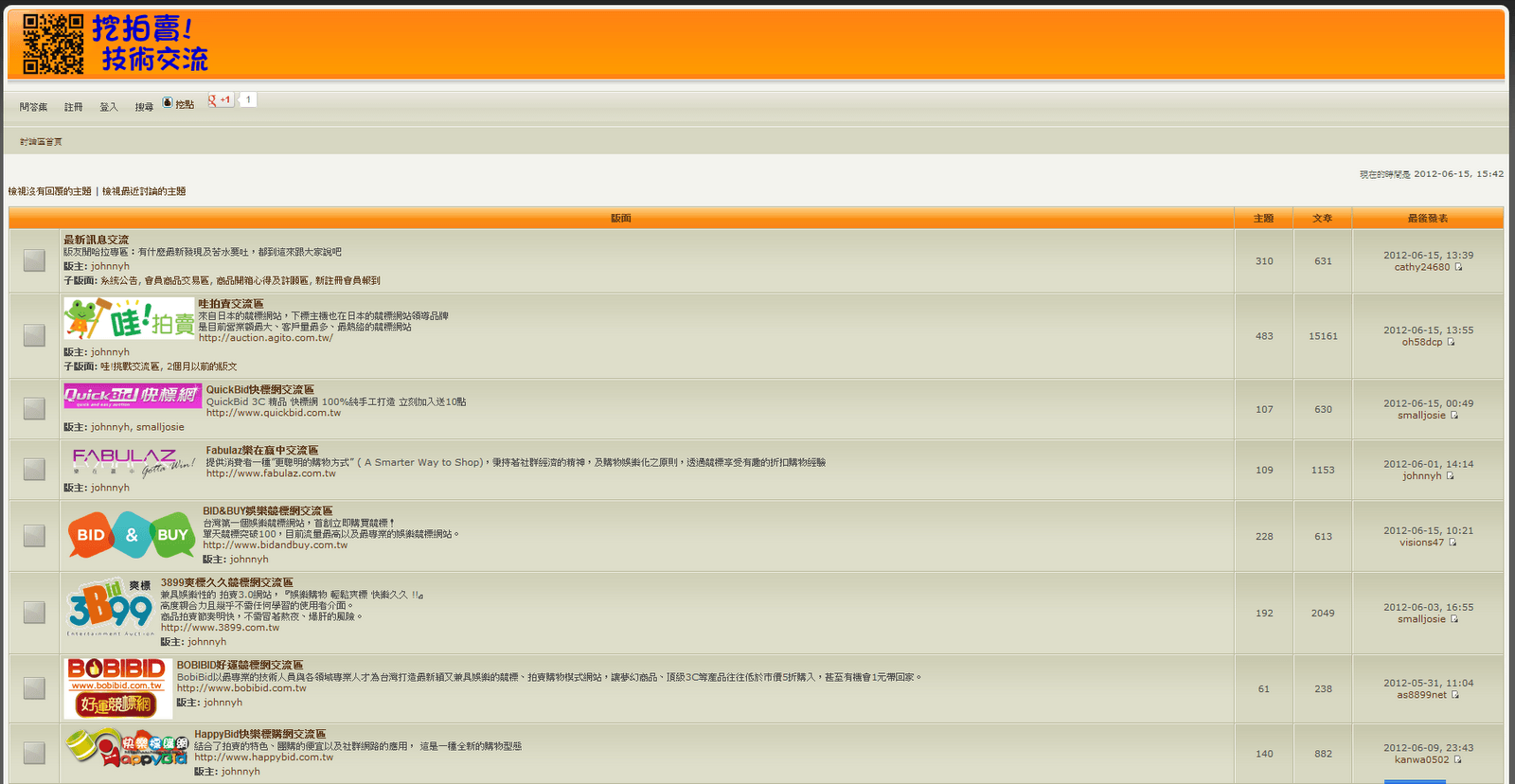
This forum was evidently established in response to the explosion of penny auction sites. Beyond tracking active items across various auction websites, members coordinate organized bidding pools and share tips for securing winning bids (I wouldn’t be surprised if bidding bots emerged soon; in fact, my friend Hsieh Tsung-Hsiang wrote an automated sniping script back in the early Yahoo Auctions era).
The platforms discussed on that forum include:
- Wa-Auction Exchange
- QuickBid Exchange
- Fabulaz Exchange
- BID&BUY Entertainment Auction Exchange
- 3899 Happy Bid Exchange
- BOBI BID Good Luck Auction Exchange
- HappyBid Exchange
- LuckyBid Exchange
- G-BUY Auction Exchange
- CCCBid Exchange
- Godbid Exchange
- Bargain Hunter Auction Exchange
- LeLePai Gaming Auction Exchange
- UBD Auction Exchange
- JustBidIt Exchange
- Bidking Exchange
- iBid Exchange
- ZaPai Auction Exchange
- BidBidGo Exchange
- Bidit Auction Exchange
- e-Bid Exchange
- Bargain King Exchange
- ComeToBid Exchange
Seeing so many bidding sites listed, I had no idea this many platforms were operating in the market. Forums for Wa-Auction, LeLePai, and CCCBid were particularly bustling. It turns out B&B was merely a modest player in this domain.
With over 1,678 members coordinating bids in that community alone, how can an isolated individual ever hope to outbid them? Are you genuinely sure you still want to spend real money buying points to bid???
Reader Q&A and Deep-Dive Discussion
Following the publication of this analysis, numerous readers and veteran players chimed in. Below is a synthesized compilation of reader feedback, critical inquiries, and first-hand empirical observations, shedding light on the mechanics and gambling psychology behind penny auction sites.
1. The Debate over Buy-It-Now Caps: Can Players Truly Score a Bargain?
Reader Guess Argues:
Although you spent a lot of time writing this, you don’t fully understand the platform’s rules, so your assumptions and conclusions are flawed! For example, when two people bid on a NT$10,000 item, points convert into NT$20 in store shopping credit. Once total points invested match the item’s retail value, no further bids can be placed. In your example, two bidders would spend roughly 416 points to buy the item outright, at which point the auction price sits at around NT$1,664. Simple math:416 * 20 + 1664 = 9984. If you try to bid again, the system alerts you that you’ve reached the buy-it-now threshold. So the bidder pays 416 points (NT$8,320) + NT$1,680 (cash difference) + shipping to own the item! Spend more time on the platform and you’ll see who is right!
Author Response:
Thank you for the feedback. But if you calmly examine this so-called “Buy-It-Now protection,” you will realize it is simply another marketing trap:
- Buy-It-Now is merely loss-mitigation lock-in, not a discount: When you have sunk NT$8,320 worth of points without winning and are forced to pay an additional NT$1,680 plus shipping out of pocket to “purchase” the product, you are essentially coerced into paying full retail price. Your capital was already locked into the platform—where is the profit?
- Encouraging people to “play more” simply encourages them to lose more: The platform’s entire profit engine relies on the sunk costs of unsuccessful bidders. Encouraging people to play more is nothing short of nudging them into a financial sinkhole.
Reader John Shih Supports:
Well said, author! Your math is spot on. Telling someone to play more is practically telling them to go lose more money. The more bids you place, the bigger your loss; only one person wins, while everyone else takes a total loss.
Reader Anonymous Highlights Blind Spots:
If you look closely at B&B’s fine print, you will discover two fatal traps:
- Limited Edition Items: Have no Buy-It-Now option at all!
- Bidding Credit Packages: Likewise have zero Buy-It-Now option!
Bidding on either category leads straight into a zero-sum war of attrition where both winners and losers lose, and the platform remains the sole winner!
Reader Chang Hsiao-Ho Calculates Real Numbers:
Applying Guess’s formula, many high-ticket items on B&B have no effective price cap. For example, an HTC Flyer retailing around NT$17,xxx closed at NT$3,693, incrementing NT$3 per bid. Factoring in total bid fees, the platform pulled in NT$28,313 in point purchases plus closing payment on a single item. The profit margin is staggering!
Author Summary:
Readers’ empirical figures directly substantiate our analysis. Penny auction platforms dangle “sub-market bargains” as bait; even when dressed up with “shopping credit offsets,” they cannot conceal the zero-sum reality where losing participants’ money is swallowed whole.
2. Community Findings: Ghost Accounts, Internal Bots, and Midnight Time Extensions?
Reader Unknown’s Log:
Something smells very fishy on this platform. I monitored auctions late at night for nearly an hour and noticed that winning usernames were exclusively formatted as “letters + two digits.” Furthermore, certain specific accounts placed over 300 bids in a single hour (with no other account formats bidding). When I recorded the bidding IDs, it became evident that the same handful of accounts took turns bidding up prices! Another anomaly: multiple items with just seconds remaining suddenly jumped to a “9-hour extension” countdown around 1:00 AM.
Readers Baby & Canfon:
- Baby: Every single bidding ID consists of 6 English letters followed by 2 digits—that is too uniform to be coincidence…
- Canfon: Curiously, system closing times are carefully staggered; items never close at the exact same moment. Is this designed to facilitate manual backstage monitoring?
Reader Rawimage:
The site appears flooded with bots sporting six-letter, two-digit IDs. They bid against you as if backed by unlimited funds, driving prices up at crucial moments. Meanwhile, cheerful photos of purported winners are plastered across the footer to convince the public it’s genuine.
Reader Chris LeE Spots ID Discrepancies:
The bidder ID displayed during active bidding often fails to match the actual username recorded in the publicly released bidding breakdown after the auction closes!
Readers Chen Da-Bao & Hsu Shih-Ping:
- Chen Da-Bao: Has anyone noticed that winning bids almost universally show as “Auto” bids?
- Hsu Shih-Ping: Anyone who writes a script to calculate when total bids reach the threshold can let an automated bot fire rapid continuous bids, snapping up the win right at the ceiling.
Author Insights:
Regarding these reader-spotted phenomena, several platform operating principles emerge:
- Automatic 9-hour midnight extensions: Platforms generally operate between 10:00 AM and 00:59 AM. Over night hours, bidding freezes and countdowns are extended. This frustrates active bidders but safely protects the house.
- Temporary pseudonyms masking shills: The official explanation claims randomized display names protect “privacy,” which are unmasked after closing; conveniently, this provides the perfect cover for house bots and shills. When the house wields infinite free points and server controls, regular participants wagering real cash against algorithms stand virtually zero chance.
3. Rampant Sniping Scripts: Can Penny Auctions Be Automated with Code?
Reader Chia-Chia Lin Discloses:
People write scripts for League of Legends (LOL); bidding auction logic is vastly simpler to code! I’d wager over 80% of starting bids are placed by platform bots (virtual accounts). For an item retailing at NT$11,000, even if won at NT$200 (spending NT$4,000 in bids), the site claims savings of NT$10,800, whereas net savings after point costs are only NT$6,000—and only the winner recovers a fraction of their points. This isn’t just B&B; on JustBidIt, 80-90% of winners are automated scripts, with real humans making up the remainder. Writing scripts is the only way to play efficiently without getting fleeced.
Author Response:
This aligns with why I highlighted communities like “Wa-Auction! Technical Exchange.” Once bidding devolves into script wars and syndicated pools, solitary consumers are simply sitting ducks.
4. Legal and Commercial Nature: Does This Constitute Gambling?
Reader Discovery212 Inquires:
These rules heavily favor the house, making it guaranteed profit while exploiting participants. The platform neglects to levy a “luxury tax” on itself or winners (refunding points); without refunds, platform returns are pure usury. While low-price wins involve luck, once prices escalate it becomes the playground of high-stakes speculators. Furthermore, public gambling is illegal in the Republic of China (ROC), so the site cleverly utilizes euphemisms like “entertainment” to dodge gambling classifications, when in reality placing a bid is virtually placing a bet!
Reader devid328 Calculates Platform Margins:
Platform profits far exceed the retail price of the merchandise. For instance, a Samsung Galaxy Note retailing over NT$20,000 closed at NT$10,160, where each bid costs 1 point (NT$20) and advances the price by NT$2.
10,160 / 2 = 5,080 bids,5,080 * 20 = NT$101,600!
Selling a NT$20,000 phone pulled in over NT$100,000 solely from participants’ bid points—a net profit of over NT$80,000! That is another form of financial trap!
Legal Perspective by The Fixer:
Many readers astutely perceive that such platforms sit on a razor’s edge with gambling. In legal practice:
- Under Articles 266 (gambling property in public venues) and 268 (operating gambling premises for profit) of the ROC Criminal Code, criminal definitions are strictly bound to physical or recognized “venues” and “direct wagering of cash or property.”
- Penny auction platforms convert cash into “entertainment points” or “bidding service fees,” framing bets as purchases of bidding services. This maneuvers in legal gray zones, shielding them from straightforward criminal gambling charges.
- Yet in economic and mathematical reality, the model aggregates the losses of the many into the winnings of the few and the windfall of the house—a system overwhelmingly stacked against retail participants.
5. Reader Reflections: Seeing Through the Illusion
Reader Unknown Reflects:
I was just about to register an account and dive in. Fortunately, I found this analysis and everyone’s insights first, saving me from losing money out of greed. I’d much rather work hard, earn an honest living, and buy what I genuinely need!
Author Concluding Remarks:
This sentiment is precisely the ultimate goal of publishing this deep dive. Whenever confronted with flashy marketing promising “flagship smartphones at 90% off,” take a moment to calculate the points burned and the house’s profit margin. You will immediately realize that “there is no such thing as a free lunch”. Diligence and honest work will always prove far more rewarding than wagering against automated bots in an opaque, rigged game.
(Note: Sincere thanks to readers Discovery212, Chiuchen-no-Natsu, Chang Hsiao-Ho, and others for their thoughtful dialogue and alumni exchanges.)
Support Independent Perspectives & In-Depth Insights
Every thoughtful analysis and candid critique comes from our dedication to truth and quality. We choose not to follow sensational algorithms or clickbait headlines.
Sustaining independent research requires reader support. Make a one-time or monthly contribution, securely processed by Google.
Payments secured by Google · Manage or cancel anytime in your Google Account


Comments