
Following recent fraudulent Facebook campaigns such as “Is McDonald’s Taiwan Facebook Ad a Scam or Official Promotion?”, another internationally recognized brand has been impersonated. Fraud syndicates are now circulating fake anniversary prize notifications falsely claiming to represent the ubiquitous convenience chain 7-Eleven.
The fraudulent notification reads: “It has been 41 years since 7-Eleven established chain stores in Taiwan, and we could not have done it without you. We are celebrating our 41st birthday by giving away free gift vouchers. ✌”
Clicking the attached link directs users to a crude questionnaire created with Google Forms, presenting three awkward questions:
- Do you frequently shop at convenience stores?
- Is there a 7-Eleven store near your residence?
- How often do you shop between 7 o’clock and 11 o’clock? (Editor’s note: It feels as though the scammers completely ran out of reasonable questions.)
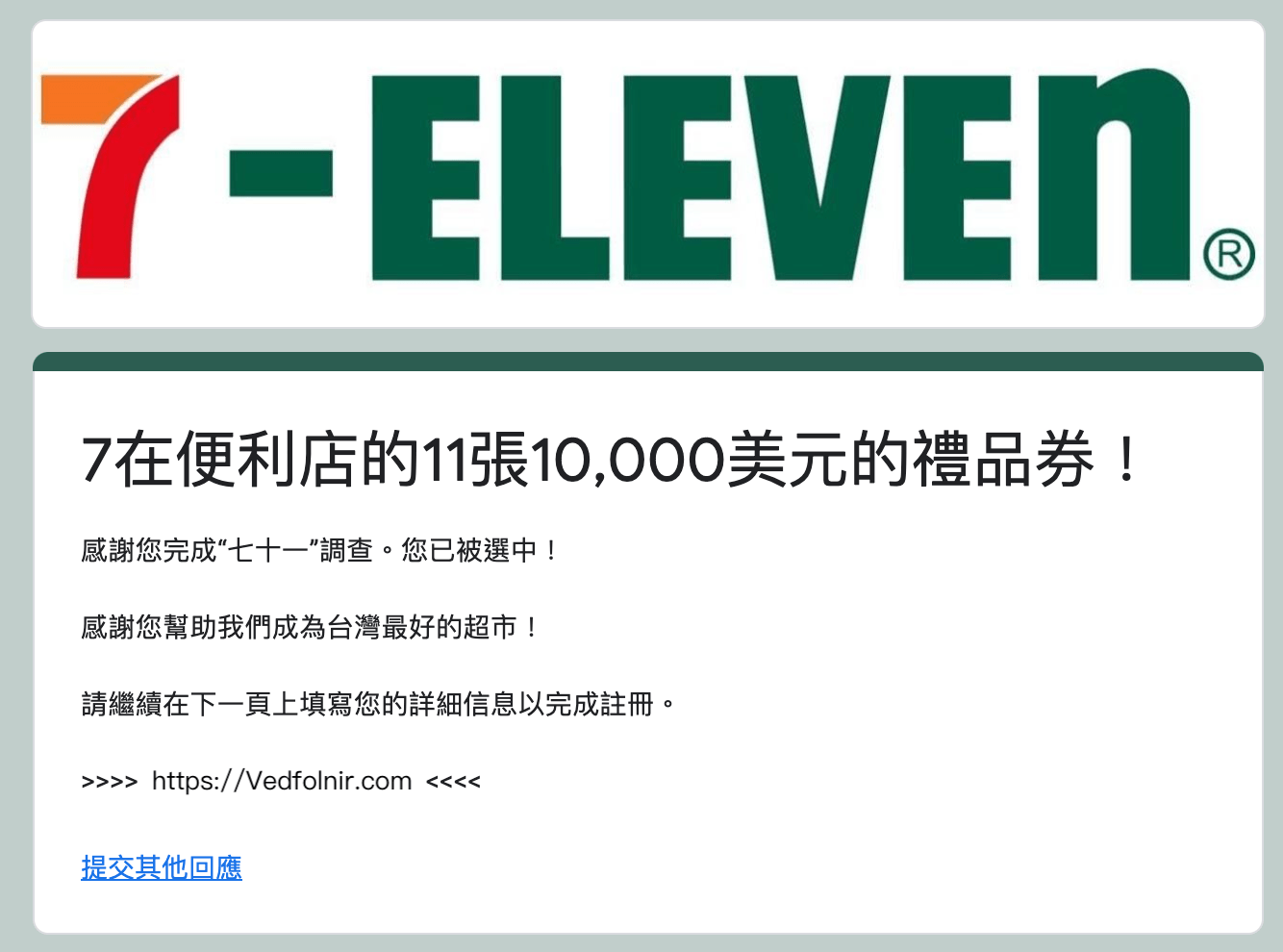
After completing these three questions, users are presented with a fraudulent prize notification page (as shown in the cover image), generously claiming that the user has won eleven gift certificates worth $10,000 USD each.
The text is riddled with unnatural phrasing and grammatical errors, clearly produced by overseas scammers using crude automated translation tools.
By tracing the bit.ly shortened URL provided in the message, we uncovered that the criminal network uses the domain weighting-gentosh.com (registered in 2017) as an intermediary redirect gateway. In this case, the traffic was redirected to an untrusted survey aggregator at tw-superdraw-61.com.
Further investigation shows that the domain registrant’s identity is concealed behind privacy protection proxies. Online intelligence confirms this domain has been exclusively linked to malicious activities with no legitimate track record.
The servers hosting these malicious assets were routed through Amazon AWS data centers, specifically A100 ROW GmbH in Germany (IP: 3.120.230.228) and Amazon Data Services India (IP: 3.6.234.252).
Once a user proceeds through the scam portal, they are bombarded with affiliate ad landing pages—ranging from paid point reward schemes and online dating apps to educational magazines. Whenever an unsuspecting victim clicks to claim a “free” gift or inputs personal sensitive data, the syndicate earns affiliate referral commissions.
In plain terms, victims unknowingly surrender their personal privacy and contact details directly to unregulated advertising brokers.
Support Independent Perspectives & In-Depth Insights
Every thoughtful analysis and candid critique comes from our dedication to truth and quality. We choose not to follow sensational algorithms or clickbait headlines.
Sustaining independent research requires reader support. Make a one-time or monthly contribution, securely processed by Google.
Payments secured by Google · Manage or cancel anytime in your Google Account




Comments