
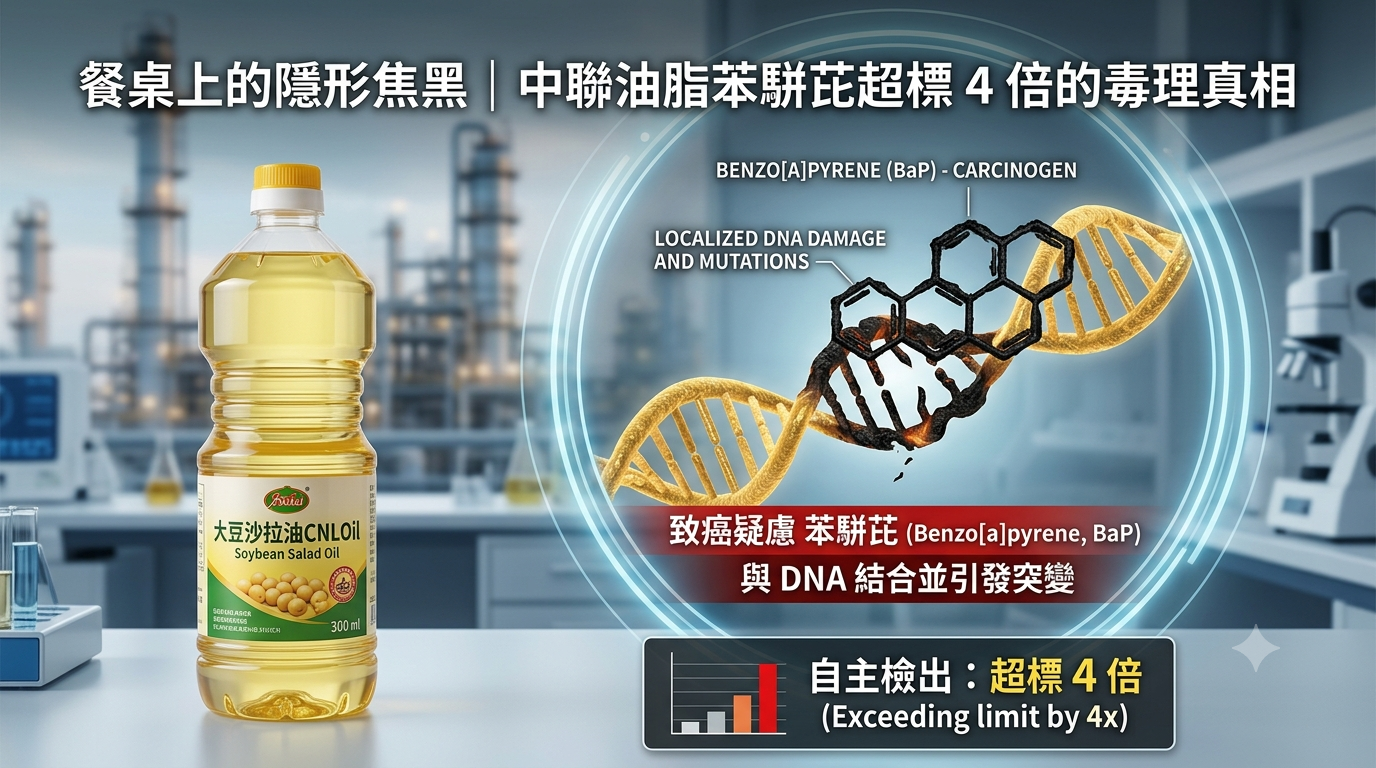
Carcinogens Lurking Inside 1,800 Tons of Golden Cooking Oil
Beneath the sparkling golden clarity of industrial soybean salad oil lay the exact same carcinogenic compounds found in charred sausages. Central Union Oil Corp. recently identified Benzo[a]pyrene (BaP)—a potent Group 1 carcinogen—at four times the statutory threshold during voluntary factory self-testing.
While this headline might appear distant, it strikes directly at household kitchens and street food vendors alike. The true gravity of the problem lies in its total invisibility.
Humans identify spoiled food through sour odors, cloudy discoloration, or slimy textures. Yet cooking oil contaminated with BaP smells neutral, pours cleanly, and fries chicken to a crispy golden perfection. BaP dissolves seamlessly within fatty lipids, slipping past every human sensory defense.
The legal threshold for BaP in edible vegetable oils is 2 ppb (micrograms per kilogram). Central Union Oil detected 8 ppb in the affected batch, leading to the sensational “four times over the limit” headlines. What does 2 ppb represent? It is roughly equivalent to dropping two drops of ink into an Olympic-sized swimming pool. At four times the limit—eight drops—its physical proportion remains minuscule, yet carcinogenic risk permits no compromise.
BaP is classified by the International Agency for Research on Cancer (IARC) as a definitive Group 1 human carcinogen. Once ingested, hepatic enzymes transform it into an intensely reactive metabolite that binds irreversibly to cellular DNA, causing mutations that elevate risks of gastrointestinal and lung malignancies.
This discovery represents an emergency braking maneuver within a massive supply chain. Commercial vegetable oil is not a boutique commodity; it is the fundamental utility of the food manufacturing sector, distributed in 18-liter metal drums to wholesalers, restaurants, night markets, and processing plants.
While voluntary detection caught this shipment, even a single day’s lag in notification could have allowed these contaminated lipids into commercial fryers and dinner tables, illustrating the extreme fragility of modern food security.
The High-Temperature Pursuit of Purity: Industrial Genesis of BaP
Oil refineries never intentionally introduce carcinogens into cooking oil. The emergence of BaP is an industrial accident borne from the uncompromising pursuit of extreme cosmetic and aromatic purity.
Crude unrefined oil freshly extracted from raw soybeans is a pungent, turbid, bitter fluid. If unrefined oil is heated in a fryer, it foams uncontrollably and fills kitchens with acrid smoke. Consumers and commercial kitchens demand refined, neutral, high-smoke-point oil.
Transforming this raw liquid into clear refined salad oil involves degumming, deacidification, bleaching, and deodorization. Deodorization, the final and most critical phase, subjects the oil to high-temperature stripping within massive vacuum columns. Engineers heat the oil to 240°C or 260°C, injecting superheated steam from below to vaporize malodorous volatile compounds.
Catastrophe strikes when thermal regulation falters. Just as excessive heat chars meat during barbecuing—generating pyrolytic BaP within burnt carbon—the same thermal degradation occurs within industrial vacuum towers. If heating coils degrade, temperatures drift upward, or residence times drag too long, lipid hydrocarbon chains crack under extreme thermal stress.
This microscopic scorching produces no visible black smoke. Fragmented carbon and hydrogen atoms recombine into exceptionally stable polycyclic aromatic structures: Benzo[a]pyrene. Highly lipophilic, newly formed BaP dissolves irrevocably into the oil matrix. No standard mechanical filter can remove it, nor does cooling precipitate it out.
Here lies a bitter industrial irony: extreme heat used to purify oil inadvertently synthesizes an exogenous carcinogen that never existed within raw soybeans. The breakdown stemmed not from tainted raw crops, but from over-cooking during the final purification threshold.
Hepatic Metabolism: How Gene-Damaging Metabolites Form
How does inadvertently consuming elevated BaP affect the human body? The answer lies in a tragic biochemical misunderstanding orchestrated by the liver.
In its native state, BaP is a chemically inert, rigid hydrocarbon. However, once absorbed into the bloodstream and delivered to the liver, cellular defense mechanisms mobilize. Cytochrome P450 enzymes rush to oxidize and cleave the lipophilic molecule so it can become water-soluble and excrete via urine.
This detoxification attempt inadvertently triggers disaster.
During oxidation, hepatic enzymes produce a reactive intermediate: anti-benzo[a]pyrene-7,8-dihydrodiol-9,10-epoxide (BPDE). In plain terms, BPDE acts like an electrically charged, reactive intruder desperate to bond. Within the cell nucleus, it binds covalently to guanine bases in DNA, forming bulky chemical DNA adducts.
This adduct behaves like grit jammed into a zipper. When cellular machinery attempts to replicate DNA during cell division, the replication fork encounters this distorted lesion and misreads genetic code.
If this mutation disables critical tumor suppressor genes, such as p53, cellular self-regulation fails, opening pathways to malignant transformation. This well-documented molecular cascade is precisely why BaP sits firmly on the Group 1 carcinogen list.
Toxicological Assessment: Do We Need to Panic?
While “four times over the limit” sounds catastrophic, Paracelsus noted that the dose makes the poison.
Let us evaluate the empirical numbers. The concentration detected was 8 ppb, meaning 8 micrograms of BaP per kilogram of oil.
If a 60 kg adult consumes 30 grams of this oil daily through stir-fries and fried foods, the daily BaP intake equals roughly 0.24 micrograms. In margin-of-exposure (MOE) toxicology, reaching dosage levels associated with measurable rodent carcinogenesis would require consuming hundreds of kilograms or tons of this oil over a condensed period.
Furthermore, if the 1,800 tons were distributed across the entire regional population, average individual exposure would measure merely tens of grams. Acute poisoning is out of the question.
Moreover, BaP surrounds us in daily life:
- Barbecue: A single charred sausage or grilled steak can deliver several micrograms of BaP—surpassing the amount in liters of this oil.
- Incense: Spending an afternoon in a dense temple exposes the lungs to polycyclic aromatic hydrocarbons far exceeding kitchen oil fumes.
- Urban Exhaust: Inhaling motorcycle exhaust at busy intersections similarly introduces continuous polycyclic compounds.
Why maintain a strict 2 ppb statutory threshold? Because soybean salad oil is a daily dietary staple. Barbecue is eaten occasionally, but cooking oil exposure accumulates continuously over a lifetime. The 2 ppb cap establishes a protective barrier ensuring absolute safety across entire lifespans.
While a fourfold excess represents an unacceptable failure of quality control warranting legal penalties and mandatory recalls, it does not represent an acute toxic disaster justifying mass panic.
Consumer Defenses and Systemic Food Safety Reforms
Consumers can establish proactive kitchen defenses. Since BaP synthesizes under high heat, cooks should avoid smoking temperatures in home cookware. Waiting for a pan to smoke heavily before adding vegetables effectively recreates the industrial deodorization accident at home.
Adopting the water-sauté method—adding water to the pan first, tossing in vegetables, and finishing with a drizzle of oil—keeps temperatures anchored near 100°C, eliminating domestic BaP formation. Rotating oil varieties rather than relying on a single brand also diversifies food safety risks.
Systemically, relying exclusively on voluntary self-testing by industrial giants creates moral hazard. Regulatory authorities must institutionalize unannounced, random factory inspections and digitize real-time telemetry from industrial deodorization columns. Safeguarding food safety requires clear, enforceable legal thresholds rather than reliance on consumer vigilance alone.
Support Independent Perspectives & In-Depth Insights
Every thoughtful analysis and candid critique comes from our dedication to truth and quality. We choose not to follow sensational algorithms or clickbait headlines.
Sustaining independent research requires reader support. Make a one-time or monthly contribution, securely processed by Google.
Payments secured by Google · Manage or cancel anytime in your Google Account



Comments