
At 2:19 p.m. today (July 24, 2020, ROC year 109), the Taipei Weather Station (station no. 46692) under Taiwan’s Central Weather Bureau recorded a temperature of 39.7°C, breaking the highest-temperature record since the station was established in 1897 during the Japanese colonial era. It is also the highest July temperature in Taipei since scientific records began, and the 17th consecutive day above 36°C, breaking multiple historical records for Taipei.
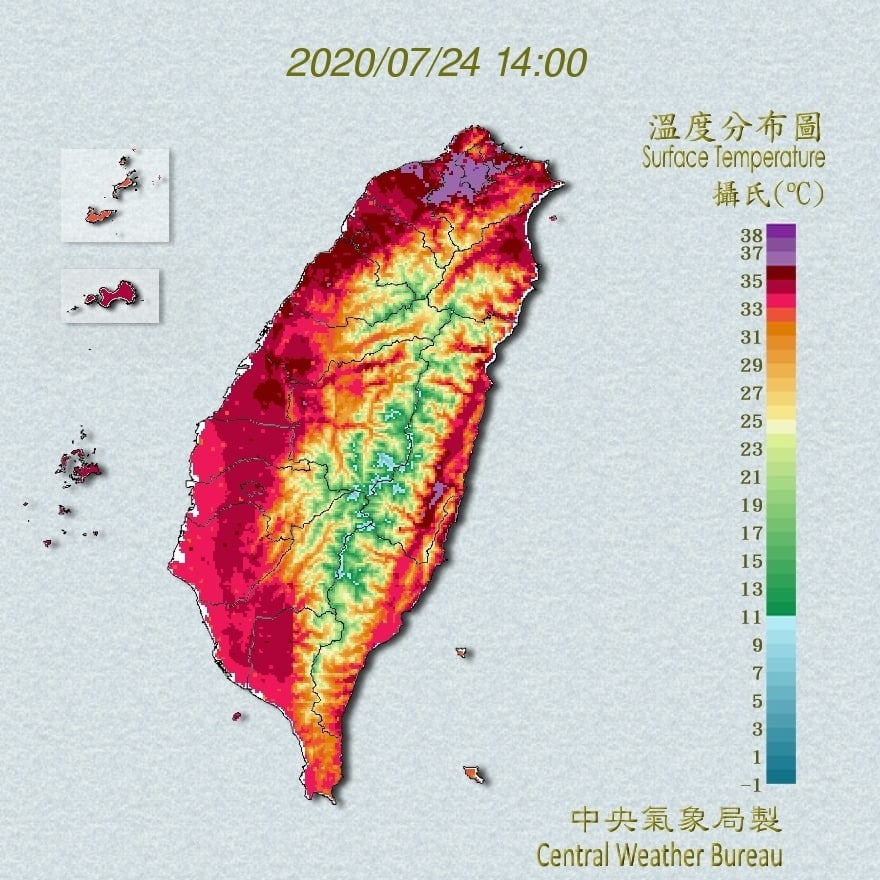
High-temperature record of July 24, 2020
Although Taipei broke its own century-old high-temperature record, the Taitung Weather Station (station no. 46766) actually recorded 40.2°C the same day, only 4.2 degrees short of the highest temperature in Chinese history. Days of sweltering heat across the island have made many people begin to feel the effects of global environmental change.
The highest temperature in modern Chinese history occurred in the eighth year of the Qianlong Emperor of the Qing dynasty (1743 CE). According to modern meteorological research, the peak may have reached an astonishing 44.4°C, affecting half of mainland China, with records of abnormally hot conditions in Beijing, Tianjin, Hebei, Shanxi, Shandong, and other parts of North China.
The Gaoyi County Gazetteer recorded: ‘From the 28th day of the fifth month to the 6th day of the sixth month, the stifling heat was unbearable; even thickly shaded walls were scorching as if burned by fire; at midday lead and tin melted, and many died of thirst.’ The Tianjin County Gazetteer also recorded the local devastation: ‘In the fifth month the heat was bitter; earth and stone were scorched; gold flowed from the mastheads; many died of heat.’
Official statistics show that between July 14 and 25 in 1743, the number of people who died of heat in and around Beijing alone reached 11,400 — not counting the uncountable numbers in other vast regions.
As is well known, the Little Ice Age at the end of the Ming dynasty (1650–1700, also called the Ming–Qing Little Ice Age) caused great famines; widespread suffering plus political corruption is thought by some scholars to have indirectly accelerated the Ming’s fall and replacement by the Qing.
However, research by the American Association of Geographers indicates that the coldest two periods of the Little Ice Age were actually 1660–1680 and 1850–1880, after the Ming’s fall. The sixth glacial period coincided with the late Qing, a time when China also faced the Taiping Rebellion, the Hui revolts, and other uprisings, ultimately leading to the Qing’s collapse and replacement by the Republic of China. This shows that the occurrence of Little Ice Ages is closely tied to the stability of Chinese regimes.
In fact, according to ancient records, China has experienced six Little Ice Ages[1], greatly affecting the climate, produce, and political situation of each dynasty, including:
- The first cold period, from the second year of King Mu of Zhou (1000 BCE) to the eastward move of King Ping of Eastern Zhou (770 BCE) — the first Little Ice Age since China’s earliest clear written records;
- The second cold period, from the fourth year of Emperor Cheng of Western Han (29 BCE), through Eastern Han, the Three Kingdoms, Jin, and the Northern and Southern Dynasties, to the twentieth year of Emperor Wen of Sui (1000 CE) — the second Little Ice Age;
- The third cold period, from the second year of Emperor Taizong of the early Northern Song (1192 CE) — the third Little Ice Age;
- The fourth cold period, from the first year of Emperor Taizu of Ming (1458 CE) to the sixth year of Emperor Dezong of Qing (1880 CE). Within this more than five-hundred-year fourth cold period, three Little Ice Ages appeared:
From the second year of Emperor Yingzong of the mid-Ming (1458 CE) to the thirty-first year of Emperor Shizong of Ming (1552 CE) — the fourth Little Ice Age in Chinese history. 5. From the twenty-eighth year of Emperor Shenzong of the late Ming (1600 CE) to the fifty-ninth year of Emperor Shengzu of Qing (1720 CE) — the fifth Little Ice Age in Chinese history. 6. From the twentieth year of Emperor Xuanzong of the late Qing (1840 CE) to the sixth year of Emperor Dezong of Qing (1880 CE) — the sixth Little Ice Age, the one closest to our own era.
In 2015, a report titled ‘Scientists Say the Sun Will Sleep in 2030 and Earth Will Enter a Little Ice Age’ sparked widespread discussion. At the National Astronomy Meeting held by the Royal Astronomical Society in the UK, Professor Valentina Zharkova[2] and her team presented a new model of solar activity cycles, suggesting that the solar cycle might enter a brief dormant state in 2030, with solar activity expected to drop by about 60%, causing Earth’s temperature to fall sharply — meaning Earth would enter another Little Ice Age.
Although scientists from various countries came forward at the time to clarify that the report was alarmist, treating a research hypothesis as a certainty and causing public panic.
Yet given the past six Little Ice Ages — and the fact that it is unknown whether even the fourth cold period has ended — it is not impossible for a Little Ice Age to occur now. Although natural disasters remain a mysterious realm beyond human prediction, there are always signs to follow.
In recent years, weather anomalies have gradually intensified, with locust plagues, floods, rat plagues, and epidemics reported frequently — always coinciding with historical events. And as we learned earlier in this article, even during the transitional periods between two Little Ice Ages, a historical high of 44.4°C could occur. So today’s 39.7°C in Taipei seems hardly surprising.
References
- Chen Yuping…
Support Independent Perspectives & In-Depth Insights
Every thoughtful analysis and candid critique comes from our dedication to truth and quality. We choose not to follow sensational algorithms or clickbait headlines.
Sustaining independent research requires reader support. Make a one-time or monthly contribution, securely processed by Google.
Payments secured by Google · Manage or cancel anytime in your Google Account



Comments