

The Taichung City Government (led by Mayor Lin Chia-lung) recently released a formal clarification responding to city councilors’ questions about potential improper favoritism toward SET TV (Sanlih E-Television) during preparations for the 2018 Taichung World Flora Exposition (Flora Expo). The controversy centers around two primary claims: whether the contractor nets NT$230 per ticket sold, and whether the procurement budget for the ticketing system was exorbitantly high. However, the city’s rebuttal introduces more questions than it answers. Below is an analysis of the logical reasoning behind the official statement.
To be clear at the outset: this article focuses solely on the logical coherence of the city government’s clarification press release, rather than alleging wrongdoing on the part of the Taichung City Government or SET TV. Legal determinations fall squarely within the remit of judicial and investigative bodies, not the scope of this commentary.
Taichung City Government’s Flora Expo Clarification
The Taichung City Government offered explanations for the alleged contractor favoritism and redundant ticketing system expenditures:
City Government Rebuttal Point 1: Does the contractor make NT$230 per ticket sold?
The City Government’s Explanation: The Taichung Flora Expo offers a wide variety of tickets—standard, group, early-bird, and bulk travel-agency allocations. When averaged across all categories, the mean ticket price will not exceed NT$146, which is lower than the Taipei Flora Expo’s average price of NT$159. How could a vendor possibly take a cut of NT$230?
City Government Rebuttal Point 2: Was the ticketing system budget disproportionately massive?
The City Government’s Explanation: The Taipei Flora Expo ticketing contract totaled NT$490 million, whereas Taichung’s totaled NT$380 million—which even includes 3 million customized Flora Expo Cards for Taichung citizens, granting one day of free admission and multiple promotional discounts!
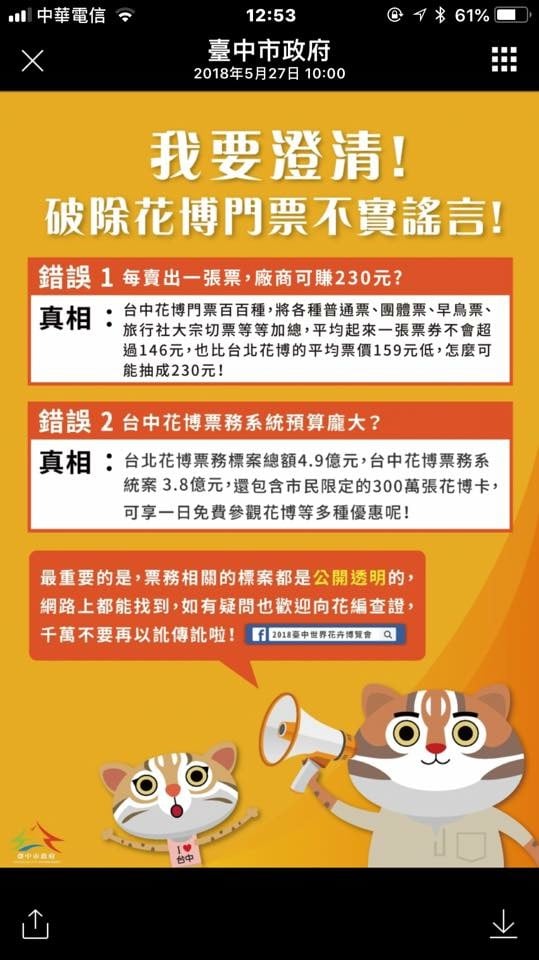
Taichung City Government Flora Expo Clarification Infographic
The rebuttal to Point 1 appears to be a semantic game. While the projected blended average price is NT$146, the actual public grievance concerns standard full-price ticket sales, where the ticketing contractor reportedly reaps NT$230 per regular ticket. Under the Taipei City Government (during Mayor Hau Lung-pin’s tenure), the contractor was restricted to roughly NT$20-plus per ticket regardless of tier—a more than tenfold difference. Relying on an average price to dismiss the issue resembles government figures citing average national wages approaching NT$60,000 to minimize wage stagnation.
Put simply, Taipei’s contractual structure ensured that baseline municipal revenue was maximized: if the vendor wanted higher profits, they had to drive substantially greater attendance, which in turn generated surplus returns for the public treasury.
By contrast, Taichung’s contractual arrangement seems structured to guarantee contractor returns while capping public revenue upside. As regular ticket sales roll out, the vendor’s profit margins climb linearly. This is akin to the government clearing land, planting pastures, and building a ranch (hosting the Flora Expo) with taxpayer funds, only to sign an agreement letting a private contractor pocket nearly two-thirds of ticket sales.
Furthermore, the Taichung Flora Expo does not open until November—so where did the city government derive this definitive “average ticket price” in its defense? It is hardly surprising that the public and city councilors share deep skepticism.
Regarding the second point in the city’s defense, from the public’s perspective, this procurement simply financed another white-elephant system.
What citizens question is why the Taichung City Government bypassed established ticketing platforms and chose a television broadcaster to engineer an entirely new ticketing system from scratch. That remains the core administrative critique facing the city leadership.
Even taking a step back: could the city not have negotiated with Taipei to license and adapt the existing Flora Expo software for a fraction of the cost, say NT$100 million? At least that would have built on prior taxpayer investments, generating revenue for Taipei while saving Taichung NT$280 million—funds that could have been directly deployed to combat regional air pollution.
Ultimately, if the Taichung administration can muster only these two logically tenuous rebuttals, observers have good reason to worry about the future of their public communication strategy.
Recommended Reading / Further Notes
- Taichung World Flora Exposition 2018: Held from November 3, 2018, to April 24, 2019.
Support Independent Perspectives & In-Depth Insights
Every thoughtful analysis and candid critique comes from our dedication to truth and quality. We choose not to follow sensational algorithms or clickbait headlines.
Sustaining independent research requires reader support. Make a one-time or monthly contribution, securely processed by Google.
Payments secured by Google · Manage or cancel anytime in your Google Account




Comments