
This was my very first time making the round trip between Tamsui in New Taipei City and Jiji Township in Nantou purely using public transportation. It was quite a novel experience for me, as I used to just drive down whenever I visited Lean.
Overall, the journey involved taking the Taipei Metro from Tamsui into Taipei, catching a highway express bus down to Taichung Railway Station, and finally heading to the All Day Bus (總達客運) Gancheng terminal to board Route 6333 bound for Jiji. The return leg retraced the exact same steps.
Curiously, on the bus leg from Jiji back to Taichung, I experienced mid-trip ticket inspection on a public coach for the very first time, which felt both somewhat bizarre and intriguing.
Later on, I took the route again. Instead of taking National Highway No. 3 (Second Northern Freeway), this trip took local suburban thoroughfares passing through Nantou City. Because the distance was longer, the fare was slightly higher, though no ticket checks were conducted that time.
Having rarely taken such long-distance regional buses, it reminded me of riding a 24-hour long-haul coach in the past where tickets were never checked halfway through. I couldn’t help but wonder why that intermediate ticket check happened on Route 6333.
In any case, this guide explains how to get directly from Jiji in Nantou to Taichung by bus, avoiding the confusion of local stops.
Transportation Overview in Jiji Township
In Jiji, a traditional bus route runs along Minsheng Road (the main thoroughfare crossing the town center). Numerous bus stops are situated along this road, served by Yuanlin Bus, All Day Bus (總達客運), and the Jiji Town Shuttle. Travelers can easily pick any convenient stop along the street to wait for their ride.
One helpful tip: try not to wait at the stop directly in front of the historic train station. Crowds gather there frequently, and even if you don’t mind jockeying for seats, boarding amidst large tourist groups is rarely a comfortable experience.
Also, even if you are just a few meters away from the bus stop, once a bus begins to pull away, drivers usually will not stop no matter how vigorously you wave. I once watched helplessly as a bus accelerated right past my flailing arms!
Jiji Town Tourist Map
To get acquainted with Jiji’s layout, take a look at the simplified transit map I drew below:
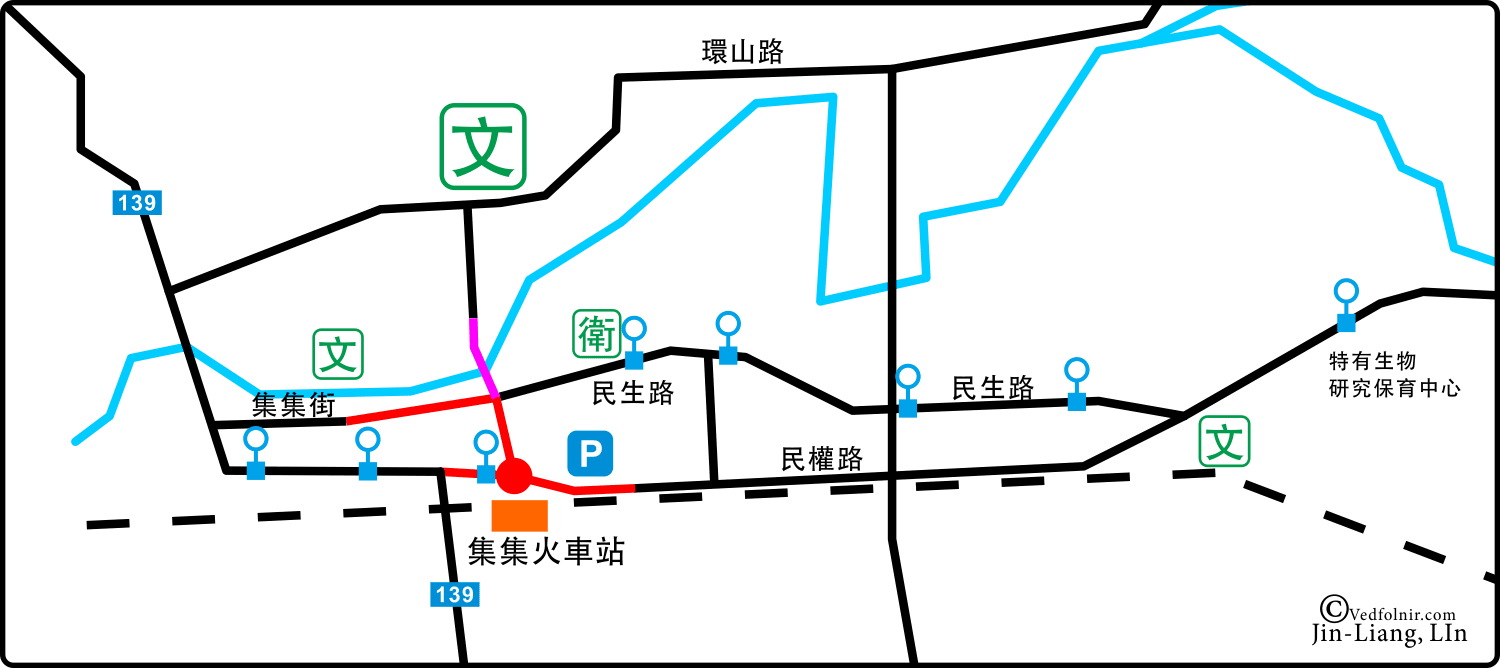 Simplified Transit Map and Bus Routes in Jiji Township, Nantou
Using Jiji Railway Station (the orange rectangle) as a central landmark, heading north brings you to the station plaza (red circle).
Branching out from this plaza, the road on the left (red line) features plenty of eateries. I highly recommend the local shaved ice parlors and Vietnamese restaurants—Lean actually took me around several distinct Vietnamese eateries to sample their cooking (there are surprisingly many here!).
The road to the right (red line) offers bicycle rentals and access to Carton King, with the Jiji Public Parking Lot located nearby as well.

Carton King Paper Lamp in Jiji, Nantou
Continuing straight north from the station plaza along the road (red line) brings you onto Minsheng Road, which serves as the primary route for buses.
Before searching for a bus stop, you might want to stop by “Chao Ke” (潮客), a beverage shop directly across from the plaza, to pick up their signature black tea. Lean strongly recommended it, and it was genuinely delicious—rumored to be brewed with famous Sun Moon Lake black tea leaves (though whether that’s true remains anyone’s guess).
With an iced tea in hand, you can stroll along Minsheng Road to find your designated bus stop sign (marked by the combined blue square and circle icon) to await your bus.
Additional Notes on the Jiji Transit Map
On the simplified map above:
- The red line highlights pedestrian-friendly routes with dense concentrations of shops and eateries.
- The purple line marks the street where the Jiji Night Market sets up every evening.
- The green Chinese character “衛” marks the local Public Health Center; the township hall and police station are located within the same precinct.
- The green Chinese character “文” indicates the educational and school district.
Route 6333 Bus Stop Information from Jiji to Taichung
Assuming most readers of this article are visiting travelers rather than local residents, I will skip the minor local feeder stops. For exact timetable details and full stop listings, refer to the bus stop sign pictured below:
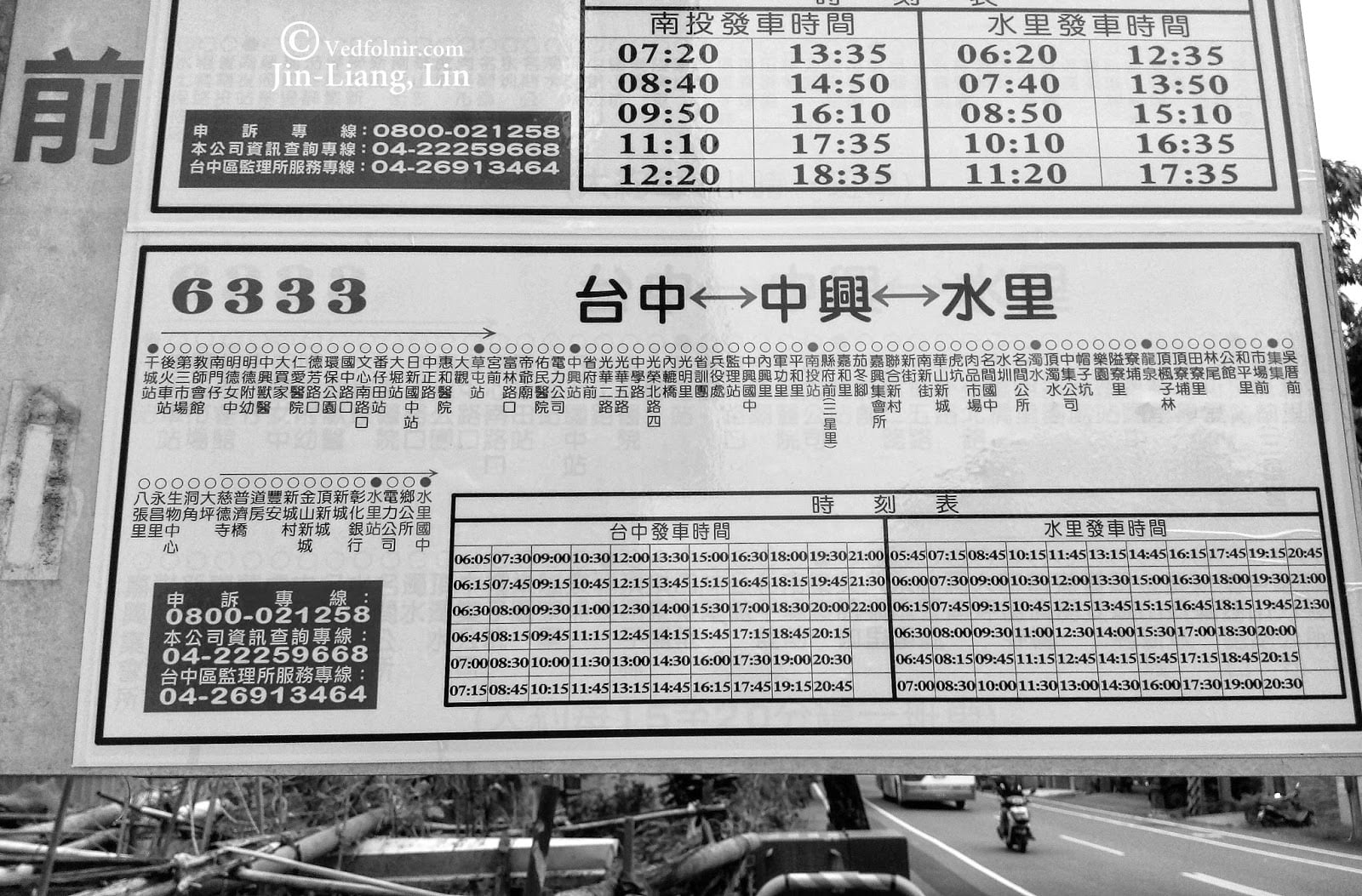 All Day Bus Route 6333 (Taichung → Zhongxing → Shuili) Timetable and Route Sign
In short: locate any stop along Minsheng Road, flag down the approaching All Day Bus Route 6333, and you’re good to go.
One fascinating quirk of this route is that it operates two vehicle formats: large full-size coaches and medium mini-buses. While the schedule shows departures every 15 minutes, large and mini-buses actually alternate departures from Shuili every 15 minutes.
In practice, this means each specific type arrives once every 30 minutes. Even if you board at the Taichung Gancheng terminal, ticket clerks will ask you to wait for the half-hourly departure that fits your preferred route.
Difference Between Large and Mini-buses on Route 6333
Here’s why they alternate:
- The mini-bus travels via National Highway No. 3 (Freeway) straight into Taichung, making it considerably faster.
- The large coach meanders through every local stop shown on the route board, which takes noticeably longer and costs slightly more.
From Jiji to Taichung, the mini-bus fare is NT$125, while the large coach fare is NT$155. (While EasyCard and iPASS are accepted, the driver remarked that paying cash can sometimes have promotional discounts.)
While the expressway mini-bus saves travel time, riding the local large coach is a lovely experience if you aren’t in a hurry.
On the mini-bus, you spend almost all your time cruising along the elevated highway with limited roadside views. On the large coach, however, the seats are much more spacious, the air conditioning is ice-cold, and you get to take in all the fascinating rural sights and town life along the scenic mountain route.
Incidentally, when I boarded the large coach and gave my destination, the kind driver warned me: “The next bus takes the highway, this one takes the longer local route and costs more!” I replied, “No worries, this bus is wonderful—it’s way too scorching hot outside to wait another 15 minutes!” Haha.
Support Independent Perspectives & In-Depth Insights
Every thoughtful analysis and candid critique comes from our dedication to truth and quality. We choose not to follow sensational algorithms or clickbait headlines.
Sustaining independent research requires reader support. Make a one-time or monthly contribution, securely processed by Google.
Payments secured by Google · Manage or cancel anytime in your Google Account



Comments