
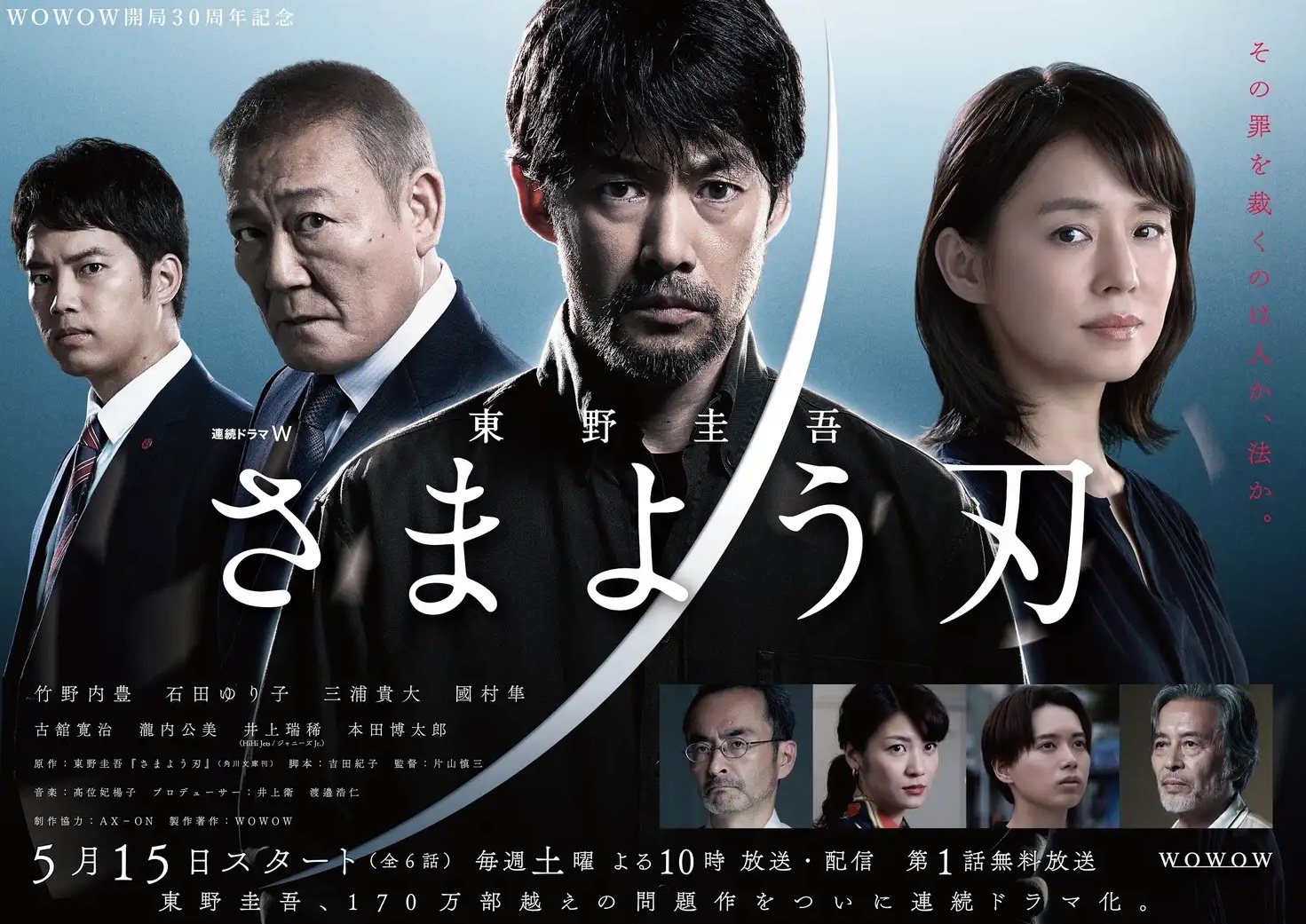
Plot summary: Single father Shigeki Nagamine lives a quiet, ordinary life with his beloved daughter, the two of them relying on each other. Then one day, Shigeki waits in vain for his daughter to return from her part-time job — all he receives is a horribly disfigured corpse. A few days later, Shigeki gets an anonymous call revealing the true identity of his daughter’s killers. These juvenile offenders, shielded by juvenile law from severe punishment, drive him to embark on a mission of revenge…
Cast:
- Takenouchi Yutaka as the protagonist Shigeki Nagamine
- Kawai Yumi as Nagamine Ema, who is drugged and raped to death
- Ishida Yuriko as Kimishima Wakako, the daughter of the innkeeper who later helps the protagonist hide
- Miura Takahiro as rookie police officer Oribe Takashi
- Furudate Kanji as veteran detective Mano Kanji
- Kunimura Jun as Hisatsuka Kozo, the case commander about to retire
- Ichikawa Riku as Sugano Kaiji, the main culprit in multiple rape and murder cases
- Nakamura Shin as Tomisaki Atsuya, accomplice in the rape-murder case
- Inoue Mizuki (HiHi Jets / Johnnys Jr.) as Nakai Makoto, an accomplice who did not take part in the murder and rape
- Honda Hirotaro as Kimishima Takaaki, the innkeeper
- Takiuchi Kumi as Odagiri Yukari, a female reporter who disregards journalistic ethics like a wild boar
Recommendation rating:
★★★★★
Thoughts After Watching Samayou Yaiba
Chunghwa Telecom’s MOD drama channel recently premiered a new Japanese drama, Samayou Yaiba (Japanese: さまよう刃; English: Samayou Yaiba), consisting of 6 episodes, each about 50 minutes long, rated for viewers aged 15 and above.
This is a novel published by Keigo Higashino in 2004, adapted into a film in 2009, and now a Japanese TV series that premiered in Japan this May and had its premiere in the Republic of China region in December.
The characters in the drama are mainly divided into three groups — the victim, their family and supporters, the police organization, and the perpetrators — and the entire story unfolds around their maneuvering against one another.
⚠️ Around the 15th minute of the first episode there is a scene of two main culprits drugging and raping someone. Although there is no nudity, the process of forced coercion is depicted. Those who cannot handle this kind of content can skip directly to the 17th minute.
(Minor spoilers below, proceed with caution)
The pacing of the whole drama is a bit fast, because the protagonist Shigeki spends a long time searching on foot across a forested mountain area for the possible hiding place of the mastermind Kaiji, and in between is hidden for several days by the female lead Wakako, so it’s impossible to know how much real time was compressed into these six episodes.
The director placed meaningful props in many background details, so those watching a second time may occasionally make new discoveries. That said, there’s no need to rewatch just for these little touches (looking into the distance).
Although one wants to say that, like all Japanese manga and dramas, the Japanese police will always be one step behind, the handling in Samayou Yaiba was also beyond this author’s expectations — they were indeed one step, even several steps, behind through the first five episodes, but in the final episode they were actually one step ahead of the protagonist.
Ji Xiaolan, the Minister of Rites of the Qing Dynasty of China, once said in his collection of supernatural tales, Yuewei Caotang Biji, that “when something is abnormal, there must be a demon behind it.” It is precisely this rare “one step ahead” that led the director to bring Shigeki a conclusion that, to me, is somewhat terrible, yet for Shigeki — who has lost both wife and daughter — is inevitable.
In the entire Samayou Yaiba series, the scene that disgusted this author most was not the drugging-rape or the murder scenes, but the ending of the first episode, when one of the main culprits, Tomisaki Atsuya, about to be killed by the rage-blinded Shigeki, instead flashes a sickening smile and, staring straight at Shigeki the father, says: “I know who you are. You’re that woman’s father, right? It felt so good, 100 points, thanks for the meal.”
This reaction, which could be called a total loss of humanity, is even more infuriating than Kaiji, who struggles desperately to survive out of fear of death. The director didn’t even give him any character setup at all — compared to Kaiji, whose background is later revealed somewhat, he really seems like a disposable chopstick used to boost the audience’s disgust, and is also a key device designed to trigger Shigeki’s determination to personally execute the killer with a hunting rifle.
There is a rather hidden character in the drama — this mysterious person keeps leaking information about the culprit’s hiding place from behind the scenes, and is also the driver pushing Shigeki step by step toward his inevitable ending.
The director also very deliberately guides the audience in the wrong direction of suspicion through many details. For a long time this author mistakenly thought it was the accomplice Makoto. After all, if he could use Ema’s father’s hand to kill Kaiji, he could also cover up his own crime, and wouldn’t have to worry about being haunted by the near-insane Kaiji in the future — it’s simply the perfect intelligent-criminal setup.
However, the author maintains very good consistency in shaping the characters’ personalities — the mind of someone who would become an accomplice really couldn’t come up with such a scheme. As for who this mysterious person is, this author didn’t guess until the first half of the sixth episode — this is the segment with a slightly higher degree of suspense in the whole drama.
“My daughter is the victim. Go catch the criminal, that’s what you police should be…” Shigeki’s words, cried out to two officers when he lost control during questioning at the police station on the third day after the incident, when he had just learned the rape-murder had occurred, still echo in my ears. Then the scene cuts to the final scene of the sixth episode, and when we finally learn who the mysterious person is, this author suddenly felt a hint of something strange.
Perhaps it was because Shigeki, at the police station, repeatedly having the case concealed from him, shouted at the police: “Can you understand the feelings of a family member whose daughter has been killed?” — that made that person become the mysterious person, continuously leaking information about the culprit to Shigeki so that he could personally kill the culprit, rather than letting the culprit be protected by the state’s lenient punishment for juvenile offenders.
Unfortunately, the end of a story is not always happy or complete — the truly detestable main culprit actually survived, while the protagonist was instead shot dead by the rookie police officer.
Watching the police officer and Kaiji, both of them killers, Wakako sadly says: “Both are murderers, yet they are divided into forgivable and unforgivable…”
Support Independent Perspectives & In-Depth Insights
Every thoughtful analysis and candid critique comes from our dedication to truth and quality. We choose not to follow sensational algorithms or clickbait headlines.
Sustaining independent research requires reader support. Make a one-time or monthly contribution, securely processed by Google.
Payments secured by Google · Manage or cancel anytime in your Google Account


Comments