
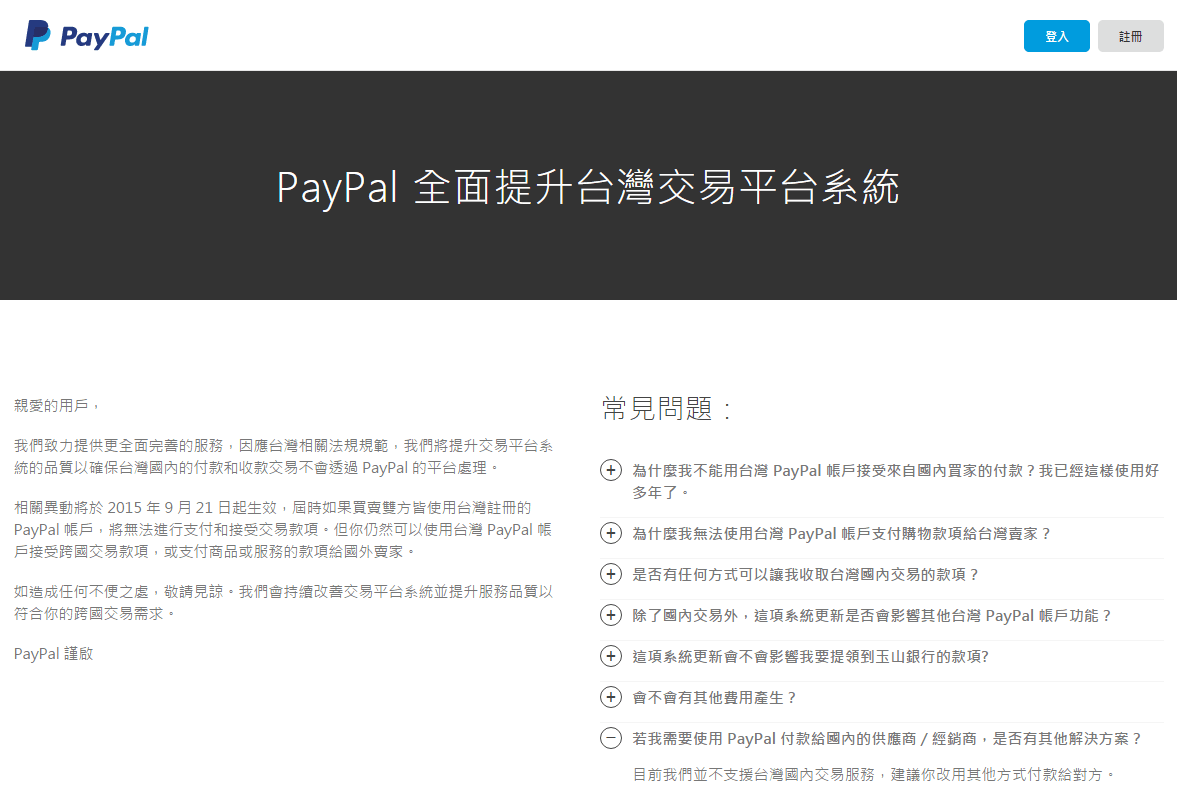
A friend on Facebook passed along shocking news today: renowned US digital payment processor PayPal is halting all domestic transaction services within Taiwan. Whether it’s paying service fees via credit card or transferring shopping funds between local users, these everyday services that have worked smoothly for years are being pulled back by PayPal. According to PayPal’s official announcement, this move is meant to "**comprehensively enhance the Taiwan transaction platform system**". Yes, you read that right: PayPal’s headline slogan is literally "**enhancing the quality of the platform system**".
The exact statement published on PayPal’s official portal reads:
“Dear User, We are committed to providing comprehensive, superior services. In accordance with local regulatory requirements in Taiwan, we will be updating our payment processing systems to ensure domestic payments and receipt of funds within Taiwan are not processed through PayPal. These changes take effect on September 21, 2015. After that date, if both buyer and seller are using Taiwan-registered PayPal accounts, domestic payments and fund transfers will no longer be possible. However, you can still use your Taiwan PayPal account to receive cross-border payments or pay for goods and services from overseas sellers. We apologize for any inconvenience caused. We will continue improving our platform and service quality to satisfy your cross-border transaction needs.”
Speaking as Bigman, this is the very first time I’ve seen an "**enhancement of platform service quality**" achieved by unilaterally terminating service for users across an entire regional market.
In truth, PayPal taking this step isn’t entirely surprising. Domestic financial regulations have long lagged behind many parts of the world. The biggest recent dispute in local fintech was PChome chief Jan Hung-tze clashing publicly with the Financial Supervisory Commission (FSC) and the Bankers Association over third-party payment regulations. One could argue that offshore payment processors had historically been operating in a gray zone fostered by outdated rules.
BUT—here comes life’s ever-present "**BUT**". In its FAQ, PayPal listed several questions. Beyond boilerplate PR lines like “PayPal has always been committed to ensuring operations comply with applicable regulations in every country and region…”, one question stood out: “Is domestic service restricted because of Taiwan regulations? If so, which specific regulation?” That question reveals the true reason PayPal felt compelled to "**enhance system quality**" by locking out local users.
PayPal’s answer was remarkably terse: "**The Act Governing Electronic Payment Institutions**". It had the shortest character count of any answer in the entire FAQ, lacking even a closing period—a deliberate rhetorical choice. Just like the title of PayPal’s Announcement Page—"**PayPal Comprehensively Enhances the Taiwan Transaction Platform System**"—it dripped with unconcealed sarcasm. Yet this regulation leaves me feeling that Taiwan’s approach to e-commerce resembles past protectionist policies meant to shield Tatung electric cookers: excessive insularity that breeds bureaucratic paralysis.
What Exactly Is the “Act Governing Electronic Payment Institutions”?
To quote the official regulatory statement, the Financial Supervisory Commission stated that the Act aims to: “soundly develop e-commerce payment services, increase public confidence in online transactions, lower payment costs for micropayments, foster a fertile environment for youth online innovation, and assist youth entrepreneurship and business commercialization.”
Currently, the Act Governing Electronic Payment Institutions has passed its third reading in the Legislative Yuan and is awaiting final implementation guidelines following discussions between the Executive Yuan and industry players. Since the regulation is already set in stone, the only plausible reason for PayPal’s "**service quality enhancement**" is that meeting domestic compliance requirements to maintain local transaction services would incur operational overhead they deem unprofitable. Hence, their conclusion to "**enhance service quality**" by simply shutting down domestic payment services.
Under Article 19 of the Act Governing Electronic Payment Institutions, specialized electronic payment institutions whose total stored-value funds in New Taiwan Dollars and foreign currencies reach a designated threshold must deposit an adequate reserve. The specific threshold, reserve ratio, deposit method, adjustments, auditing, and other compliance rules are determined by the Central Bank in consultation with the competent authority.
The only saving grace is that offshore transactions remain unaffected, as local ROC domestic regulations do not restrict overseas payments; we can continue remitting funds to foreign sellers and receiving payments from global buyers. However, if two local residents transact on eBay, the seller will now have to set up a listing on Ruten or Yahoo Auction instead. Alternatively, for someone like me who has long used PayPal as a primary account for global transactions, what was once a convenient, universal domestic-and-international tool is broken. For local transactions, we will now have to find another credit card processor (such as those domestic banking conglomerates that have long eyed the local payment processing pie), pay redundant setup and management fees, get clipped for an extra slice of processing costs, and endure additional web integration headaches.
Article 14 of the Act Governing Electronic Payment Institutions stipulates: “Unless an offshore institution applies for approval and establishes an electronic payment institution pursuant to this Act, it shall not engage in the businesses set forth in paragraph 1 of Article 3 within the territory of the Republic of China. Without approval by the competent authority, no person shall cooperate with or assist an offshore institution in engaging in the businesses set forth in paragraph 1 of Article 3 within our territory.”
Furthermore, PayPal already holds a legitimate payment partnership with E.SUN Bank, allowing Taiwan account holders to withdraw PayPal funds into E.SUN accounts. Yet judging by PayPal’s immediate "**enhancement of service quality**" and unilateral rollback of local user privileges at the first sign of regulatory friction, long-term trust in partnering with PayPal has taken a severe hit.
In conclusion: Am I allowed to flip the table on PayPal yet?
Support Independent Perspectives & In-Depth Insights
Every thoughtful analysis and candid critique comes from our dedication to truth and quality. We choose not to follow sensational algorithms or clickbait headlines.
Sustaining independent research requires reader support. Make a one-time or monthly contribution, securely processed by Google.
Payments secured by Google · Manage or cancel anytime in your Google Account




Comments