
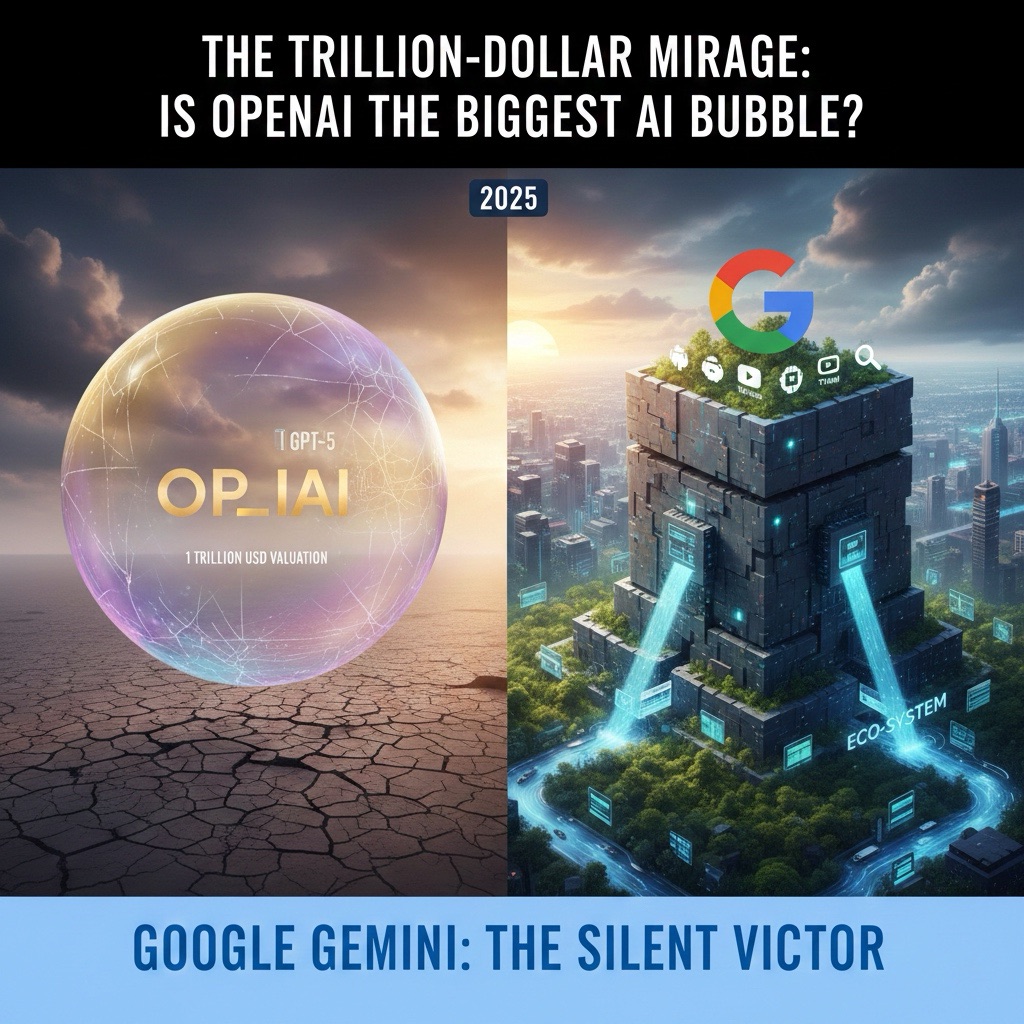
In the capital markets of 2025, OpenAI is seeking a public listing at a staggering trillion-dollar valuation, marking an undeniable milestone in tech history.
Yet, once the marketing luster is stripped away, this seemingly impregnable fortress reveals itself to be standing at its most perilous precipice.
For long-term investors and industry observers alike, looming behind OpenAI’s spotlight are immense vulnerabilities: rapid technological commoditization and a glaring lack of an organic product ecosystem.
1. Technological Convergence: The Lead Time Gap Is Evaporating
OpenAI’s foundational myth was rooted in “technological supremacy.” However, developments throughout 2025 have proven that early technical leadership does not equal a permanent monopoly.
- Vanishing Training Gap: OpenAI previously dominated via upfront brute-force compute investments. Today, the brute-force methodology of frontier model training has been completely decoded across the industry.
- Performance Ceilings and Convergence: Whether comparing GPT-5 to Gemini 3.0 or Claude 4, real-world benchmarks show that frontier models now converge tightly in reasoning, writing fluency, and logical synthesis.
- The Open-Source Surge: Open-source models such as Meta’s Llama series have commoditized capabilities that once demanded hundreds of millions of dollars to build. When an architectural moat shrinks to a lead time of weeks or months, the massive premium sustaining a trillion-dollar valuation loses its physical foundation.
2. The Ecosystem Deficit: OpenAI Remains a Digital “Plugin”
The most fatal dilemma confronting OpenAI is straightforward: it commands a brilliant “brain,” but lacks its own “body.”
While ChatGPT undoubtedly reshaped the technological landscape, it remains a standalone utility tool that users must consciously launch. In the commercial reality of modern computing, distribution channels reliably trump raw model power.
- OpenAI remains structurally dependent on Microsoft Office and Apple iOS ecosystems to reach daily end users.
- This parasitic operational architecture means OpenAI is constantly vulnerable to being sidelined by platform gatekeepers, or forced to surrender exorbitant gateway tolls.
Google Gemini: The Quiet, Resilient Victor
In sharp contrast to OpenAI’s aggressive public posturing, Google—after overcoming initial organizational inertia—is now demonstrating its true might as a vertically integrated AI infrastructure powerhouse.
1. Genuine Closed-Loop Ecosystem Integration
Google does not sell disconnected utilities; it commands an entrenched digital lifestyle. Gemini is not merely an isolated application; it is natively embedded across essential daily surfaces:
- Android OS: The operational core powering billions of mobile devices worldwide.
- Google Workspace: The primary productivity engine driving millions of enterprises globally.
- YouTube and Search: The planet’s largest dynamic knowledge repository and primary traffic funnel.
When users draft emails in Gmail, author documents in Docs, or browse research videos on YouTube, Gemini operates ambiently. This frictionless, ambient presence—demanding neither separate subscriptions nor application switching—provides the fertile soil required for lasting AI platform dominance.
2. Full-Stack Advantages in Custom Silicon and Compute Infrastructure
While OpenAI continues to burn billions leasing NVIDIA GPUs and Oracle cloud capacity, Google has spent over a decade perfecting its proprietary Tensor Processing Units (TPUs).
- Cost Efficiency: As artificial intelligence transitions into a high-volume, low-margin utility phase, Google’s internal silicon and hyper-scale data centers enable it to deliver state-of-the-art inference at fractional costs.
- Co-Design Synergy: Google TPUs and Gemini models are co-optimized from the silicon up. This hardware-to-software vertical integration creates an operational moat that a pure-play software vendor like OpenAI can never replicate.
Conclusion: The AI Race Shifts from a Sprint to a Marathon
Throughout tech history, early pioneers like Netscape created iconic browser innovations, only to be overtaken by Microsoft’s ubiquitous platform operating system. Today, OpenAI faces its own profound “Netscape moment.”
As novelty wears off and enterprises evaluate unit economics, raw inference cost, and operational integration, an OpenAI burdened by sky-high valuations yet devoid of distribution moats risks becoming the premier tech bubble of our era.
Meanwhile, tech titans with comprehensive product suites, self-owned hardware stacks, and direct ownership of global distribution highways—led by Google—stand ready to endure and capture the marathon’s ultimate rewards.
Support Independent Perspectives & In-Depth Insights
Every thoughtful analysis and candid critique comes from our dedication to truth and quality. We choose not to follow sensational algorithms or clickbait headlines.
Sustaining independent research requires reader support. Make a one-time or monthly contribution, securely processed by Google.
Payments secured by Google · Manage or cancel anytime in your Google Account


Comments