
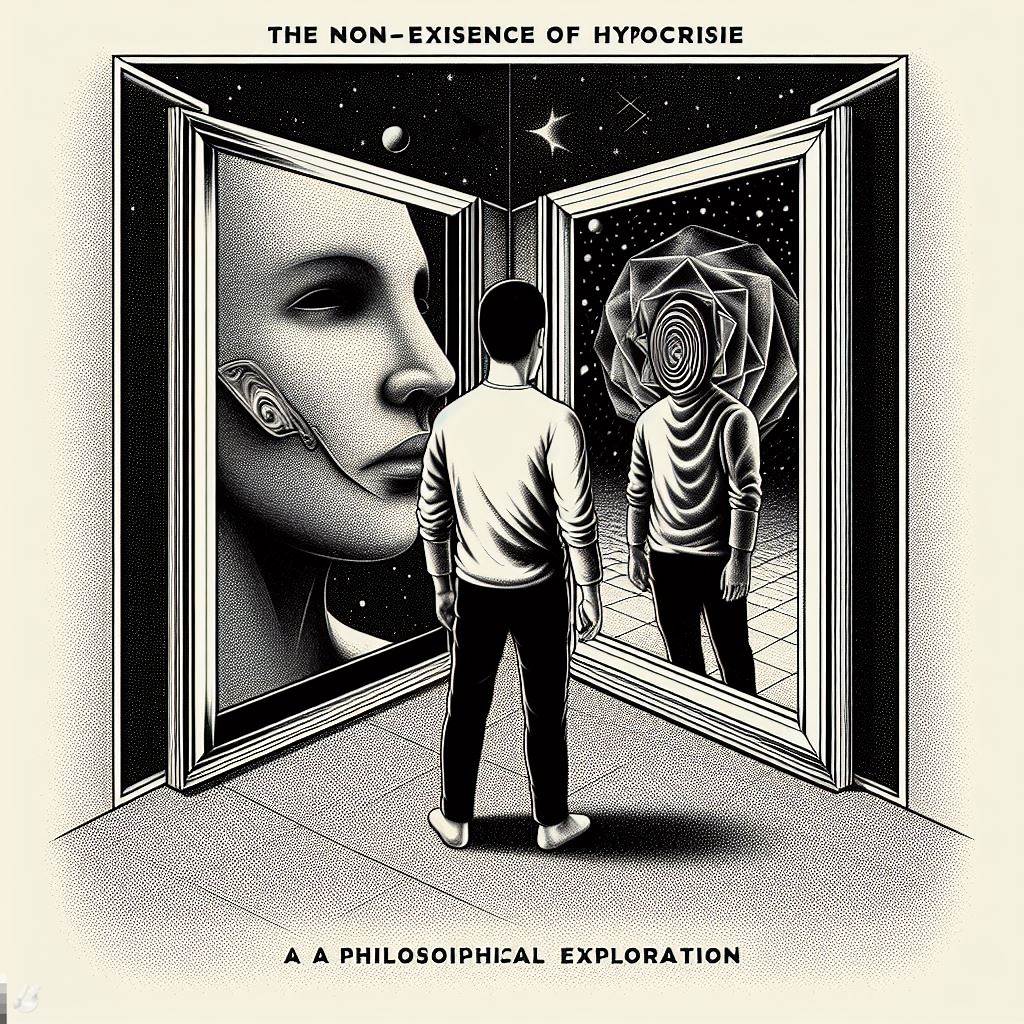
“Hypocrisy” is one of the most frequently weaponized labels in online commentary, typically thrown at those who perform benevolent acts under the cynical suspicion of harboring ulterior motives or hidden malicious intent.
More troubling are antisocial keyboard cynics who reflexively slap the label of “hypocrisy” onto virtually any altruistic act they encounter on the internet.
Yet if we pause to think critically: Does the concept of “hypocrisy” actually hold any meaningful moral ground?
Can we objectively judge whether an action is inherently good or evil? Do we possess the right—or even the epistemological capability—to arbitrate whether someone’s virtuous deed stems from genuine compassion or calculated deceit?
In this article, I want to explore an intriguing proposition: that in the objective world, hypocrisy does not truly exist.
Clear Boundaries Between Good and Evil
First, we must establish a foundational premise: “Good is good, and evil is evil.”
This means whether an action is morally good or bad depends strictly on the tangible consequences of the action itself, rather than the actor’s unobservable internal motives, mental state, or a slippery slope of hypothetical future harms.
For instance, when a person donates money to a charity, that act is intrinsically good because it provides real assistance to people in need. Whether the donor gave out of pure altruism, for social prestige, or simply to secure a tax deduction does not diminish the positive impact delivered to the beneficiaries.
Conversely, if an individual commits murder or arson, that act is inherently evil because it inflicts irrevocable harm upon innocent people. Whether driven by hatred, self-defense rationalizations, or a perverted sense of justice, nothing alters the objectively destructive nature of the act.
All too often, we oversimplify other people’s behaviors into a chaotic moral fog, evaluating and judging them entirely according to our personal subjective likes and dislikes.
When navigating complex social events, the most grounded approach is to treat each individual action independently on its own merits, rather than anchoring our perceptions to enduring stereotypes based on a single instance.
The Walls Guarding the Human Mind
Second, we must recognize a fundamental fact: “We cannot read another person’s mind.”
We can never attain complete access to someone else’s inner motives or psychological makeup; we can only infer them through their outward deeds and spoken words.
However, these inferences are notoriously prone to error. People may conceal their true thoughts, or their mode of self-expression may be misunderstood by onlookers.
In many cases, an individual has mentally orchestrated a multi-step sequence to achieve a constructive result, yet observers see only the first step and rashly conclude that they have acted in bad faith.
For example, when someone smiles at you, you might perceive warmth when they actually harbor contempt. Conversely, if someone appears cold or aloof, you might assume they are indifferent when they are merely socially anxious. We cannot reliably determine moral character purely through our subjective emotional reactions.
The Pitfall of Bias
Finally, we must acknowledge an undeniable reality: “We harbor biases against others far more often than we realize.”
We routinely project our own value systems, ideological beliefs, passing emotions, and vested interests onto others to pass praise or condemnation.
Yet such evaluations are almost always flawed. We routinely overlook the external constraints, unique backgrounds, and contextual reasons influencing another person’s actions, unilaterally imposing our subjective standards onto them.
For example, when someone disagrees with our viewpoint, we might impulsively write them off as foolish, when in fact they possess valid insights. Or if someone’s interests clash with our own, we might brand them selfish, when their stance is perfectly reasonable from their perspective. We cannot render moral judgments through the distorted lens of personal prejudice.
Conclusion
Drawing these observations together, we arrive at a thought-provoking conclusion: in an objective sense, “hypocrisy” is an empty construct. We cannot invalidate a good deed by presuming the benefactor’s hidden intentions, nor can we excuse an evil act based on noble claims of intent.
We can only evaluate goodness or malice through the objective reality of actions and their real-world outcomes. Such an assessment is objective, untainted by our subjective guesswork or emotional biases.
Therefore, we ought to respect benevolent actions wherever they occur. We should refrain from using the accusation of “hypocrisy” to demean others’ moral integrity, and we must never weaponize the charge of “hypocrisy” as a shield to excuse our own shortcomings or justify cynical inaction.
Consider the common adage contrasting the “honest villain” with the “hypocritical gentleman”—it is often used by cynics to normalize petty behavior under the guise of authenticity. Yet judged by actual outcomes, there is no such thing as a “hypocritical gentleman”; there are simply undiscovered wrongdoers and exposed wrongdoers.
Let us pursue truth, goodness, and beauty with sincerity. Rather than hiding behind masks to deceive others or ourselves, letting deeds speak for themselves is the only way to build a more harmonious, authentic, and compassionate society.
Support Independent Perspectives & In-Depth Insights
Every thoughtful analysis and candid critique comes from our dedication to truth and quality. We choose not to follow sensational algorithms or clickbait headlines.
Sustaining independent research requires reader support. Make a one-time or monthly contribution, securely processed by Google.
Payments secured by Google · Manage or cancel anytime in your Google Account




Comments