

Whenever browsing camera forums, whenever someone asks for buying advice, a chorus of seasoned enthusiasts invariably chimes in with “buy once, cry once” and pushes you toward the top flagship model. A flashgun, which unlocks immense creative potential in photographic lighting, is certainly no exception.
As members of the Nikon camp, our lips have never hesitated to echo this mantra (even if our wallets tremble).
Speaking of flashes, the SB-900 remains an unforgettable pain in everyone’s wallet. The slogan of being the “easiest flagship gear to max out” has echoed for ages (though after shooting with it for a while, one inevitably starts eyeing high-end studio monolights).
Scheduled for official release on December 15, Nikon’s latest flagship flash, the “Nikon Speedlight SB-910”, builds upon the technological architecture of the SB-900. It brings key refinements and upgrades to its user interface, thermal shutdown protection, and introduces hard color-correction filters (replacing the previous flexible gel types) for enhanced safety and usability.
With the launch of the SB-910, the SB-900 will gracefully fade into history (since their MSRPs are nearly identical, though who knows whether certain local distributors will discount the SB-900 to clear inventory, or hike the price of the SB-910 instead!?).
In other words, rather than treating the SB-910 as a radical overhaul, it is best viewed as a hardware refresh of the SB-900. The basic button layout and exterior architecture remain largely unchanged, though physical dimensions have been slightly trimmed (the SB-900 measured 78.0 x 146.0 x 118.5 mm, whereas the SB-910 comes in at 78.5 x 145.0 x 113.0 mm).
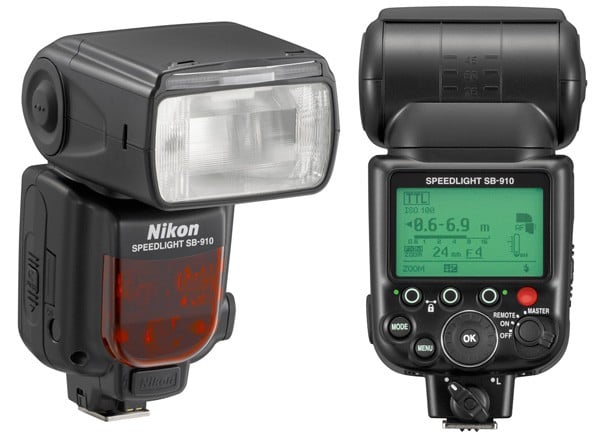
Nikon Speedlight SB-910
The most prominent upgrade in the SB-910 tackles the SB-900’s aggressive thermal protection mechanism. The SB-900’s thermal safeguard operated in two phases: thermal detection and complete shutdown cutoff. However, having the flash hard-lock during a critical moment can leave photographers in a dire bind right in the middle of an essential shoot.
To address this, the SB-910 removes the hard cutoff lock. Instead, it adopts a “power delay” mechanism that progressively throttles recycling times, allowing internal heat sufficient time to dissipate without completely halting shooting.
While I personally remain skeptical about whether recycling delays will feel more convenient in high-pressure shooting scenarios than an outright cutoff (at least when an SB-900 completely locks up, you immediately know to switch to a backup flash), Nikon clearly had specific engineering considerations for this adjustment. Whether it fulfills photographers’ real-world expectations remains to be seen once hands-on user reports roll in.
That said, I suspect the most significant evolution in the SB-910 goes beyond just the known press release bullet points.
Given that the flash body has actually decreased in overall volume, the internal structure may incorporate new materials and thermal designs that substantially enhance heat dissipation efficiency. This improved thermal headroom is likely what enabled Nikon to discard the hard shutdown threshold in favor of dynamic recycling throttling.
Although throttling recycling speed may modestly impact a photographer’s burst pace (and raises questions about potential Kelvin color temperature drift across extended firing), the fact that internal heat drops faster minimizes overall shooting downtime.
In essence, rather than merely slowing down recycling to suppress heat, Nikon seems to have paired improved thermal dissipation with an adaptive recycling algorithm, making the shooting workflow smoother and more dependable. Naturally, this remains my educated conjecture for now.
Support Independent Perspectives & In-Depth Insights
Every thoughtful analysis and candid critique comes from our dedication to truth and quality. We choose not to follow sensational algorithms or clickbait headlines.
Sustaining independent research requires reader support. Make a one-time or monthly contribution, securely processed by Google.
Payments secured by Google · Manage or cancel anytime in your Google Account




Comments